
Joint CfSM and (B)OrderS Book Forum - The Birth of Sensory Power: Doing Things with Words, Numbers and Neurons
When: Thursday, February 26, 2026, 4:00 PM - 6:00 PM
Where: Room 313, Third Floor, School of Law, Queen Mary University of London, Mile End Road London, E1 4NS London
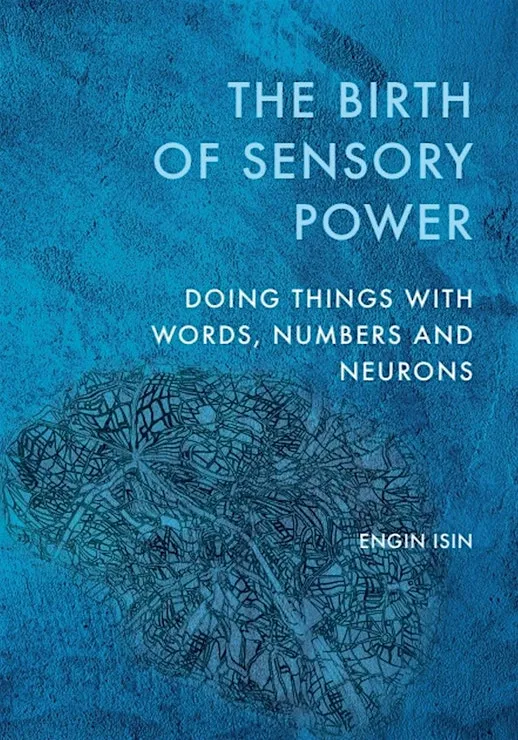
This Joint Centre for the Study of Migration (CfSM) and (B)OrderS Book Forum, co-organised by Dr Rachel Humphris (CfSM / Queen Mary Politics), Dr Andrew Pitt ((B)OrderS / Queen Mary Law) and Professor Violeta Moreno-Lax ((B)OrderS / Queen Mary Law & Hertie School), will discuss the latest monograph by Professor Emeritus Engin Isin ((B)OrderS / Queen Mary SPIR): The Birth of Sensory Power (Edinburgh University Press, 2025) with the author and distinguished commentators.
About the event
Join us for a conversation centring around Engin Isin’s latest book featuring distinguished scholars studying the politics and ethics of data, algorithm, sensors, and machines: Claudia Aradau, Nick Couldry, Ayona Datta, Jennifer Gabrys, Rachel Humphris, Elke Schwarz, and Lasse Thomassen.
The Birth of Sensory Power is a history of autopoietic machines since 1934. The book revisits scholarship on power, tracing it from Spinoza and Nietzsche through Deleuze, Foucault and Bourdieu. It explores the development of modern datasciences, focusing on ‘doing things with numbers’. This requires expanding the scholarship on power with Derrida and Austin, who deal with ‘doing things with words’, and connecting it to the development of neurosciences, which involve ‘doing things with neurons’.
The book’s main argument is that the convergence between datasciences and neurosciences enabled the rise of artificial intelligence. This convergence transcended the simple analogy between brains and machines, leading to an understanding of brains as machinic and the construction of machines in a similar manner. These autopoietic machines have become pervasive in everyday life over a century and now dominate it.
The book intricately weaves a history of the imitation game against a backdrop of the kingship game (sovereign power), the citizenship game (disciplinary power) and the population game (regulative power). This presents a complex narrative as a deconstruction of artificial intelligence, viewing it as analytics for understanding the production, functioning, and malfunctioning of autopoietic machines.
About (B)OrderS: Centre for the Legal Study of Borders, Migration and Displacement
Founded in 2022, the (B)Orders Centre focuses on the study of bordering, ordering and othering processes through law. It constitutes an excellence hub for intellectual collaboration and the evaluation of the role of law in the making and unmaking of borders and their impact on global (im)mobility. It connects scholars within and beyond Queen Mary Law School to harness existing inter- and multi-disciplinary research into law, borders and (im)mobility and shape future policy and research agendas in response to global challenges.
About CfSM: Centre for the Study of Migration
Established in 1995, the CFSM functions as a research hub drawing on the expertise of members from across Queen Mary working in collaboration with national and international partners and networks. The research interests of colleagues range from historical to contemporary work including mixed migration flows and settlement in London; refugee and migrant health; border controls and the securitisation of migration; low-paid work and transnational migration; the migration-development nexus; migration governance; digital technology and migration; religion, society and immigration, migration and culture and representations of migrants in film and photography. The Centre is committed to forging equitable and sustainable partnerships with organisations working in the field of migration and diaspora in the local Tower Hamlets area, other parts of London, the UK and abroad. It provides facilities for researchers from visiting research fellows and students who wish to spend a period of migration-related study at Queen Mary.