
Research offers hope of protecting women’s hearts after pre-eclampsia
Inflammation may be responsible for lasting changes to the heart following pregnancies complicated by pre-eclampsia or high blood pressure, according to new research from Queen Mary University of London.
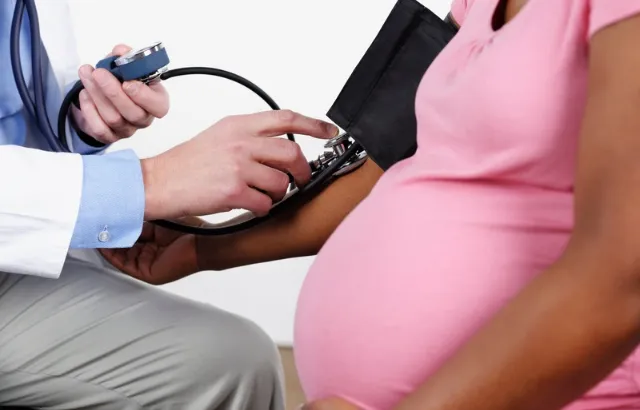
Pregnant woman having her blood pressure monitored.
Researchers at Queen Mary’s William Harvey Research Institute have found that inflammation during pregnancy may contribute to changes in heart structure and function that persist after childbirth.
Funded by the British Heart Foundation (BHF) and published in Nature Cardiovascular Research, the study suggests that reducing inflammation during pregnancy could help protect women's heart health and lower their risk of cardiovascular problems later in life.
Pre-eclampsia and gestational hypertension (high blood pressure during pregnancy) are collectively known as hypertensive disorders of pregnancy and affect up to one in 10 pregnancies. Women who develop these conditions can experience lasting changes to their hearts, increasing their risk of heart disease in later life. However, the reasons why these changes persist after childbirth have not been fully understood.
The researchers found that women with pre-eclampsia or gestational hypertension had higher levels of inflammatory proteins in their blood during pregnancy than women with normal blood pressure. These higher levels were associated with poorer heart function three to six months after giving birth, even though inflammation had subsided by then.
The study involved 60 women in their third trimester of pregnancy, including 38 with pre-eclampsia or gestational hypertension and 22 with normal blood pressure. Blood tests showed that levels of certain inflammatory proteins, known as cytokines and chemokines, were up to twice as high in women with hypertensive disorders of pregnancy.
The team also studied mice with pregnancy-related high blood pressure. As in the women, the mice developed changes to their heart structure and function, alongside increased inflammation.
When the mice were given progesterone, a hormone with anti-inflammatory properties, during pregnancy, inflammation levels fell and heart function improved. These benefits continued after birth, suggesting that treatment during pregnancy could help prevent lasting changes to the heart.
However, giving progesterone after birth did not produce the same effects. This suggests there may be a key window during pregnancy when inflammation can be reduced to protect the heart.
Dr Suchita Nadkarni, study lead and Associate Professor of Cardiovascular Immunology at Queen Mary, said: “This is the first evidence that inflammation is a driving force behind the changes in women's hearts that can persist after a pregnancy complicated by pre-eclampsia or high blood pressure. We now want to follow up larger groups of women for longer after pregnancy to understand the links between inflammation and longer-term changes to the heart.”
The researchers hope their findings will lead to further studies into whether existing anti-inflammatory medicines could help protect women who develop high blood pressure or pre-eclampsia during pregnancy.
Dr Sonya Babu-Narayan, Clinical Director at the British Heart Foundation and Consultant Cardiologist, said: “Women who develop high blood pressure or pre-eclampsia during pregnancy have been left at an increased risk of future heart attack and stroke, and there has been insufficient research to answer questions about why or how that risk could be reduced.
“These early findings offer hope that in future, simple readily available medicines that reduce inflammation could be repurposed to help protect women's heart health during pregnancy complicated by high blood pressure. More research in larger groups of women and over longer periods will be needed to find out. For now, pregnant women should follow the advice of their healthcare professional as usual.”