
How red blood cell precursors help regulate the immune system
Research at Queen Mary University of London has uncovered how cells involved in red blood cell production influence the development of neutrophils, helping the body fight infection while limiting inflammation.
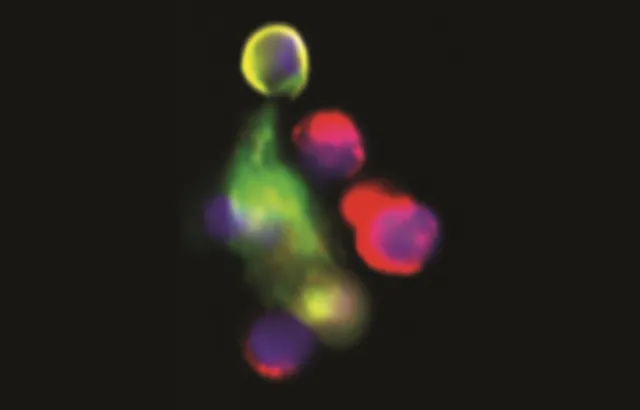
ImageStream imaging flow cytometry of erythroblastic islands in mouse bone marrow showing F4/80-positive macrophages (green), CD71-positive erythroid progenitors (red), Ly6G-positive neutrophils (yellow), and nuclei stained with Hoechst 33342 (blue).
Researchers at the William Harvey Research Institute, Queen Mary University of London, have found that cells involved in making red blood cells also help determine how the immune system responds to infection and injury.
Published in Blood, the study shows that erythroid cells, which develop into red blood cells, produce natural signalling molecules that influence neutrophils. These white blood cells are among the first to respond when the body encounters harmful bacteria or tissue damage.
The research highlights an unexpected role for the bone marrow, where blood cells are made, in preparing neutrophils for their work in the body.
Neutrophils are essential for fighting infection, but their activity needs to be carefully regulated. If they release too many inflammatory substances or accumulate in tissues, they can damage healthy cells.
The researchers found that erythroid cells produce specialised pro-resolving mediators, signalling molecules derived from omega-3 fatty acids that help regulate inflammation. These molecules are present in healthy bone marrow, where they influence neutrophil development before the cells enter the bloodstream.
Professor Jesmond Dalli, Professor of Molecular Pharmacology at Queen Mary and the study’s corresponding author, said: “Neutrophils need to be effective enough to fight infection, but sufficiently controlled to avoid damaging healthy tissues. Our findings suggest that part of this balance is established much earlier, during their development in the bone marrow.”
To investigate the role of this signalling pathway, the team disrupted it in mice. Their neutrophils were more likely to release inflammatory substances, form structures called neutrophil extracellular traps and move into tissues.
Neutrophil extracellular traps help capture microbes, but excessive formation can contribute to tissue damage. The mice also had fewer neutrophils in their bloodstream.
Further experiments indicated that macrophages, immune cells that support the bone marrow environment, played a major part in these effects. The results point to communication between erythroid cells, macrophages and developing neutrophils that helps shape immune function.
The effects extended beyond changes in neutrophil behaviour. Mice with a disrupted signalling pathway were less able to clear bacteria during infection and developed more severe inflammation in an experimental model of colitis, a condition that affects the bowel.
The findings suggest that the bone marrow influences not only how many neutrophils the body produces, but also how well they perform their role. Disrupting this process can leave the body less able to fight infection while increasing the risk of inflammation-related damage.
The research may help scientists better understand diseases in which neutrophils do not function properly, including chronic inflammatory conditions and infections. It could also inform future work on how immune function changes with age.
Further research is needed to determine whether these mechanisms could be targeted in people. However, the study identifies a role for the bone marrow’s natural signalling systems in maintaining a balanced immune response.