
Environmental Monitoring with Waste-Derived Biodegadable Materials
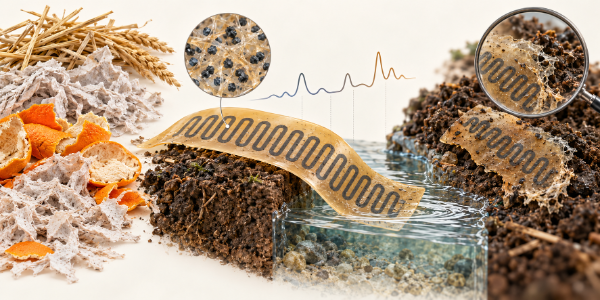
Waste-derived biodegradable nanocomposites for sensing in waste-affected environments
Lead Supervisor: Dimitrios Papageorgiou • Website • Email
Degree Programme: PhD in Materials Science (School of Engineering and Materials Science)
Co-Supervisor:
Michael Jie (School of Physical and Chemical Sciences)
Project Description
Can materials made from waste help us understand polluted environments without adding to their long-term burden? This PhD will develop biodegradable polymer nanocomposites from waste resources and investigate their use as temporary sensors in waste-affected environments. Candidate matrices include cellulose from paper or agricultural residues, chitosan from shellfish waste, gelatin or collagen from food-processing residues, and starch from food waste. These will be combined with functional fillers derived from waste, such as activated carbon from biomass. Silver nanoparticles prepared using polyphenol-rich waste extracts may be considered where their sensing benefit justifies closer assessment of release and environmental effects. Early screening will select a small number of promising material systems for detailed study.
The research will establish how feedstock variability, processing and filler–polymer interactions influence structure, mechanical integrity, water uptake and electrical response. Selected materials will be developed into simple sensing elements, initially targeting moisture and ionic changes. Sensitivity, selectivity, drift and useful operating lifetime will be evaluated against reference measurements in controlled conditions, followed by representative waste-affected media such as landfill leachates, contaminated soils or wastewater residues. The final sensing target and environment will be selected from the strongest initial results. A central question is what happens after the sensor has served its purpose.
The student will investigate how exposure changes performance and breakdown, distinguishing dissolution and fragmentation from biodegradation. Mass loss and structural changes will be complemented by mineralisation measurements where suitable facilities or collaborations can be arranged. Residual particles, filler release and potential environmental effects will inform material selection; a biodegradable matrix alone does not establish that the complete device is environmentally benign. The project connects polymer and composite engineering with waste chemistry and environmental assessment. It addresses Waste as a condition of life by examining how materials function and change within waste-affected settings.
Through the programme’s interdisciplinary training, it will also consider how sensing, disposal practices and infrastructure shape the usefulness and consequences of these technologies, linking to Socio-technical systems. The intended outcome is evidence-based design guidance and a demonstrator with a measured service life and assessed material fate.
What we're looking for in a student
We welcome applicants with a background in materials science, polymer science, chemistry, chemical engineering, environmental engineering, physics or a related discipline. An interest in experimental research, sustainable materials and environmental questions is essential. Experience with polymers, composites, electrical measurements or waste processing would be useful. Training will cover waste-derived material preparation, composite processing, mechanical and thermal characterisation, microscopy and spectroscopy, electrical sensing and degradation assessment. The student will work across materials engineering and chemistry at QMUL, with access to relevant facilities subject to training and local arrangements. The Living With Waste programme will provide opportunities to connect laboratory research with wider environmental and social perspectives.
Key words: Waste valorisation; Biodegradable polymers; Nanocomposites; Environmental sensing; Lifecycle Analysis