
PSD - Dr Eleni Matechou
Living with gulls: integrating surveys, tracking, citizen science and imagery to model how our waste shapes where gulls live and who lives with them
Supervisor: Dr Eleni Matechou
Project description:
This is a four-year, fully funded Leverhulme Living with Waste scholarship, with a substantial conference and travel budget. The student will join a cohort of doctoral researchers and receive broad interdisciplinary training.
The project will develop spatio-temporal statistical models for multi-source data to understand how waste shapes where gulls live and which communities live with them. The models will be used to quantify how landfill operations and urban food waste have shifted gulls between coast, landfill and town; identify which communities live with gulls, and how this relates to deprivation, housing and waste services; and assess whether changes to waste management could reduce human-gull conflict without displacing it or harming gull populations. Gulls cost councils substantial sums, are in decline, and the impacts of their urban presence fall unevenly. How waste drives these three dynamics is poorly understood.
The student will gain skills in statistical modelling, data integration and machine learning, valued in academia, government and industry, and apply them to a growing question: how decisions about waste change the way people and wildlife share space. The interdisciplinary training offered through the Living with Waste programme, and co-supervision by human and cultural geographers, will equip the student with qualitative skills and the ability to situate the research within social scientific, political and humanities debates on human-nonhuman relations in urban contexts.
Background:
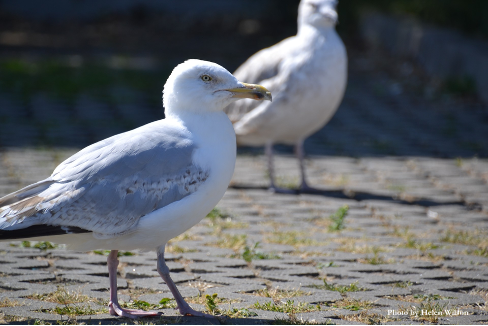
Like other ‘trash species’, gulls are increasingly understood through their relationship with waste: they scavenge, raid bins and produce their own unsightly detritus, making them one of the most complained-about animals in Britain. Yet UK gull populations have dropped sharply in recent decades, and all common species are of conservation concern. As coastal environments come under pressure, gulls have followed our waste. Landfills draw large numbers of gulls, which shift as sites open, close or expand, while towns offer a steady supply of food waste from streets and bins. How we manage waste determines where gulls live, and which communities live with them.
Available data include structured surveys of coastal colonies and winter roosts; ringing and GPS tracking of individual birds; citizen science records; and council records of nests, complaints and control licences. These will be integrated within suitable frameworks and linked to data on landfill sites, waste collection, street litter and neighbourhoods. Additional data will be extracted from images and text by identifying gulls in citizen science photographs, locating and classifying complaints in free-text council records, and mapping landfill extent from aerial and satellite imagery.
The student will be supervised by statisticians Dr Eleni Matechou (QMUL) and Dr James Clarke (British Trust for Ornithology, BTO), and human geographers Dr Archie Davies (QMUL) and Professor Helen Wilson (Durham).
Applicant Profile:
Applicants should hold, or expect to obtain, an MSc (or equivalent) in Mathematics, Statistics or a related quantitative subject, with a strong background in statistical modelling and programming in R or Python. Experience with Bayesian methods, spatial or spatio-temporal data, or machine learning is desirable but not essential. No prior knowledge of ecology or social science is needed, but applicants should be interested in working across disciplines. The student will receive training in Bayesian hierarchical and spatio-temporal modelling, data integration and statistical ecology through the supervisory team and the National Centre for Statistical Ecology, alongside the programme's Waste School. They will have access to national bird monitoring data through the BTO, and opportunities to visit the BTO and present at international conferences.
For further inquiries, please contact Dr Eleni Matechou directly e.matechou@qmul.ac.uk.
Further information on the Project page: https://www.qmul.ac.uk/about/hss/research/postgraduate-research-student-funding-opportunities/leverhulme-living-with-waste-doctoral-programme/projects-and-supervisors/2026-4-year-call/living-with-gulls/
Leverhulme Living with Waste Doctoral Programme: https://www.qmul.ac.uk/about/hss/research/postgraduate-research-student-funding-opportunities/leverhulme-living-with-waste-doctoral-programme/
Funding Notes:
Funded by the Leverhulme Living with Waste Doctoral Programme. The studentship covers tuition fees and a stipend at UKRI rates for four years, plus a £10,000 research and training grant. Open to home and international applicants; the programme can fund up to six international students across all years.
Deadline: 15 January 2027, 17:00.
Apply through the Queen Mary admissions portal for a PhD in Statistics, entering “Leverhulme Living with Waste” as the funding source and stating that you are applying through Route A to this project.
Details about how to apply: https://www.qmul.ac.uk/about/hss/research/postgraduate-research-student-funding-opportunities/leverhulme-living-with-waste-doctoral-programme/how-to-apply/
Further information:
How to apply
Entry requirements
Fees and funding

As one of the UK’s most diverse universities, QMUL fosters an inclusive and supportive academic community.
The School of Mathematical Sciences is committed to the equality of opportunities and to advancing women’s careers. As holders of a Bronze Athena SWAN award, we offer family-friendly benefits and support part-time study.