
Items
 When academic language becomes suspicious: GenAI, authorship and linguistic legitimacy
Dr Manesha Peiris, Senior Lecturer from the School of Physical and Chemical Sciences at Queen Mary University of London, reflects on authenticity, authorship and how we judge academic writing.
Date added: Thursday, October 29, 2026
 Beyond AI marking: putting pedagogy at the centre with LearnOuts
Luigi Ventimiglia, Reader in Economics and Finance, and Paulo Oliva, Reader in Electronic Engineering and Computer Science, at Queen Mary University of London, reflect on the development of LearnOuts, an innovative assessment and feedback toolkit designed to strengthen constructive alignment and support the responsible integration of AI in education. Drawing on their experience of developing and piloting the platform across four Schools, they explore how technology can improve feedback quality, reduce academic workload and support a more coherent learning journey.
Date added: Thursday, October 22, 2026
 Supporting students to reclaim their agency through co-creation in a world with Generative AI
Jonathan Jackson, Senior Lecturer, School of Physical and Chemical Sciences, shares reflections on his recent research on Generative AI in education.
Date added: Friday, September 18, 2026
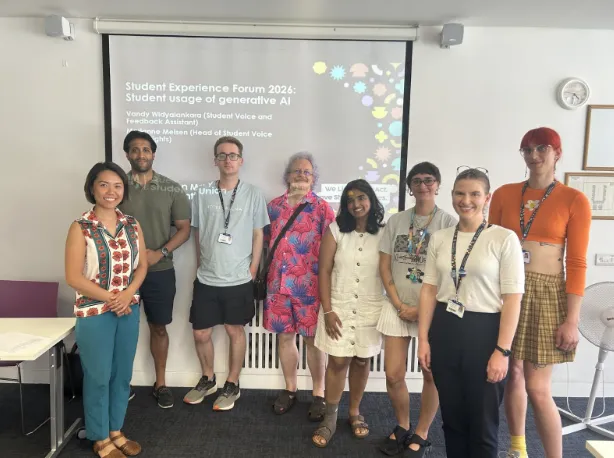 What Queen Mary Students Are Telling Us About Generative AI
From academic study and language support to wellbeing and careers planning, generative AI is becoming embedded in everyday student experiences. Drawing on findings from the Queen Mary Students' Union's 2026 Student Experience Forum, this blog explores student perspectives on AI, guidance, equity and the future of higher education.
Date added: Thursday, August 27, 2026
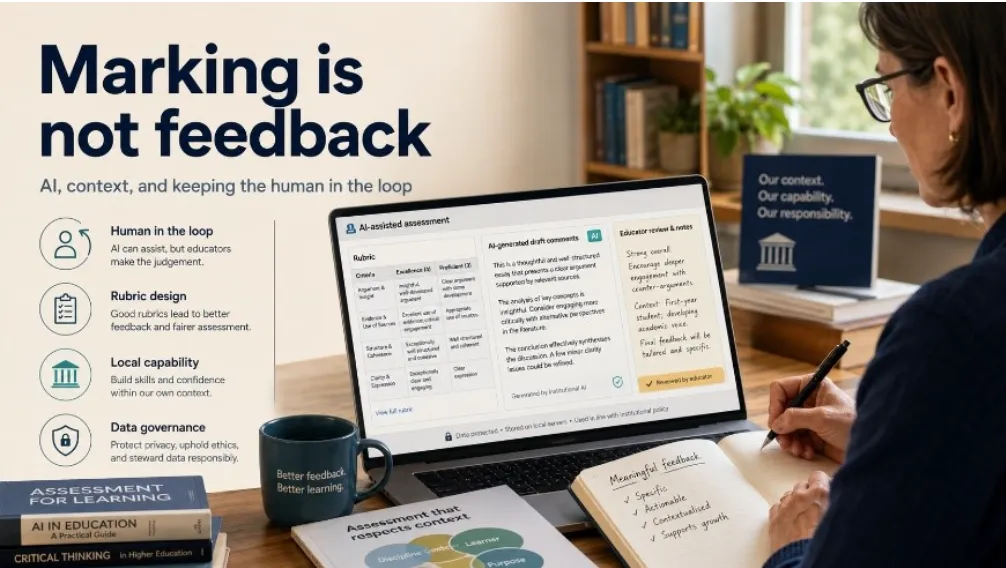 Marking is not feedback: reflections on AI, context, and keeping the human in the loop
AI can support marking, but academic judgement remains essential for meaningful feedback. Drawing on recent research and the pilot of her AI-powered marking and feedback tool EduMark, Dr Deepshikha Deepshikha explores why feedback depends on context, care, and keeping educators in control.
Date added: Tuesday, August 18, 2026
 Designing AI-enhanced yet AI-resilient marketing education
Dr Farrah Arif's blog reflects on a recent undergraduate module at Queen Mary, University of London, Influencer Marketing and AI Trends, which was designed to address exactly this challenge. The aim was not to resist AI, but to integrate it thoughtfully - creating a learning environment that is both AI-enhanced and AI-resilient.
Date added: Monday, July 13, 2026
 Reframing Feedback: Using AI to Support the Affective Dimension of Learning
Dr Manesha Peiris outlines how feedback is central to learning but often carries significant emotional weight, particularly in high-pressure STEM contexts where grades are closely tied to learners’ sense of performance and validation. Feedback must be actionable, psychologically safe, and emotionally attuned, with LLMs offering potential support for more equitable learner engagement.
Date added: Tuesday, July 7, 2026
 The ABC levels of GenAI integration: understanding uneven outcomes in higher education
In this post, Dr Qianqian Chai explores how differences in AI-curriculum integration shape what students and educators actually gain. Introducing the ABC framework, it examines varying approaches from ad hoc use to more embedded practices, and asks what it really means to use GenAI in ways that support learning, judgement, and curriculum design.
Date added: Thursday, June 25, 2026
 No Shortcuts to Learning with Generative AI?
The generative-AI revolution through which we are living has enormous potential to increase business productivity, and this alone is sufficient reason to ensure our graduates are familiar with the possible uses of large language models and their offshoots. But it’s also a reason to be cautious. How does gen. AI fit into the economy of learning, where time is arguably a principal currency?
Date added: Tuesday, May 26, 2026
 From TikTok Workouts to Curriculum Design: Why AI Competence Needs a Programme-Level Approach
Generative AI is rapidly transforming how engineering students learn and solve problems. While global frameworks now define what AI competence should include, translating these ideas into coherent degree programmes remains a challenge. Professor Yue Chen explores why AI competence cannot be developed through isolated modules and introduces AICoDE, a framework designed to support programme-level curriculum design in engineering education.
Date added: Monday, April 20, 2026
 The shadow AI university – who gets an AI-enabled education?
Students are quietly organising around AI use in an emergent peer-led innovation network. But, Professor Chie Adachi (Interim Academic Director of the Centre for Excellence in AI in Education) warns, inequitable access could entrench a two-tier learning experience.
Date added: Wednesday, March 18, 2026
AI for Reflective Practice: Thoughts and Tensions
Dr Manesha Peiris explore how AI tools can help reflective practice, whilst identifying the risk of reinforcing performative, surface‑level reflection. She suggests that educators need to reframe reflection as a dialogic, process‑focused activity rather than a written product.
Date added: Monday, March 9, 2026
 When Generative AI Becomes a Learning Partner in Virtual Reality
Dr Lei Fang draws on a recent international study, reflecting on what it takes for Generative AI (GenAI) to act as a learning partner, rather than a pedagogical novelty.
Date added: Monday, February 23, 2026
 Artificial Intelligence in Dental Education: International Perspectives from Vietnam
Dr Ali Nankali explores AI's growing role in dental education, emphasising responsible integration, ethical governance, staff development and enhanced clinical reasoning.
Date added: Tuesday, February 10, 2026
 AI for Marking: What It Can (and Cannot) Do in University Assessment
Dr Riasat Islam takes a practical, evidence-based look at how AI can support marking and feedback in higher education without compromising fairness or academic standards
Date added: Monday, January 12, 2026
 Not faster but fairer: tame ‘techno-solutionism’ to build inclusive futures with AI
University leaders and academics must resist an open-armed embrace of AI and ask tough questions about who, really, is benefitting from its use in order to shape an inclusive future, writes Chie Adachi
Date added: Monday, January 19, 2026
 'Squashing bugs not snakes’: co-creating an AI-motivated Python toolkit to develop engineering students’ programming proficiency
Muhie Al Haimus, Silvia Santafe and Dr Rehan Shah share a student-staff co-creation initiative which developed a comprehensive Python Toolkit designed to provide equitable access to essential programming skills.
Date added: Monday, January 26, 2026
 Generative AI in Language Teaching: A Reflective Perspective from 25 Years in Higher Education
Dr Elsa Petit takes a reflective look at how generative AI can complement the human dimension of language learning.
Date added: Monday, January 5, 2026
 AI and authentic assessing
AI hasn’t broken assessments. They were already flawed. Academic integrity issues aren’t new: whether it’s outsourcing essays, copying past work, or using ChatGPT, pretending it’s your own remains cheating argues Dr Stephen Buckingham.
Date added: Monday, December 15, 2025
 Why universities must build an AI-positive culture
Professor Alastair Robertson highlights why universities must foster an AI-positive culture, ensuring students and staff develop essential AI literacy to meet evolving industry demands and prepare for the future.
Date added: Monday, December 1, 2025
 Integrating AI in Curriculum: Simplifying Complexity for Broader Adoption
Artificial Intelligence (AI) is transforming industries, making AI literacy essential in higher education. However, educators face challenges in integrating AI effectively. A structured framework is needed to bridge the gap and support AI-driven curricula, writes Xue Zhou.
Date added: Friday, February 28, 2025
 Advancing AI Literacy: Sprint Day Highlights Framework for Curriculum Innovation
Lilian Schofield reports from the Sprint Day workshop, which showcased a new AI teaching and learning framework, highlighting best practices for AI integration in curricula and fostering staff collaboration.
Date added: Friday, February 28, 2025
 Generative AI at Queen Mary: Building Community, Capacity and Confidence
Generative Artificial Intelligence (GenAI) is transforming higher education, presenting both immense potential and complex challenges for teaching, learning and assessment. Karen Hudson tells us how the Centre aims to empower staff to use GenAI in an informed, critically reflective and ethical way, ensuring that it enhances rather than undermines educational excellence, in alignment with the Queen Mary core values.
Date added: Friday, March 14, 2025
 Universities must promote AI augmentation, not automation
When technology is deployed to augment individuals’ capacities, they retain the power to shape social and political outcomes, says Stephanie Marshall.
Date added: Monday, April 14, 2025
 AI tools for education, learning and research: a session designed to build and enhance AI literacy
Giorgio Chianello shares his new interactive workshop designed to help students and staff develop Artificial Intelligence (AI) literacy and build skills in using and assessing output for generative AI for teaching, learning and research.
Date added: Wednesday, April 16, 2025
 Future Ready: Shaping AI Education Through Collaboration
Academic Head of Centre, Dr Aisha Abuelmatti leads the Queen Mary Future Ready project, integrating cross-disciplinary AI and entrepreneurial skills for tomorrow’s job market.
Date added: Monday, May 12, 2025
 My Journey with AI in Dental Education
Dr Ali Nankali reflects on his recent experiences exploring the potential uses of AI for dentistry education.
Date added: Thursday, June 12, 2025
 When AI gets it wrong: Teaching critical thinking through logical puzzles
Dr Yuan Zhao argues that if we want our students to use AI tools critically and ethically, we must create learning experiences that demonstrate both their strengths and pitfalls.
Date added: Wednesday, July 2, 2025
 The Great Deskilling Dilemma
The rapid adoption of AI tools is changing both medical practice and education. Dr Amiirah Nuckchady calls for a pedagogical revolution in response.
Date added: Friday, August 1, 2025
 The Role of Generative AI in Education: Questions, Reflections, and Provocations
Jonathan Jackson asks, if GenAI tools can both benefit and harm students’ learning, where does this leave us as educators?
Date added: Monday, September 1, 2025
 Delivering rubric-aligned, real-time feedback with EduMark AI
Dr Deepshikha introduces EduMark AI, a proof-of-concept tool developed to explore how AI might support more consistent and personalised feedback in student assessment.
Date added: Wednesday, October 1, 2025
 Teaching with Generative AI: Balancing Innovation and Environmental Responsibility
Professor Cédric John raises the question: how can universities model responsible AI use while integrating these technologies into teaching and assessment?
Date added: Monday, November 3, 2025
 Queen Mary launches new course to boost students' AI skills
Paula Funnell introduces a new QMplus resource for students, AI for Student Learning and Research, which provides a foundation for understanding the ethical and academically appropriate potential use of AI in learning and research.
Date added: Monday, November 3, 2025