
Haptic dentistry: the next frontier?
When it comes to remote learning, the study of certain subjects involving practical laboratory work seems impossible. Dentistry is surely one of them. How can students gain valuable clinical experience – even if it is using a ‘phantom head’ – in the lab when a global pandemic has dictated they stay home?
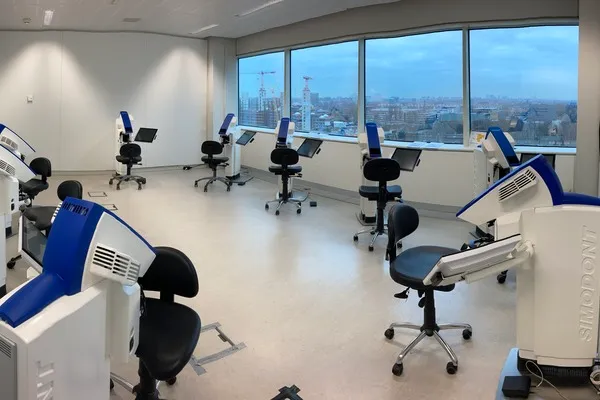
Haptic simulators
That was the question Electronic Resources Officers Ben Audsley, Catherine McLean and the team at Barts and The London School of Medicine and Dentistry sought to answer in March 2020.
A swift shift to online learning saw them quickly train staff and students to use tools such as Blackboard Collaborate via QMplus but it hadn’t been designed for that purpose. “To begin with we were firefighting,” recalls Audsley, “but over the summer we were able to redesign QMplus to a personalised template, copy content over and add ‘extras’ for blended and online learning. Year leads, academics and staff all contributed to put students at the centre of the learning journey.”
Video has also played an important part in the transition to digital learning. “We’ve been busy filming and building up a video library of clinical procedures,” explains Audsley. “But it’s not a passive platform - the emphasis is on interactive learning so there are quizzes, Q&A forums and tasks students must complete to unlock the next level, all integrated with QMplus.”
Virtual experience
Replicating clinical procedures is the biggest hurdle and that’s when Audsley’s excitement becomes palpable. “We’re looking at using AR and VR to carry out procedures and experience sensations,” he reveals.
“Haptic dentistry is the next frontier for clinical learning – not just for lockdown. The technology is incredible: it takes scanned patient data (x-rays, 3D scans and so on) to create a virtual mouth of a real person so students can train.”
The Institute of Dentistry is eagerly awaiting state-of-the-art haptic simulators, as Head of Undergraduate Programmes, Dr Amitha Ranauta, explains: “Dentistry is a skilled profession, which relies on the tactile skills of a dentist when treating patients. Haptic technology is known to provide a unique experience that uses the sense of touch as kinesthetics to the user. The ‘force feedback’ system in a haptic device means a clinician in training can feel the ‘tissues’ during pre-clinical procedures before working on real patients.”
And the advantages don’t end there: “Students can practise the same procedure repeatedly, with continuous feedback, by resetting the simulator,” reveals Ranauta. “These simulators also provide objective feedback on skill performance, which means they can be used for formative assessments. Haptic technology will play an important role in boosting student confidence and improving their psychomotor skills.”
Once haptic simulators are in place, Audsley’s vision for the future extends to a scenario-based virtual learning environment: “We want to create a 360-degree virtual-reality (VR) clinic so students can get the full experience. They’ll be able to greet a patient at the front desk, walk them through to a clinical room and talk them through any treatments. It will be as close to real-life as possible.”