Thank you for considering an application
To apply you’ll need to:
- Make note of the Queen Mary institution code: Q50
- Make note of your chosen course UCAS code:
Physics
- F300 — BSc (Hons)
- F302 — BSc (Hons) with a Year Abroad
- FFX0 — BSc (Hons) with Foundation
- F306 — BSc (Hons) with Professional Experience
- Click on the link below:
Have further questions? How to apply | Entry requirements
Physics BSc
4 study options
Physics BSc (Hons)
Key information
- Degree
- BSc (Hons)
- Duration
- 3 years
- Start
- September 2027
- UCAS code
- F300
- Institution code
- Q50
- Typical A-Level offer
- Grades ABB at A-Level. This must include grade A or above in at least one of Mathematics and Physics. Both subjects are required.
Full entry requirements (including contextual admissions) - Home fees
- £10050
- Overseas fees
- £34750
Funding information
Paying your fees
Physics with a Year Abroad BSc (Hons)
Key information
- Degree
- BSc (Hons)
- Duration
- 4 years
- Start
- September 2027
- UCAS code
- F302
- Institution code
- Q50
- Typical A-Level offer
- Grades ABB at A-Level. This must include grade A or above in at least one of Mathematics and Physics. Both subjects are required.
Full entry requirements (including contextual admissions) - Home fees
- £10050
- Overseas fees
- £34750
Funding information
Paying your fees
Physics with Foundation BSc (Hons)
Key information
- Degree
- BSc (Hons)
- Duration
- 4 years
- Start
- September 2027
- UCAS code
- FFX0
- Institution code
- Q50
- Typical A-Level offer
- Grades CCC at A-Level.
Full entry requirements (including contextual admissions) - Home fees
- £10050
- Overseas fees
- £26750
Funding information
Paying your fees
Physics with Professional Experience BSc (Hons)
Key information
- Degree
- BSc (Hons)
- Duration
- 4 years
- Start
- September 2027
- UCAS code
- F306
- Institution code
- Q50
- Typical A-Level offer
- Grades ABB at A-Level. This must include grade A or above in at least one of Mathematics and Physics. Both subjects are required.
Full entry requirements (including contextual admissions) - Home fees
- £10050
- Overseas fees
- £34750
Funding information
Paying your fees
Overview
From gravitational waves to black holes, physics is key to unlocking the secrets of the universe. What will you discover?
Physics will shape many of the solutions needed to tackle global issues. At Queen Mary, you won’t just learn the theory, you’ll get close to the people doing the research and have opportunities to put your knowledge into practice. Join our thought-provoking, Institute of Physics-accredited course and discover where physics could take you.
Not many universities can say they’ve been teaching physics since 1896, helped shape string theory, or count three Nobel Prize winners among their physics community.That history continues today, with our academics leading research into everything from materials for healthcare to the next generation of radiation detectors. You’ll have the chance to get involved in their work through real projects and develop the skills to tackle questions that matter.
Explore the questions that shape our world
We’re recognised globally for our leading research. Our physicists helped discover the W and Z bosons and contributed to the discovery of the Higgs boson, and they're still active on major international collaborations today, working on the questions physics hasn't answered yet. That research reach spans four groups, from new theories of how liquids and solids behave to new materials for healthcare.
We’ll introduce you to our alumni to help you explore your options, and you’ll take part in short consultancy projects that put your skills into practice before you graduate. You’ll develop the analytical, problem-solving and practical skills to take your physics knowledge into research, technology and a wide range of careers.
Structure
You can complete your Physics degree in three, four or five years.
If you are a BSc student and choose to study abroad, your time abroad will be during Year 3 and Year 3 modules will instead be studied in Year 4.
Year 1
Core and compulsory
- Professional Skills for Scientists
- Mathematical Techniques I
- Classical Physics
- Scientific Measurement
- Modern Physics
- Electric and Magnetic Fields
- Mathematical Techniques 2
- Our Universe
Please note that all modules are subject to change.
Year 2
Core and compulsory
- Thermodynamics
- Quantum Mechanics A
- Physics Laboratory
- Condensed Matter
- Electromagnetic Waves and Optics
- Mathematical Techniques 3
- Introduction to Scientific Computing
Guided elective
Please note that all modules are subject to change.
Year 3
Core and compulsory
Guided elective
- The Physics of Galaxies
- Spacetime and Gravity
- Statistical Data Analysis
- Quantum Mechanics B
- Particle and Nuclear Physics
- Physical Cosmology
- Quantum Mechanics and Symmetry
- Machine Learning and Artificial Intelligence
Please note that all modules are subject to change.
The full programme details and description are available in our Programme and Module Directory
Study options
Apply for this degree with any of the following options. Take care to use the correct UCAS code - it may not be possible to change your selection later.
Integrated foundation year
Students who do not have the required high school qualifications for admission to this degree, and students who do not meet their UCAS Conditional offer may be considered for the 4 year degree (foundation year plus the 3 year degree).
International students with Year 12 or a completed international high school certificate qualify for the one year foundation programme commonly known as the ISEFP.
The foundation programme offers a range of transferable skills and an opportunity to improve on your knowledge content in relevant Maths and Science subjects.
You will enrol on a Physics BSc with Foundation which will offer progression to a range of degrees in the School of Physics and Astronomy including BSc Physics. At the end of the foundation programme, students will be required to meet the progression requirements for admission to BSc Physics.
Professional Placement
Students studying BSc or MSci Physics with Professional Experience have the option to apply for a one-year paid Professional Experience internship within their degree programme.
The Professional Experience degree programmes are identical to the BSc and MSci Physics routes except for the addition of the internship year.
You will complete your internship during the third year of your degree programme (or fourth for MSci), returning to Queen Mary for your final year of study.
A Professional Placement/Industrial Experience year is not guaranteed, but you will receive support to identify and apply for opportunities, as well as interview preparation support to secure a placement/industrial experience year.
Year abroad
If you choose to undertake a Year Abroad, this will take place in your third or fourth year of study. You'll then return to Queen Mary for your final year or years of study.
We have partner institutions in Australia, Canada, Malayisa, Singapore, New Zealand, Hong Kong, South Korea, Taiwan, Japan and the USA. For more detail on where you can study on your Year Abroad and things to consider before applying, visit our Study Abroad pages.
Student Testimonial
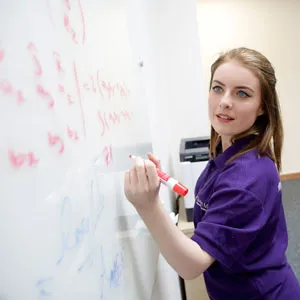
The School has a really friendly and supportive atmosphere. We have a student support officer and each student also has an Academic Adviser. There are also lots of opportunities to work together with other students or discuss work informally with lecturers.
Teaching
Teaching and learning
You’ll learn through a combination of lectures, laboratory sessions and tutorial classes. Your total teaching time will be around 20 hours per week, but you are expected to spend time on independent study and coursework or lab reports. Overall, you should be spending around 40 hours on your studies each week.
Assessment
You will be assessed by various methods depending on the nature of the work being carried out. For example, if the module involves practical work only, the assessment will be based on laboratory reports. For non-practical modules you will be assessed by weekly coursework, termly assignments and an end-of-year examination.
Resources and facilities
The School offers excellent on-campus resources to aid your studies, including:
- teaching laboratories
- a rooftop observatory
- a dedicated study space for physics students
- professional research facilities for use in final-year projects.
Entry requirements
| A-Level | Grades ABB at A-Level. This must include grade A or above in at least one of Mathematics and Physics. Both subjects are required. |
| IB | International Baccalaureate Diploma with a minimum of 32 points overall, including 6,5,5 from three Higher Level subjects. This must include 6 in Higher Level Mathematics or Physics, with both subjects being taken at Higher Level. |
| BTEC | BTEC qualifications are considered for entry to this programme.\n |
| Access HE | Access qualifications are not considered for entry to this programme. |
| GCSE | Both GCSE English and Maths at grade C or 4 or an acceptable equivalent will be required.\n\n |
| EPQ | Alternative offers may be made to applicants taking the Extended Project Qualification. \nFor further information please visit: qmul.ac.uk/undergraduate/entry/epq |
| Contextualised admissions | Our standard contextual offer: BBC including BB in Maths and Physics at A-Level. \n\nOur enhanced contextual offer: BCC including BC in Maths and Physics at A-Level. \n\nMore information on our contextual offer criteria can be found on our contextualised admissions page. \n\nPlease note that General Studies and Critical Thinking are excluded from any A-Level offer and cannot be considered. \n |
| A-Level | Grades ABB at A-Level. This must include grade A or above in at least one of Mathematics and Physics. Both subjects are required. |
| IB | International Baccalaureate Diploma with a minimum of 32 points overall, including 6,5,5 from three Higher Level subjects. This must include 6 in Higher Level Mathematics or Physics, with both subjects being taken at Higher Level. |
| BTEC | BTEC qualifications are considered for entry to this programme. |
| Access HE | Access qualifications are not considered for entry to this programme. |
| GCSE | Both GCSE English and Maths at grade C or 4 or an acceptable equivalent will be required. |
| EPQ | Alternative offers may be made to applicants taking the Extended Project Qualification. For further information please visit: qmul.ac.uk/undergraduate/entry/epq |
| Contextualised admissions | Our standard contextual offer: BBC including BB in Maths and Physics at A-Level. Our enhanced contextual offer: BCC including BC in Maths and Physics at A-Level. More information on our contextual offer criteria can be found on our contextualised admissions page. Please note that General Studies and Critical Thinking are excluded from any A-Level offer and cannot be considered. |
| A-Level | Grades CCC at A-Level. |
| IB | International Baccalaureate Diploma with a minimum of 26 points overall, including 4,4,4 from three Higher Level subjects. Higher Level Mathematics or Physics is preferred. |
| BTEC | BTEC qualifications are considered for entry to this programme. |
| Access HE | We consider applications from students with the Access to Higher Education Diploma in a science discipline e.g. Biology, Chemistry, Maths or Physics. The minimum academic requirement is to achieve 60 credits overall, with 45 credits at Level 3, of which 9 credits must be at Distinction, 36 credits at Merit or higher. Applications are considered on a case by case basis. |
| GCSE | Both GCSE English and Maths at grade C or 4 or an acceptable equivalent will be required. |
| Contextualised admissions | We consider every application on its individual merits and will take into consideration your individual educational experiences and context. More information on how academic schools and programmes use this information as part of the admissions process, can be found on our contextualised admissions pages. |
| A-Level | Grades ABB at A-Level. This must include grade A or above in at least one of Mathematics and Physics. Both subjects are required. |
| IB | International Baccalaureate Diploma with a minimum of 32 points overall, including 6,5,5 from three Higher Level subjects. This must include 6 in Higher Level Mathematics or Physics, with both subjects being taken at Higher Level. |
| BTEC | BTEC qualifications are considered for entry to this programme. |
| Access HE | Access qualifications are not considered for entry to this programme. |
| GCSE | Both GCSE English and Maths at grade C or 4 or an acceptable equivalent will be required. |
| EPQ | Alternative offers may be made to applicants taking the Extended Project Qualification. For further information please visit: qmul.ac.uk/undergraduate/entry/epq |
| Contextualised admissions | Our standard contextual offer: BBC including BB in Maths and Physics at A-Level. Our enhanced contextual offer: BCC including BC in Maths and Physics at A-Level. More information on our contextual offer criteria can be found on our contextualised admissions page. Please note that General Studies and Critical Thinking are excluded from any A-Level offer and cannot be considered. |
Non-UK students
We accept a wide range of European and international qualifications in addition to A-levels, the International Baccalaureate and BTEC qualifications. Please visit International Admissions for full details.
If your qualifications are not accepted for direct entry onto this degree, consider applying for a foundation programme.
English language
Find out more about our English language entry requirements, including the types of test we accept and the scores needed for entry to the programme.
You may also be able to meet the English language requirement for your programme by joining a summer pre-sessional programme before starting your degree.
Further information
Funding
Loans and grants
UK students accepted onto this course are eligible to apply for tuition fee and maintenance loans from Student Finance England or other government bodies.
Scholarships and bursaries
Queen Mary offers a generous package of scholarships and bursaries, which currently benefits around 50 per cent of our undergraduates.
Scholarships are available for home, EU and international students. Specific funding is also available for students from the local area. International students may be eligible for a fee reduction. We offer means-tested funding, as well as subject-specific funding for many degrees.
Find out what scholarships and bursaries are available to you.
Support from Queen Mary
We offer specialist support on all financial and welfare issues through our Advice and Counselling Service, which you can access as soon as you have applied for a place at Queen Mary.
Take a look at our Student Advice Guides which cover ways to finance your degree, including:
- additional sources of funding
- planning your budget and cutting costs
- part-time and vacation work
- money for lone parents.
Careers
Preparing you for your future
Our physics degree gives you skills employers value.
Whether you want to continue your studies and pursue a career in research, specialise in a particular area of physics, or apply your skills in engineering, technology, IT, finance and beyond, we’ll prepare you for your future career with highly valued numeracy, data analysis, coding and problem-solving skills.
Many of our graduates continue their studies with a PhD or MSc, often as a pathway into research. Others take their physics expertise into a wide range of industries, where the analytical and technical skills developed through the degree are highly transferable.
Put your physics skills into practice
Apply your physics knowledge to real-world challenges through practical work, projects and problem-solving. Develop your skills in areas such as coding, data analysis and modelling, while working on challenges that connect physics to technology, engineering, research and beyond.
Physics opens doors to careers across science and beyond. From conducting cutting-edge research and developing new technologies to using data to solve complex problems in business and finance, our graduates can apply their skills in a wide range of roles and industries.
Where our graduates are now
Civil Servant Scientist, Defence Science and Technology Lab
Cloud Engineer, Kubrick Group
Cyber Security Associate, PWC
Decarbonisation Surveyor, Kent Country Council
Graduate Geophysicist, CGG
IOS Engineer, IBM
Junior Python Engineer, AI Global Media
Propulsion Engineer, European Astrotech Ltd
Research Scientist, National Physical Laboratory
Sales Engineer, Hamamatsu Photonics Uk Ltd
Senior Associate, Deloitte
Software Engineer at multiple companies including Goldman Sachs, Bloomberg LP, Amazon and Apple
Quant Researcher, Mitsubishi UFJ Financial Group
Career support
Build your experience and confidence with specialist careers support and industry opportunities throughout your degree. We run weekly careers advice sessions and events, including software bootcamps and career-focused sessions.
The school organises exclusive industrial placements for Physics students, with dedicated support from a placement coordinator.
You’ll also have access to a dedicated careers consultant and internship coordinator, who can help you explore your options, develop your employability and take the next step towards your goals.
The Queen Mary careers team can also offer:
specialist advice on choosing a career path
support with finding work experience, internships and graduate jobs
feedback on CVs, cover letters and application forms
interview coaching.
Data for these courses
Physics - BSc (Hons)
The Discover Uni dataset (formerly Unistats)
About the School
The School of Physical and Chemical Sciences (SPCS) at Queen Mary combines the academic rigour of a Russell Group institution with a friendly and supportive atmosphere.
The Department of Physics and Astronomy’s teaching academics work on high-profile international collaborations, including experiments at CERN. Our researchers are searching for new planets around distant stars, developing and applying quantum technologies and theoretical concepts. Our PsiStar Physics and Astronomy Society is extremely active with around 200 members. Our academics use cutting edge experimental and theoretical techniques, alongside modern data science, to push the boundaries of their research areas.
The Department is proud to have played a role in some of the most exciting discoveries of the past 100 years, including the discovery of the W, Z, and Higgs bosons, the discovery of the closest Earth-like exoplanet to us, Proxima B, and the first ‘superstring revolution’.
We have recently recruited new staff in key areas such as particle physics, quantum technology, and space weather. We have state of the art laboratories, computing facilities, and a rooftop observatory, offering high-quality support for Physics and Astronomy teaching and research.
The Department of Chemistry enjoys an outstanding research and teaching quality reputation. We are a vibrant department, carrying out internationally leading research in fields such as Functional Materials and Nano Science, Synthesis, Catalysis, and Physical and Computational Chemistry. In the most recent Research Excellence Framework (REF) 2021, Chemistry ranked 8th in the United Kingdom for Research Impact and 9th in the UK for Research Output.
We have recently recruited new staff in key areas such as Carbon Nanotechnology, Organic Electronics, and Catalysis. The £5.2m refurbishment and modernisation of our Chemistry Lab facilities have secured the highest quality standard for Chemistry teaching and research.