Thank you for considering an application
To apply you’ll need to:
- Make note of the Queen Mary institution code: Q50
- Make note of your chosen course UCAS code:
Finance
- L10D — BSc(Econ) (Hons)
- L10C — BSc(Econ) (Hons) with a Year Abroad
- L11X — BSc(Econ) (Hons) with a Year Abroad with Foundation
- L10B — BSc(Econ) (Hons) with a Year in Industry
- L113 — BSc(Econ) (Hons) with a Year in Industry with Foundation
- L11F — BSc(Econ) (Hons) with Foundation
- Click on the link below:
Have further questions? How to apply | Entry requirements
Finance BSc (Econ)
6 study options
Finance BSc(Econ) (Hons)
Key information
- Degree
- BSc(Econ) (Hons)
- Duration
- 3 years
- Start
- September 2026
- UCAS code
- L10D
- Institution code
- Q50
- Typical A-Level offer
- Grades AAA at A-Level. This must include A-Level Mathematics.
Full entry requirements (including contextual admissions) - Home fees
- £9790
- Overseas fees
- £29450
Funding information
Paying your fees
Finance with a Year Abroad BSc(Econ) (Hons)
Key information
- Degree
- BSc(Econ) (Hons)
- Duration
- 5 years
- Start
- September 2026
- UCAS code
- L10C
- Institution code
- Q50
- Typical A-Level offer
- Grades AAA at A-Level. This must include A-Level Mathematics.
Full entry requirements (including contextual admissions) - Home fees
- £9790
- Overseas fees
- £29450
Funding information
Paying your fees
Finance with a Year Abroad with Foundation BSc(Econ) (Hons)
Key information
- Degree
- BSc(Econ) (Hons)
- Duration
- 5 years
- Start
- September 2026
- UCAS code
- L11X
- Institution code
- Q50
- Entry Requirements
- Full entry requirements (including contextual admissions)
- Home fees
- £SUPPRESS
- Overseas fees
- £25500
Funding information
Paying your fees
Finance with a Year in Industry BSc(Econ) (Hons)
Key information
- Degree
- BSc(Econ) (Hons)
- Duration
- 5 years
- Start
- September 2026
- UCAS code
- L10B
- Institution code
- Q50
- Typical A-Level offer
- Grades AAA at A-Level. This must include A-Level Mathematics.
Full entry requirements (including contextual admissions) - Home fees
- £9790
- Overseas fees
- £29450
Funding information
Paying your fees
Finance with a Year in Industry with Foundation BSc(Econ) (Hons)
Key information
- Degree
- BSc(Econ) (Hons)
- Duration
- 5 years
- Start
- September 2026
- UCAS code
- L113
- Institution code
- Q50
- Entry Requirements
- Full entry requirements (including contextual admissions)
- Home fees
- £SUPPRESS
- Overseas fees
- £25500
Funding information
Paying your fees
Finance with Foundation BSc(Econ) (Hons)
Key information
- Degree
- BSc(Econ) (Hons)
- Duration
- 5 years
- Start
- September 2026
- UCAS code
- L11F
- Institution code
- Q50
- Entry Requirements
- Full entry requirements (including contextual admissions)
- Home fees
- £SUPPRESS
- Overseas fees
- £25500
Funding information
Paying your fees
Overview
Explore the theory and logic behind economic decision-making, risk management, and the behaviour of financial markets.
The relationships between financial systems, economies, and society are more complex than ever. Join us to explore financial topics such as asset pricing and corporate finance, alongside applied economics.
We’re carrying out leading research in finance: bond and foreign exchange, financial derivatives, portfolio management, and much more. By joining our community, you’ll hear the latest insights and become part of conversations about how the industry is changing.
Professional recognition
Industry immersion from day one
Immersing you in the financial world is important to us. Our Banking and Finance Society, the Economics Society, and the Trading and Investment Society organise academic and social events for students. You’ll be the first to hear about opportunities to network and make invaluable connections.
We’re one of the few UK universities to offer training and access to Bloomberg trading terminals, as well as an Interactive Brokers Trader Workstation (TWS) and FXCM FX Trading Station. All of this means you can apply your skills to analyse real-time financial market data. From corporate strategy to technology management, whatever area interests you, we’ll help you get ready for career success.
Structure
You can complete your Finance degree in three or four years. If you choose to spend a year in industry or study abroad, this will take place in Year 3, and the Year 3 modules will instead be studied in Year 4.
Year 0
Please note that all modules are subject to change.
Year 1
Core and compulsory
- World Economy
- Mathematical Methods in Economics and Finance
- Economics and Finance in Action
- Foundations of Finance
- Macroeconomics I
- Microeconomics I
- Statistical Methods in Economics
- Principles of Economics
- Personal and Career Development Plan 1
Please note that all modules are subject to change.
Year 2
Core and compulsory
- Asset Pricing
- Games and Strategies
- Econometrics 1
- Financial Statements and Analysis
- Corporate Finance and Valuation
- International Finance
- Personal and Career Development Plan 2
Please note that all modules are subject to change.
Year 3
Core and compulsory
Guided elective
- Trading in Financial Markets
- Sustainable Finance
- Economics Project II
- Economics Project I
- Futures and Options
- International Financial Strategy
- Finance Case Studies
- Portfolio Management
- Big Data Applications for Finance
Please note that all modules are subject to change.
The full programme details and description are available in our Programme and Module Directory
Study options
Apply for this degree with any of the following options. Take care to use the correct UCAS code - it may not be possible to change your selection later.
Integrated foundation year
International students can apply for our Finance BSc with an Integrated Foundation Year. The foundation year, taught on campus by Queen Mary lecturers, prepares you for the rest of the programme and can be started in September.
Year in industry
Develop your business skills and spend a year on placement – apply for our year in industry option. You'll put your understanding of finance into practice in a real-world environment, gaining invaluable experience for your future career.
Find out more about a year in industry.
Year abroad
Go global and study abroad as part of your degree – apply for our Finance BSc with a Year Abroad. Queen Mary has links with universities in Europe, North America, Asia and Australia (partnerships vary for each degree programme).
Find out more about study abroad opportunities.
Teaching
Teaching and learning
You will receive approximately three hours of weekly contact time per module, comprising lectures led by academic staff and smaller classes.
For every hour spent in class, you’ll complete a further two to three hours of independent study.
Student Support at the School of Economics and Finance
As a Finance student, you will have full access to the university’s academic and pastoral support. You will be assigned an academic adviser who will guide and support you throughout your studies at Queen Mary.
Find out more about student support.
Assessment
Assessment typically includes a combination of coursework (presentations, assignments, essay report writing, in-class tests, research and project work) and/or examinations in May or June.
Resources and facilities
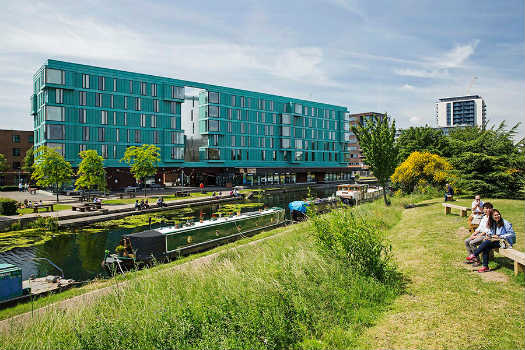
You will study Finance in one of Queen Mary’s newest buildings – the Graduate Centre which opened in 2017. The £39m building was built with energy efficiency in mind, and provides excellent on-campus resources to aid your studies, including:
- Specialist facilities including two computer labs (64 PCs) which includes a trading lab with 25 Bloomberg terminals
- Modern learning spaces with lecture theatres, seminar rooms, and study areas
- Industry-standard software such as Stata, MATLAB, Mathematica, ArcGIS, and more, with some available for personal installation
- Access to financial and economic data platforms including Bloomberg, Macrobond, WRDS, The Economist, and the Financial Times
Find out more about our resources and facilities.
Entry requirements
| A-Level | Grades AAA at A-Level. This must include A-Level Mathematics. |
| IB | International Baccalaureate Diploma with a minimum of 36 points overall, including 6,6,6 from three Higher Level subjects. This must include a minimum of 6 in Standard Level Mathematics, if not being studied at Higher Level. We will consider either Mathematics: Applications and interpretation or Mathematics: Analysis and approaches at Standard or Higher Level. Excludes Maths Studies. |
| BTEC | BTEC qualifications are considered for entry to this programme.\n |
| Access HE | We consider applications from students with the Access to Higher Education Diploma. The minimum academic requirement is to achieve 60 credits overall, with 45 credits at Level 3, of which 30 credits must be at Distinction, and 15 credits at Merit or higher. Applications are considered on a case by case basis. Applicants will also be expected to achieve, or have already achieved, A-Level Mathematics at grade A. |
| GCSE | Minimum five GCSE passes including English and Maths at grade B or 5. |
| EPQ | Alternative offers may be made to applicants taking the Extended Project Qualification. \nFor further information please visit: qmul.ac.uk/undergraduate/entry/epq |
| Contextualised admissions | Our standard contextual offer: ABB with A in Maths at A-Level. \n\nOur enhanced contextual offer: BBB including Maths at A-Level. \n\nMore information on our contextual offer criteria can be found on our contextualised admissions page. \n\nPlease note that General Studies and Critical Thinking are excluded from any A-Level offer and cannot be considered. |
| A-Level | Grades AAA at A-Level. This must include A-Level Mathematics. |
| IB | International Baccalaureate Diploma with a minimum of 36 points overall, including 6,6,6 from three Higher Level subjects. This must include a minimum of 6 in Standard Level Mathematics, if not being studied at Higher Level. We will consider either Mathematics: Applications and interpretation or Mathematics: Analysis and approaches at Standard or Higher Level. Excludes Maths Studies. |
| BTEC | BTEC qualifications are considered for entry to this programme. |
| Access HE | We consider applications from students with the Access to Higher Education Diploma. The minimum academic requirement is to achieve 60 credits overall, with 45 credits at Level 3, of which 30 credits must be at Distinction, and 15 credits at Merit or higher. Applications are considered on a case by case basis. Applicants will also be expected to achieve, or have already achieved, A-Level Mathematics at grade A. |
| GCSE | Minimum five GCSE passes including English and Maths at grade B or 5. |
| EPQ | Alternative offers may be made to applicants taking the Extended Project Qualification. For further information please visit: qmul.ac.uk/undergraduate/entry/epq |
| Contextualised admissions | Our standard contextual offer: ABB with A in Maths at A-Level. Our enhanced contextual offer: BBB including Maths at A-Level. More information on our contextual offer criteria can be found on our contextualised admissions page. Please note that General Studies and Critical Thinking are excluded from any A-Level offer and cannot be considered. |
Non-UK students
We accept a wide range of European and international qualifications in addition to A-levels, the International Baccalaureate and BTEC qualifications. Please visit International Admissions for full details.
If your qualifications are not accepted for direct entry onto this degree, consider applying for a foundation programme.
English language
Find out more about our English language entry requirements, including the types of test we accept and the scores needed for entry to the programme.
You may also be able to meet the English language requirement for your programme by joining a summer pre-sessional programme before starting your degree.
Further information
Funding
Loans and grants
UK students accepted onto this course are eligible to apply for tuition fee and maintenance loans from Student Finance England or other government bodies.
Scholarships and bursaries
Queen Mary offers a generous package of scholarships and bursaries, which currently benefits around 50 per cent of our undergraduates.
Scholarships are available for home, EU and international students. Specific funding is also available for students from the local area. International students may be eligible for a fee reduction. We offer means-tested funding, as well as subject-specific funding for many degrees.
Find out what scholarships and bursaries are available to you.
Support from Queen Mary
We offer specialist support on all financial and welfare issues through our Advice and Counselling Service, which you can access as soon as you have applied for a place at Queen Mary.
Take a look at our Student Advice Guides which cover ways to finance your degree, including:
- additional sources of funding
- planning your budget and cutting costs
- part-time and vacation work
- money for lone parents.
Careers
If a career in economics, banking or finance is your calling, this programme will provide you with an impressive entry route – in addition to opening up pathways for postgraduate studies.
Recent BSc Finance graduates have been hired by:
- Accenture
- Bank of England
- National Audit Office
- Blackrock
- Goldman Sachs
Career support
We provide our students and recent graduates with support ranging from finding the right career, improving your CV, and organising work experience opportunities.
You’ll also benefit from opportunities designed to boost your employability, including:
- Personal and Career Development Plan – a core module, helping you build confidence, self-awareness, and career planning skills.
- Finance Trading Programme – an optional programme offering practical insight into financial markets and trading strategies.
- qNomics – an optional hands-on consultancy initiative where students work on real projects, developing skills in finance, economics, policy, and communication.
Find out more on our
Data for these courses
Finance - BSc(Econ) (Hons)
The Discover Uni dataset (formerly Unistats)
About the School
The School of Economics and Finance at Queen Mary is ranked in the top 100 for Economics & Econometrics in the 2025 QS World University Rankings.
As one of London’s top Schools of Economics and Finance, we provide a solid foundation in economic and financial theory and practice, driven by research-led teaching from experts in the field, ensuring that not only will you be studying at the cutting edge of these disciplines, but also across a wide range of extracurricular school activities to enhance your learning experience.
Our faculty members are recognised experts in their fields, who impact on policy making and public debate. The breadth and depth of our expertise allows us to offer courses in all major areas of economics and finance, and you'll be at the heart of the latest thinking and cutting-edge research.
Each year we run a varied programme of lectures and talks by guest speakers, attracting big names from the worlds of economics, business and politics. We also support two societies where you can meet others with a shared interest in economics, finance and investment. Our proximity to the City and Canary Wharf gives us strong industry links.