Thank you for considering an application
To apply you’ll need to:
- Make note of the Queen Mary institution code: Q50
- Make note of your chosen course UCAS code:
Pharmacology and Innovative Therapeutics
- B211 — BSc (Hons)
- CCX2 — BSc (Hons) Biological Sciences with Foundation
- B21Y — BSc (Hons) with a Year Abroad
- B2Y1 — BSc (Hons) with Year in Industry
- Click on the link below:
Have further questions? How to apply | Entry requirements
Pharmacology and Innovative Therapeutics BSc
4 study options
Pharmacology and Innovative Therapeutics BSc (Hons)
Key information
- Degree
- BSc (Hons)
- Duration
- 3 years
- Start
- September 2026
- UCAS code
- B211
- Institution code
- Q50
- Typical A-Level offer
- Grades ABB at A-Level. This must include A-Level Biology or Chemistry. A second science subject at A-Level, of Biology, Chemistry, Maths or Physics is also required.
Full entry requirements (including contextual admissions) - Home fees
- £9790
- Overseas fees
- £32950
Funding information
Paying your fees
Biological Sciences with Foundation BSc (Hons)
Key information
- Degree
- BSc (Hons)
- Duration
- 4 years
- Start
- September 2026
- UCAS code
- CCX2
- Institution code
- Q50
- Typical A-Level offer
- Grades CCC at A-Level. This must include A-Level Biology or Chemistry. A second science subject at A-Level from either Biology, Chemistry, Maths, Further Maths, Physics or Psychology is also required.
Full entry requirements (including contextual admissions) - Home fees
- £9790
- Overseas fees
- £25500
Funding information
Paying your fees
Pharmacology and Innovative Therapeutics with a Year Abroad BSc (Hons)
Key information
- Degree
- BSc (Hons)
- Duration
- 4 years
- Start
- September 2026
- UCAS code
- B21Y
- Institution code
- Q50
- Typical A-Level offer
- Grades ABB at A-Level. This must include A-Level Biology or Chemistry. A second science subject at A-Level, of Biology, Chemistry, Maths or Physics is also required.
Full entry requirements (including contextual admissions) - Home fees
- £9790
- Overseas fees
- £32950
Funding information
Paying your fees
Pharmacology and Innovative Therapeutics with Year in Industry BSc (Hons)
Key information
- Degree
- BSc (Hons)
- Duration
- 4 years
- Start
- September 2026
- UCAS code
- B2Y1
- Institution code
- Q50
- Typical A-Level offer
- Grades ABB at A-Level. This must include A-Level Biology or Chemistry. A second science subject at A-Level, of Biology, Chemistry, Maths or Physics is also required.
Full entry requirements (including contextual admissions) - Home fees
- £9790
- Overseas fees
- £32950
Funding information
Paying your fees
Overview
The pharmaceutical and biotechnology industries need pharmacology experts. Could you be the next pioneer?
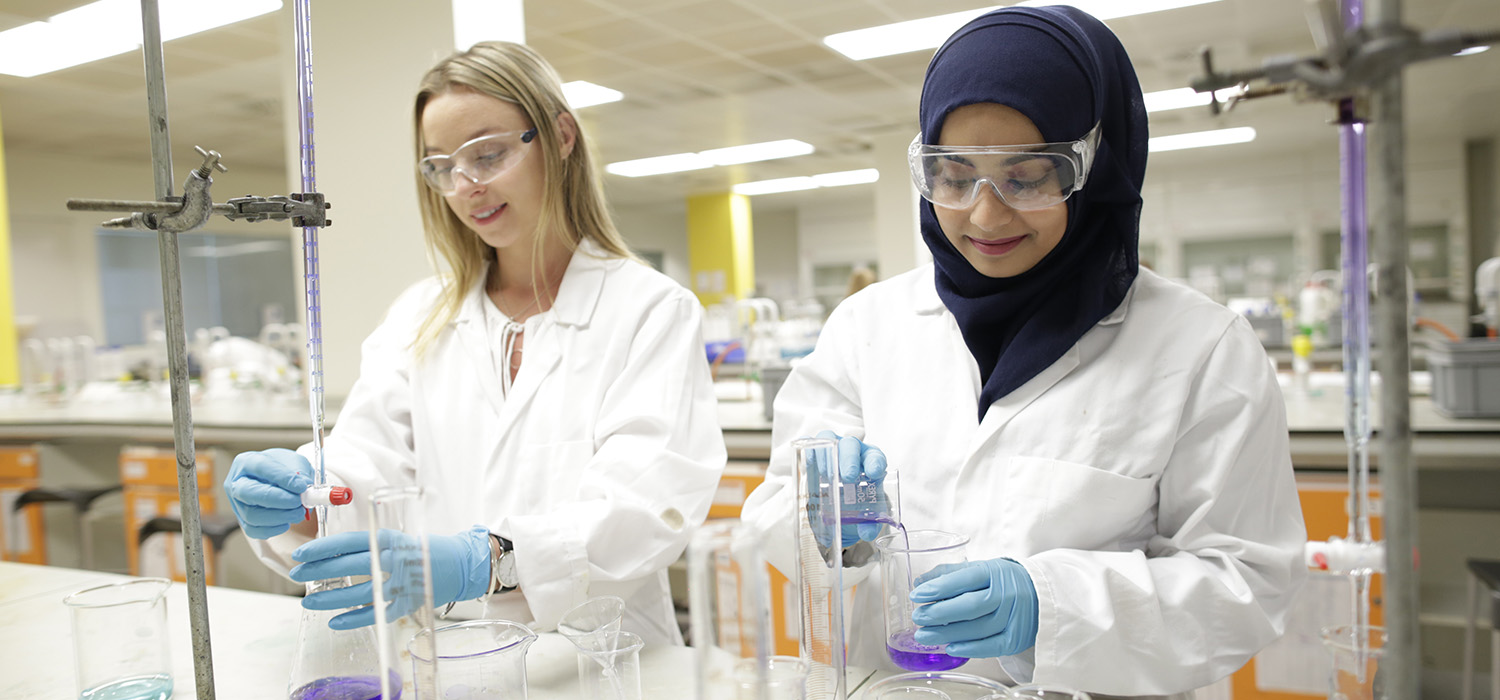
<p><span data-contrast="auto">Explore basic, molecular and clinical pharmacology. Get practical experience using scientific instruments in modern labs. Understand the clinical trial and regulatory pathways for bringing new drugs from an initial idea through to the patient.</span><span data-ccp-props="{"201341983":0,"335559739":200,"335559740":312}"> </span></p>
<p><span data-contrast="auto">Taught by the School of Biological and Behavioural Sciences and the Faculty of Medicine and Dentistry, this course combines their strengths, their academic experts and facilities. As well as the drug development cycles, the team will teach you about the </span><span data-contrast="auto">practical aspects of managing a pharmacology business</span><span data-contrast="auto">, from</span><span data-contrast="auto"> research and development costs</span><span data-contrast="auto"> to </span><span data-contrast="auto">marketing and licensing. </span><span data-ccp-props="{"201341983":0,"335559739":200,"335559740":312}"> </span></p>
<p><span data-contrast="auto">And did we mention you can complete a year in industry or a year abroad?</span><span data-ccp-props="{"201341983":0,"335559739":200,"335559740":312}"> </span></p>
<h2 aria-level="2">Research that saves lives</h2>
<p><span data-contrast="auto">The Faculty of Medicine and Dentistry is home to the William Harvey Research Institute, a world-leading pharmacology centre. All of the research happening here underpins our teaching.</span><span data-ccp-props="{"201341983":0,"335559739":200,"335559740":312}"> </span></p>
<p><span data-contrast="auto">We</span><span data-contrast="auto">’</span><span data-contrast="auto">re carrying out research on basic sciences aiming to identify novel targets for drug development, such as our research into the control of cell division which will help develop cancer treatments. Other academics are focused on evaluating the efficacy of drugs further down the development pipeline. Feel inspired by everyone you connect with and discover how you</span><span data-contrast="auto">’</span><span data-contrast="auto">ll make an impact.</span><span data-ccp-props="{"201341983":0,"335559739":200,"335559740":312}"> </span></p>
<p><span data-ccp-props="{"201341983":0,"335559685":720,"335559739":200,"335559740":312,"335559991":360}"> </span></p>
Structure
You can complete your Pharmacology and Innovative Therapeutics degree in three or four years.
If you choose to study abroad, this will take place in Year 3, and the Year 3 modules will instead be studied in Year 4.
Year 1
Core and compulsory
- Genetics
- Cells
- Research Skills for Pharmacologists
- Human Anatomy
- Tissue Biology
- Biomolecules of Life
- Biomedical Physiology I - Exchange, Movement and Integration
- Introduction to Pharmacology
Please note that all modules are subject to change.
Year 2
Core and compulsory
- Biomolecules of Life II
- Biomedical Physiology II - Cardiovascular and Respiratory
- Drug Target and Identification
- Basic Immunology
- The Business of Pharmacology
- Clinical Pharmacology and the Assessment of Drug Safety
Guided elective
- Human Genetic Disorders
- Cellular and Molecular Neuroscience
- Research Design and Analysis
- Membrane and Cellular Biochemistry
Please note that all modules are subject to change.
Year 3
Core and compulsory
- Classic Papers and Current Topics in Pharmacology
- Translational Pharmacology and Innovative Therapeutics
- Drug Design
- Clinical Trials and Regulatory Affairs
Guided elective
- Research Project in Pharmacology
- Structured Research Project
- Project: Engaging the Public with Science
- Cancer Biology
- Advanced Immunology
- Stem Cells and Regenerative Medicine
- Advanced Human Genetic Disorders
- Molecular Basis of Personalised Medicine
- Endocrine Physiology and Biochemistry
Please note that all modules are subject to change.
The full programme details and description are available in our Programme and Module Directory
Study options
Apply for this degree with any of the following options. Take care to use the correct UCAS code - it may not be possible to change your selection later.
Year in industry
To successfully secure a placement before the start of the 3rd year students need to meet the progression hurdle of achieving a Year 2 average module mark of at least 60% with no failed modules across Years 1 and 2.
Students will be responsible for seeking industrial placements with the support of an industrial placement co-ordinator. However, it is highly competitive and placements are not guaranteed.
Successful students will study 120 credits made up of BMD5555. The year in industry is pass/fail and students who don't pass their year will be transferred onto the standard 3 year programme.
Students will apply for industrial placements during their second year. If you do not secure an industrial placement, choose not to undertake a year in industry, or do not pass the year, you will be transferred to the standard three-year BSc degree.
Year abroad
Go global and study abroad as part of your degree – apply for our Pharmacology and Innovative Therapeutics BSc with a Year Abroad. Queen Mary has links with universities in Europe, North America, Asia and Australia (partnerships vary for each degree programme).
Find out more about study abroad opportunities at Queen Mary and what the progression requirements are. Learn more about financing your year abroad.

Student Testimonial
"This course stood out for its blend of drug discovery and real-world therapeutic innovation. Learning from researchers at the William Harvey Research Institute was incredibly inspiring. A key highlight was my third-year project at the William Harvey Heart Centre, where I studied aortic aneurysms using histological staining —an experience that strengthened my practical skills and clarified the impact I hope to make in pharmacology. Beyond the lab, being part of the WHRI Society and working as a student ambassador helped me connect with others interested in drug development and share my enthusiasm for pharmacology."
Teaching
Teaching and learning
We use a mixture of teaching styles - lectures, tutorials, classroom activities and laboratory work.
Outside of classes, you’ll need to spend 20 to 25 hours per week preparing, writing up and reading.
Assessment
Each module is assessed by written examinations and/or coursework (practical reports, essays, posters, presentations, problem sheets, online exercises and tests.
Final-year students undertake a research or investigative project, assessed with a detailed written report, poster and presentation.
Resources and facilities
<p>The School offers excellent on-campus resources to aid your studies, including:</p>
<ul>
<li>newly refurbished lecture theatres</li>
<li>up-to-date IT facilities</li>
<li>modern, well-equipped labs.</li>
</ul>
<p>You’ll also benefit from the expertise of the William Harvey Research Institute, a world-leading pharmacology centre based within Barts and the London School of Medicine and Dentistry.</p>
<p><a class='action' title='View tour of Fogg Building' href='https://www.qmul.ac.uk/study/explore-our-campuses/mile-end/ge-fogg-building/'>View tour of Fogg Building</a></p>
<p><a class='action' title='View tour of Blizard Building' href='https://www.qmul.ac.uk/study/explore-our-campuses/whitechapel/blizard-building/'>View tour of Blizard Building</a></p>
<p><a class='action' title='View Charterhouse Square campus images' href='https://www.qmul.ac.uk/study/explore-our-campuses/charterhouse-square/'>View Charterhouse Square campus images</a></p>
Entry requirements
| A-Level | Grades ABB at A-Level. This must include A-Level Biology or Chemistry. A second science subject at A-Level, of Biology, Chemistry, Maths or Physics is also required. |
| IB | International Baccalaureate Diploma with a minimum of 32 points overall, including 6,5,5 from three Higher Level subjects. This must include Biology and Chemistry at Higher Level. |
| BTEC | BTEC qualifications are not considered for entry to this programme. |
| Access HE | Access qualifications are not considered for entry to this programme. |
| GCSE | Minimum five GCSE passes including English and Maths at grade C or 4. |
| Contextualised admissions | Our standard contextual offer: Grades BBC including BB in Biology or Chemistry and one further science subject from Chemistry, Maths, Further Maths or Physics at A-Level. \n\nOur enhanced contextual offer: Grades BCC including B in Biology or Chemistry and one further science subject from Chemistry, Maths, Further Maths or Physics at A-Level. \n\nMore information on our contextual offer criteria can be found on our contextualised admissions page. \n\nPlease note that General Studies and Critical Thinking are excluded from any A-Level offer and cannot be considered. \n |
| A-Level | Grades CCC at A-Level. This must include A-Level Biology or Chemistry. A second science subject at A-Level from either Biology, Chemistry, Maths, Further Maths, Physics or Psychology is also required. |
| IB | International Baccalaureate Diploma with a minimum of 26 points overall, including 4,4,4 from three Higher Level subjects. This must include Biology or Chemistry at Higher Level. A second science subject at Higher Level of Chemistry, Maths, Further Maths, Physics or Psychology is also required. |
| BTEC | BTEC qualifications are considered for entry to this programme. |
| Access HE | We consider applications from students with the Access to Higher Education Diploma in a science discipline e.g. Biology, Chemistry, Maths or Physics. The minimum academic requirement is to achieve 60 credits overall, with 45 credits at Level 3, of which 9 credits must be at Distinction, 36 credits at Merit or higher. Applications are considered on a case by case basis, and we may request an interview. Due to the high volume of applications, we do not make offers of study purely on the basis of meeting grade requirements. |
| GCSE | Minimum five GCSE passes including English and Maths at grade C or 4. |
| Contextualised admissions | We consider every application on its individual merits and will take into consideration your individual educational experiences and context. More information on how academic schools and programmes use this information as part of the admissions process, can be found on our contextualised admissions pages. |
| A-Level | Grades ABB at A-Level. This must include A-Level Biology or Chemistry. A second science subject at A-Level, of Biology, Chemistry, Maths or Physics is also required. |
| IB | International Baccalaureate Diploma with a minimum of 32 points overall, including 6,5,5 from three Higher Level subjects. This must include Biology and Chemistry at Higher Level. |
| BTEC | BTEC qualifications are not considered for entry to this programme. |
| Access HE | Access qualifications are not considered for entry to this programme. |
| GCSE | Minimum five GCSE passes including English and Maths at grade C or 4. |
| EPQ | Alternative offers may be made to applicants taking the Extended Project Qualification. For further information please visit: qmul.ac.uk/undergraduate/entry/epq |
| Contextualised admissions | Our standard contextual offer: Grades BBC including BB in Biology or Chemistry and one further science subject from Chemistry, Maths, Further Maths or Physics at A-Level. Our enhanced contextual offer: Grades BCC including B in Biology or Chemistry and one further science subject from Chemistry, Maths, Further Maths or Physics at A-Level. More information on our contextual offer criteria can be found on our contextualised admissions page. Please note that General Studies and Critical Thinking are excluded from any A-Level offer and cannot be considered. |
Non-UK students
We accept a wide range of European and international qualifications in addition to A-levels, the International Baccalaureate and BTEC qualifications. Please visit International Admissions for full details.
If your qualifications are not accepted for direct entry onto this degree, consider applying for a foundation programme.
English language
Find out more about our English language entry requirements, including the types of test we accept and the scores needed for entry to the programme.
You may also be able to meet the English language requirement for your programme by joining a summer pre-sessional programme before starting your degree.
Further information
Funding
Loans and grants
UK students accepted onto this course are eligible to apply for tuition fee and maintenance loans from Student Finance England or other government bodies.
Scholarships and bursaries
Queen Mary offers a generous package of scholarships and bursaries, which currently benefits around 50 per cent of our undergraduates.
Scholarships are available for home, EU and international students. Specific funding is also available for students from the local area. International students may be eligible for a fee reduction. We offer means-tested funding, as well as subject-specific funding for many degrees.
Find out what scholarships and bursaries are available to you.
Support from Queen Mary
We offer specialist support on all financial and welfare issues through our Advice and Counselling Service, which you can access as soon as you have applied for a place at Queen Mary.
Take a look at our Student Advice Guides which cover ways to finance your degree, including:
- additional sources of funding
- planning your budget and cutting costs
- part-time and vacation work
- money for lone parents.
Careers
<h4>Medicine or dentistry</h4>
<p>The Pharmacology and Innovative Therapeutics programme provides a strong background for medicine or dentistry, as you will have studied a wide range of biomedical subjects and developed an in-depth knowledge of medicines.</p>
<p><span>The 19 highest-ranked students from our Biomedical Sciences, Neuroscience and Pharmacology and Innovative Therapeutics programmes are guaranteed an interview for the five-year A100 Medicine MBBS degree at Queen Mary University of London. For the top seven ranked students, there is a guaranteed interview for the five year A200 BDS dentistry programme. Students are selected at the end of the second year on the basis of an aggregate of academic ranking (50%) and UCAT score (50%) and start the programme after they have completed their final year. </span>Of these students, the top five will also be considered for the four-year A101 MBBS Graduate Entry Programme.</p>
<h4>Other careers</h4>
<p>87 per cent of our graduates are in work or further study within 15 months of graduation (Graduate Outcomes Survey 2021/22).</p>
<ul>
<li>Some graduates pursue a career in the pharmaceutical and biotechnology industry, within a regulatory agency or in a wider biomedical area.</li>
<li>Some opt for postgraduate study. Top graduates may be eligible for fully-funded PhD training within Queen Mary’s William Harvey Research Institute.</li>
<li>Others transfer their skills to careers in diverse fields, including media, technology and management.</li>
</ul>
<p>Recent BSc Pharmacology and Innovative Therapeutics graduates are employed in roles such as:</p>
<ul>
<li>Clinical Trials Administrator/ Associate</li>
<li>Medical Writer</li>
<li>Research Assistant</li>
<li>Research Officer</li>
<li>Research Scientist Data Analyst</li>
<li>Science Technician</li>
</ul>
<p>Our graduates work in a range of organisations including: </p>
<ul>
<li>Applied Nano Detectors</li>
<li>Diabetes (UK)</li>
<li>Hammersmith Medicines Research Ltd</li>
<li>Havas Media</li>
<li>JDH Health Care</li>
<li>Medpace</li>
<li>Mid and South Essex NHS Foundation Trust</li>
<li>University College London Hospitals NHS Foundation Trust</li>
</ul>
<p>Graduate Outcomes Survey 2020/21 and 2021/22</p>
Career support
The School of Biological and Behavioural Sciences has a careers consultant, who can offer specialist advice and organise subject-specific events. We also have a dedicated internships coordinator.
The Queen Mary careers team can also offer:
<ul>
<li>specialist advice on choosing a career path</li>
<li>support with finding work experience, internships and graduate jobs</li>
<li>feedback on CVs, cover letters and application forms</li>
<li>interview coaching.</li>
</ul>
Learn more about career support and development at Queen Mary.
Data for these courses
Pharmacology and Innovative Therapeutics - BSc (Hons)
The Discover Uni dataset (formerly Unistats)
About the School
The School of Biological and Behavioural Sciences is a large and dynamic school with strong links to industry. We offer a stimulating and supportive learning experience.
You’ll experience inspirational teaching from high-calibre staff who are leaders in their field. According to the Research Excellence Framework 2021, 91 per cent of our Biological Sciences research is either world-leading or internationally excellent. You’ll stay up to date with weekly departmental seminars on new research findings.
Thanks to our close teaching and research links, students have special opportunities for original investigative work with the Natural History Museum, ZSL London Zoo, Forest Enterprise, and University of London’s Marine Biological Station at Millport in Scotland.