Thank you for considering an application
To apply you’ll need to:
- Make note of the Queen Mary institution code: Q50
- Make note of your chosen course UCAS code:
Design, Innovation and Creative Engineering
- 4L71 — MEng (Hons)
- HHX3 — BEng (Hons) Engineering with Foundation
- 4L7Y — MEng (Hons) with a Year Abroad
- H3N7 — MEng (Hons) with Industrial Experience
- Click on the link below:
Have further questions? How to apply | Entry requirements
Design, Innovation and Creative Engineering MEng
4 study options
Design, Innovation and Creative Engineering MEng (Hons)
Key information
- Degree
- MEng (Hons)
- Duration
- 4 years
- Start
- September 2026
- UCAS code
- 4L71
- Institution code
- Q50
- Typical A-Level offer
- Grades AAA at A-Level. This must include A-Level Maths or Physics. If students do not have an additional A-level in a creative subject they should be able to demonstrate creativity by another method, for example as a GCSE or an activity outside school.
Full entry requirements (including contextual admissions) - Home fees
- £9790
- Overseas fees
- £32950
Funding information
Paying your fees
Engineering with Foundation BEng (Hons)
Key information
- Degree
- BEng (Hons)
- Duration
- 5 years
- Start
- September 2026
- UCAS code
- HHX3
- Institution code
- Q50
- Typical A-Level offer
- Grades BBB at A-Level. This must include A-Level Mathematics.
Full entry requirements (including contextual admissions) - Home fees
- £9790
- Overseas fees
- £25500
Funding information
Paying your fees
Design, Innovation and Creative Engineering with a Year Abroad MEng (Hons)
Key information
- Degree
- MEng (Hons)
- Duration
- 5 years
- Start
- September 2026
- UCAS code
- 4L7Y
- Institution code
- Q50
- Typical A-Level offer
- Grades AAA at A-Level. This must include A-Level Maths or Physics. If students do not have an additional A-level in a creative subject they should be able to demonstrate creativity by another method, for example as a GCSE or an activity outside school.
Full entry requirements (including contextual admissions) - Home fees
- £9790
- Overseas fees
- £32950
Funding information
Paying your fees
Design, Innovation and Creative Engineering with Industrial Experience MEng (Hons)
Key information
- Degree
- MEng (Hons)
- Duration
- 5 years
- Start
- September 2026
- UCAS code
- H3N7
- Institution code
- Q50
- Typical A-Level offer
- Grades AAA at A-Level. This must include A-Level Maths or Physics. If students do not have an additional A-level in a creative subject they should be able to demonstrate creativity by another method, for example as a GCSE or an activity outside school.
Full entry requirements (including contextual admissions) - Home fees
- £9790
- Overseas fees
- £32950
Funding information
Paying your fees
Overview
Future design graduates will need to be both artist and scientist, able to understand and apply the latest technology alongside the creative process.
Engineering alone can’t solve the complex challenges of the 21st century - and design can only go so far without the right technology to bring ideas to life. That’s where this course comes in.
Our hands-on programme blends creative design thinking with cutting-edge engineering expertise, equipping you with the skills to innovate beyond conventional solutions. You won’t just apply existing knowledge to solve problems - you’ll rethink the problem itself, uncovering overlooked users and challenging assumptions to design more effective, human-centred solutions.
From pitches to portfolios
In tutorial-style sessions, we’ll encourage you to think and develop as an independent designer, with pitches, presentations and portfolios to put your skills to the test. You’ll explore material properties of artefacts as well as looking at their environmental impact and manufacturing. All with support from academics and technical staff, as well as visiting design consultants.
In your final year, you’ll identify and explore a design problem that interests you. Past students have designed kit for the London Air Ambulance, tools to help patients communicate pain more effectively and solutions to avoid single-use containers in the cosmetic industry.
Many students progress to postgraduate study in engineering or design and innovation. Some find their first product design role. Others work in engineering, technology or a range of management careers. Whatever you do next, you could be the person who solves problems faced by communities around the globe.
Professional recognition
The Design Engineering programmes are accredited by the Institution of Engineering Designers as partially meeting the academic requirements for registration as a Chartered Engineer (CEng), and fully meeting the academic requirements for registration as a Registered Product Designer.

Structure
Year 1
Core and compulsory
- Studio Practice Year 1
- Engineering Design
- Computational and Mathematical Modelling 1
- Materials Engineering
- Data and Design
- Exploring Engineering
- Computational and Mathematical Modelling 2
- Skills for Engineers
Please note that all modules are subject to change.
Year 2
Core and compulsory
- Studio Practice Module Year 2 Human and Machine
- Materials for Sustainability
- Introduction to Robotics
- Instrumentation and Measurements
- Designing for Sustainable Manufacture
- Materials Processing and Manufacturing
- Robot Design and Mechatronics
- Professional Engineering Skills
Please note that all modules are subject to change.
Year 3
Core and compulsory
- Studio Practice Year 3 GDP Industry Related Design Project
- Studio Practice Year 3 Individual Design Project Joie de Vivre
- Design for Human Interaction
- Sustainability Assessments for Design
- User Experience Design
Guided elective
Please note that all modules are subject to change.
Year 4
Core and compulsory
Guided elective
- Nanotechnology and Nanomedicine
- Medical Robotics and Surgical Techniques
- Engineering Design Optimisation and Decision Making
- Introduction to Systems Engineering
- Modern Robotics: Fundamentals and Applications
- Clinical Sensors and Measurements
- Medical Ethics and Regulatory Affairs
- Cognitive Robotics
- Environment, Ethics and Economics in Engineering Design
- Mechatronics
Please note that all modules are subject to change.
The full programme details and description are available in our Programme and Module Directory
Study options
Apply for this degree with any of the following options. Take care to use the correct UCAS code - it may not be possible to change your selection later.
Student Testimonial
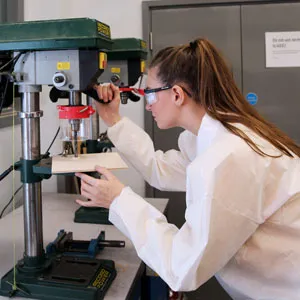
Design, Innovation and Creative Engineering is a unique course. You're allowed to develop in your own way and engage in projects outside the curriculum. Visiting museums as part of the programme was brilliant because we can immerse ourselves in the world of design.
Teaching
Teaching and learning
You'll learn through a combination of lectures, laboratory practicals and problem-based learning. You should plan for 14-17 hours of formal teaching each week, plus time spent on group projects. For every hour spent in class, you'll complete a further one to two hours of independent study.Assessment
Assessment typically includes a combination of coursework, written reports, projects, presentations, group work and exams in the summer.Resources and facilities
The School offers excellent on-campus resources to aid your studies, including: an information teaching laboratory, with over 300 multimedia workstations a new Creative Engineering Hub, offering fabrication, 3D printing, maker and exhibition space a design studio mechanical testing facilities.
Entry requirements
| A-Level | Grades AAA at A-Level. This must include A-Level Maths or Physics. If students do not have an additional A-level in a creative subject they should be able to demonstrate creativity by another method, for example as a GCSE or an activity outside school. |
| IB | International Baccalaureate Diploma with a minimum of 36 points overall, including 6,6,6 from three Higher Level subjects. This must include Mathematics or Physics. If students do not have an IB creative subject at standard or higher level they should be able to demonstrate creativity in their personal statement by another method, for example through an activity outside school. |
| BTEC | BTEC qualifications are not considered for entry to this programme. |
| Access HE | We consider applications from students with the Access to Higher Education Diploma in a Physics and Mathematics based discipline. Entry will normally be to the BEng or BSc. The minimum academic requirement is to achieve 60 credits overall, with 45 credits at Level 3, of which 33 credits must be at Distinction and 12 credits at Merit or higher. Applications are considered on a case by case basis. |
| GCSE | Minimum five GCSE passes including English at grade C or 4. |
| EPQ | Alternative offers may be made to applicants taking the Extended Project Qualification. \nFor further information please visit: qmul.ac.uk/undergraduate/entry/epq |
| Contextualised admissions | Our standard contextual offer: ABB including A in Maths or Physics at A-Level. \n\nOur enhanced contextual offer: BBB including Maths or Physics at A-Level. \n\nMore information on our contextual offer criteria can be found on our contextualised admissions page. \n\nPlease note that General Studies and Critical Thinking are excluded from any A-Level offer and cannot be considered. \n |
| A-Level | Grades BBB at A-Level. This must include A-Level Mathematics. |
| IB | International Baccalaureate Diploma with a minimum of 30 points overall, including 5,5,5 from three Higher Level subjects. This must include Mathematics at Higher Level. We will consider either Mathematics: Applications and Interpretation or Mathematics: Analysis and Approaches at Higher Level. |
| BTEC | BTEC qualifications are considered for entry to this programme. |
| Access HE | We consider applications from students with the Access to Higher Education Diploma in a Physics and Mathematics based discipline. The minimum academic requirement is to achieve 60 credits overall, with 45 credits at Level 3, of which 15 credits must be at Distinction and 30 credits at Merit or higher. Applications are considered on a case by case basis. |
| GCSE | Minimum five GCSE passes including English and Maths at grade C or 4. |
| Contextualised admissions | We consider every application on its individual merits and will take into consideration your individual educational experiences and context. More information on how academic schools and programmes use this information as part of the admissions process, can be found on our contextualised admissions pages. |
| A-Level | Grades AAA at A-Level. This must include A-Level Maths or Physics. If students do not have an additional A-level in a creative subject they should be able to demonstrate creativity by another method, for example as a GCSE or an activity outside school. |
| IB | International Baccalaureate Diploma with a minimum of 36 points overall, including 6,6,6 from three Higher Level subjects. This must include Mathematics or Physics. If students do not have an IB creative subject at standard or higher level they should be able to demonstrate creativity in their personal statement by another method, for example through an activity outside school. |
| BTEC | BTEC qualifications are not considered for entry to this programme. |
| Access HE | We consider applications from students with the Access to Higher Education Diploma in a Physics and Mathematics based discipline. Entry will normally be to the BEng or BSc. The minimum academic requirement is to achieve 60 credits overall, with 45 credits at Level 3, of which 33 credits must be at Distinction and 12 credits at Merit or higher. Applications are considered on a case by case basis. |
| GCSE | Minimum five GCSE passes including English at grade C or 4. |
| EPQ | Alternative offers may be made to applicants taking the Extended Project Qualification. For further information please visit: qmul.ac.uk/undergraduate/entry/epq |
| Contextualised admissions | Our standard contextual offer: ABB including A in Maths or Physics at A-Level. Our enhanced contextual offer: BBB including Maths or Physics at A-Level. More information on our contextual offer criteria can be found on our contextualised admissions page. Please note that General Studies and Critical Thinking are excluded from any A-Level offer and cannot be considered. |
| A-Level | Grades AAA at A-Level. This must include A-Level Maths or Physics. If students do not have an additional A-level in a creative subject they should be able to demonstrate creativity by another method, for example as a GCSE or an activity outside school. |
| IB | International Baccalaureate Diploma with a minimum of 36 points overall, including 6,6,6 from three Higher Level subjects. This must include Mathematics or Physics. If students do not have an IB creative subject at standard or higher level they should be able to demonstrate creativity in their personal statement by another method, for example through an activity outside school. |
| BTEC | BTEC qualifications are not considered for entry to this programme. |
| Access HE | We consider applications from students with the Access to Higher Education Diploma in a Physics and Mathematics based discipline. Entry will normally be to the BEng or BSc. The minimum academic requirement is to achieve 60 credits overall, with 45 credits at Level 3, of which 33 credits must be at Distinction and 12 credits at Merit or higher. Applications are considered on a case by case basis. |
| GCSE | Minimum five GCSE passes including English at grade C or 4. |
| Contextualised admissions | Our standard contextual offer: ABB including A in Maths or Physics at A-Level. Our enhanced contextual offer: BBB including Maths or Physics at A-Level. More information on our contextual offer criteria can be found on our contextualised admissions page. Please note that General Studies and Critical Thinking are excluded from any A-Level offer and cannot be considered. |
Non-UK students
We accept a wide range of European and international qualifications in addition to A-levels, the International Baccalaureate and BTEC qualifications. Please visit International Admissions for full details.
If your qualifications are not accepted for direct entry onto this degree, consider applying for a foundation programme.
English language
Find out more about our English language entry requirements, including the types of test we accept and the scores needed for entry to the programme.
You may also be able to meet the English language requirement for your programme by joining a summer pre-sessional programme before starting your degree.
Further information
Funding
Loans and grants
UK students accepted onto this course are eligible to apply for tuition fee and maintenance loans from Student Finance England or other government bodies.
Scholarships and bursaries
Queen Mary offers a generous package of scholarships and bursaries, which currently benefits around 50 per cent of our undergraduates.
Scholarships are available for home, EU and international students. Specific funding is also available for students from the local area. International students may be eligible for a fee reduction. We offer means-tested funding, as well as subject-specific funding for many degrees.
Find out what scholarships and bursaries are available to you.
Support from Queen Mary
We offer specialist support on all financial and welfare issues through our Advice and Counselling Service, which you can access as soon as you have applied for a place at Queen Mary.
Take a look at our Student Advice Guides which cover ways to finance your degree, including:
- additional sources of funding
- planning your budget and cutting costs
- part-time and vacation work
- money for lone parents.
Careers
Career support
Throughout the course, students have access to a bespoke careers programme, including workshops on job hunting and job applications as well as employer events.The Queen Mary careers team can also offer: specialist advice on choosing a career path support with finding work experience, internships and graduate jobs feedback on CVs, cover letters and application forms interview coaching. Learn more aboutData for these courses
Design, Innovation and Creative Engineering - MEng (Hons)
The Discover Uni dataset (formerly Unistats)
About the School
With a 100-year track record in significant impacts and advancements, we offer accredited programmes that prioritise problem-based learning and career-readiness for rapidly growing sectors. Join a diverse and collaborative community whose unique perspectives and engineering skills are changing the world.
Study with an award-winning academic team behind revolutionary developments in medical robotics, pre-clinical drug testing, sustainable materials and renewable energy. From our home in Mile End, you’ll have access to first-rate facilities that complement your learning.
Graduates from our programmes go on to do amazing things, like making affordable period underwear for the humanitarian sector, and inventing a washing machine that doesn’t need electricity to run.