
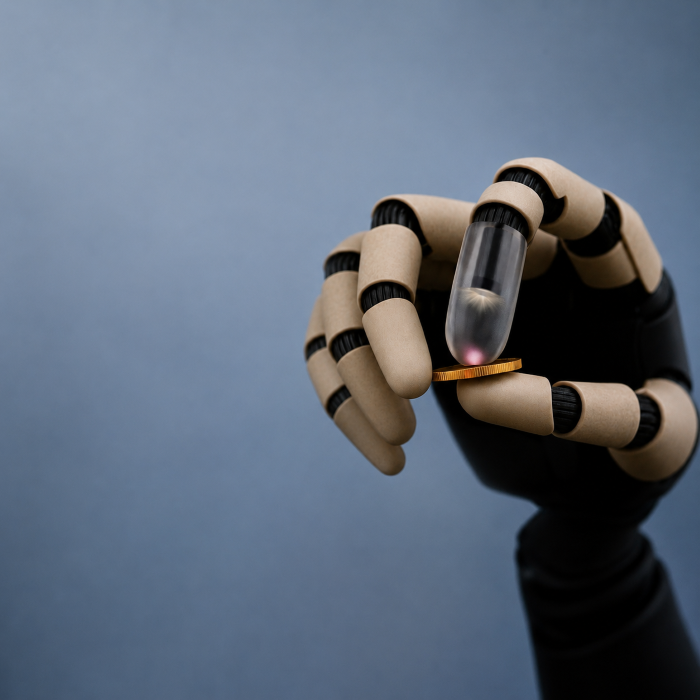
The evolution of robots
In this world of Artificial Intelligence (AI), machines can analyse vast amounts of information, recognise patterns at extraordinary speed and generate content that often appears remarkably human.
However, if AI is to move beyond digital environments and become a meaningful presence in factories, hospitals, homes and public spaces, it will need more than computational power.
It will need a body capable of sensing and understanding contact – one of robotics' greatest challenges. A challenge researchers at Queen Mary are overcoming.
Teaching robots to feel
Modern robots can identify objects with impressive accuracy, but many struggle with tasks humans perform without conscious thought. Picking up a delicate object without crushing it, assisting a patient during rehabilitation or safely interacting with people in shared environments all require an ability to feel.
The importance of this challenge is becoming increasingly clear. Manufacturers are seeking more adaptive automation systems capable of handling complex products and variable production environments. Healthcare providers are exploring robotic technologies that can support rehabilitation, assistive care and minimally invasive procedures. Logistics companies are looking for systems that can manipulate objects safely and efficiently. In all these applications, touch is not an optional feature; it is a prerequisite for effective interaction.
A new approach to tactile sensing
A human hand contains more than 10,000 mechanoreceptors that continuously gather information about pressure, texture, movement and force. Rather than attempting to recreate every biological receptor with electronics, Dr. Giacomo Sasso, main author of the study, asked a simple question: “Could the material itself perform part of the sensing?”
For decades, engineers have attempted to solve the problem by adding more sensors, more components and more processing power. But this makes the machines more expensive, less scalable and harder to integrate into practical applications.
A collaboration between Queen Mary academics, including Dr. Giacomo Sasso, Professor James Busfield, Professor Nicola Pungo, Visiting Professor Federico Carpi and colleagues in the University of Florence has found a solution.
Rather than continually adding layers of sensing hardware and processing capability, the team explored whether intelligence and sensing can be embedded directly into the materials themselves. To do this, they developed a tactile sensing system based on a mechanochromic material – a material that changes colour when subjected to mechanical strain. In this way, the material itself becomes part of the sensing process.
“The next breakthrough in AI may not come from making machines better at generating text, recognising images or processing data. It may come from enabling them to interact with the physical world with greater sensitivity, adaptability and awareness.”— Professor James Bustfield, FREng FIMMM FHEA Professor of Materials at Queen Mary University of London

Traditional tactile sensing systems collect raw data and then attempt to reconstruct physical interactions through computational pipelines. In contrast, mechanochromic materials encode information directly into the visual signal. When pressure is applied, the mechanochromic material generates colour variations that are captured by a simple camera and converted into detailed maps of touch and pressure in real time.
This means that instead of relying on highly engineered sensor architectures, mechanical cues are transformed directly into optical information – so instead of reconstructing touch after data acquisition, the system observes it directly, in turn dramatically simplifying the sensing pathway.
This new approach is not only more accurate but also more scalable and cost-effective, meaning it could be more easily integrated into existing systems.
"In effect, part of the sensing process occurs within the material before the data even reaches the computer."— Dr. Giacomo Sasso, Postdoctoral Research Associate at Queen Mary University of London
To share the findings in an accessible way, the research team have created a short YouTube video to translate the paper visually. See how the sensor works here.
What this means for us
Improving tactile sensing in machines holds enormous potential. As robotics increasingly moves beyond factories into healthcare, homes and everyday environments, advances in tactile sensing could help machines interact more safely, more precisely and more naturally with the physical world.
In manufacturing, it could enable robots to handle delicate components and adapt more effectively to changing production requirements. In healthcare, it could support development of next-generation prosthetics and diagnostic tools capable of monitoring fine motor control – the list goes on. This new approach from Queen Mary academics and their collaborators could dramatically improve how robots sense the world around them, which would have massive, positive real-world impact.
Find out more
The School of Engineering and Materials Science provides outstanding degree programmes coupled with internationally leading research, which is reflected in all our undergraduate programmes. Our taught postgraduate programmes are similarly first class and provide students with a fantastic opportunity to engage with cutting-edge research in: Bioengineering, Intelligent Transport, Sustainable Engineering and Engineering and Materials Education. Our extensive industrial connections provide graduates with excellent employability in stimulating and well-paid careers.