
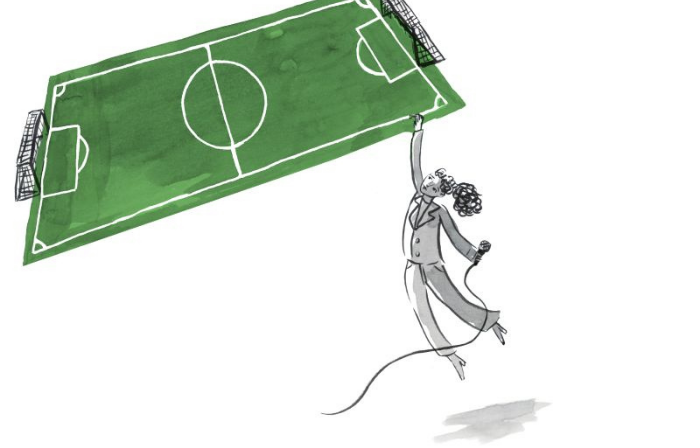
Language and gender bias in football
Researchers from Queen Mary University of London, in collaboration with the University of Glasgow and the University of Southampton, have found that listeners judge female commentators more negatively than male commentors – even when they’re saying the same thing.
Same thing, different perceptions
In the study, carried out by Dr Sophie Holmes-Elliott, Senior Lecturer in Sociolinguistics at Queen Mary, Dr Louis Strange (University of Glasgow) and Dr Matthew Hunt (University of Southampton), researchers tested how audiences responded to football commentary by:
- playing the same match clips with identical scripts, voiced by either a man or a woman.
- manipulating commentators’ vocal pitch to explore whether having a higher or lower voice shapes listener perceptions, for both men and women
The main conclusion the team reached was that women commentators received more negative feedback and ratings compared to male commentators. They found that for status-based attributes such as competence, knowledge and experience, male listeners prefer male commentators to female commentators. However, female listeners show no preference.
Speaking on the results, Dr Holmes-Elliott said: “Our work shows the nebulous barriers women in football face in the form of inequalities of recognition, where, on account of their gender, they are denied full rights, access, and respect as participating members of the football community, as players, commentators, and even fans.
“Going beyond football, these results reflect the challenges faced by women as they strive for equal recognition and opportunities at work, especially in public-facing roles.”
“Going beyond football, these results reflect the challenges faced by women as they strive for equal recognition and opportunities at work, especially in public-facing roles.”— Dr Sophie Holmes-Elliott, Senior Lecturer in Sociolinguistics at Queen Mary University of London.

A double bind
In addition to looking at perceptions around gender, the team looked at whether pitch played a role in how people respond to commentary.
The team found that it does affect how listeners perceive and rate commentators’ attributes, with lower-pitched female voices receiving the harshest judgements. They found that:
- both men and women rated lower-pitched female voices as less attractive than the baseline (‘higher’) female voice
- male listeners rated the more gender-typical (i.e., higher) female voice as friendlier
- female listeners rated the less gender-typical (i.e., higher) male voice as friendlier.
Combined, these finding highlight a ‘double-bind’ for women working in football commentary – they are penalised for both sounding too feminine, and for not conforming to expectations of how women ‘should’ sound.
Dr Holmes-Elliott said: “We did have some encouraging findings. We found that listeners who have a strong interest in football are generally less likely to rate female commentators negatively, suggesting that negative attitudes are not shared by all football fans, especially those who are most invested in the sport.”
"We found that listeners who have a strong interest in football are generally less likely to rate female commentators negatively."— Dr Sophie Holmes-Elliott, Senior Lecturer in Sociolinguistics at Queen Mary University of London.