
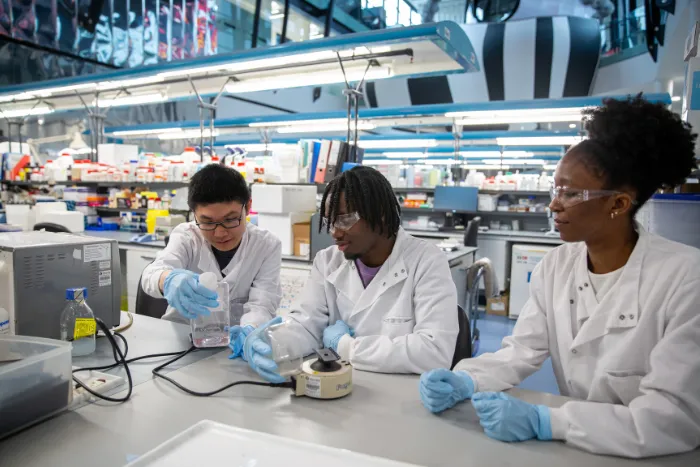
Too often, the voices of young people are overlooked in research, even though its outcomes will impact them, now, or in the future.
At Queen Mary University of London, members of the Centre for Creative Collaboration and Centre for Public Engagement wanted to change this. They wanted to understand the best way to bring young people’s views and ideas into research, in a way that was meaningful, beneficial and manageable for all involved.
To do this, they embarked on a participatory research project that aimed to understand the best way to support children and young people to actively participate in research.
Embedding young people in research
With funding from Research England and led by Lily Gilder, Youth Insight Participatory Research Officer at Queen Mary, the team worked with fourteen18-25-year-olds – called Youth Insight Researchers – from Queen Mary and across east London.
Their project explored how young people can play an active role in research and how their voices can be meaningfully included in knowledge production.
The Youth Insight Researchers were embedded across a range of active research projects at Queen Mary, working alongside academics in fields including dentistry, early years education, creative arts and public and mental health. They were co-researchers with the academics, speaking with them, observing their work, contributing their own perspectives, and reflections and discussing how participation can be meaningfully embedded in research.
“The toolkit speaks to the need for real-world research examples that provide guidance for how participatory research can be done.”— Lily Gilder, Youth Insight Participatory Research Officer, Queen Mary University of London
A participatory research toolkit
Having competed their research activities, the Youth Insight Researchers came together to share what they had learned with Lily.
Together, they co-designed a participatory research toolkit that aims to support researchers in carrying out research with young people, rather than for them. Aimed at addressing the relational, ethical and practical challenges that can come from involving young people in research, the toolkit serves as a basis for training, reflection, and confidence- and capacity-building in participatory research. It offers practical guidance, alongside reflections from young people and case studies drawn from across Queen Mary’s research community to support researchers in navigating this approach.
The team also collaborated with the Interdisciplinary Sharing of Participatory Youth Research Experiences network, where it was discussed and reviewed by researchers and practitioners across various disciplines. This collaborative approach helped to strengthen and refine the toolkit’s content, so it is applicable across a range of research contexts.

Using the toolkit
The toolkit explores:
- When and why participatory approaches might be appropriate
- How to design meaningful and ethical involvement
- Recruitment, relationship-building, and facilitation skills
- Working collaboratively with parents, schools, youth orgs and other 'gatekeepers'
- Navigating emotions, complexity, and uncertainty
- Working with creative methods
It can be used in a range of contexts, including:
- Workshops and training sessions
- Teaching and learning environments
- Peer reflection
- Community engagement and collaborative partnerships
“Good participatory research shows a commitment to validating lived experiences”— Elsie Mahamou, Youth Insight Researcher, Queen Mary University of London