

CREAATIF and AI
The Crafting Responsive Assessments of AI & Tech-Impacted Futures (CREAATIF) Project
The CREAATIF project, led by Dr Aoife Monks and other researchers at Queen Mary University of London’s Centre for Creative Collaboration and Digital Environment Research Institute, is run in partnership with four major unions – Equity, Bectu, the Musicians’ Union, and the Society of Authors – and in partnership with the Alan Turing Institute and the Institute for the Future of Work.

Over the course of 2024, the project team spoke to 335 freelance creative workers to understand how Generative AI (GenAI) is affecting their rights, work, and livelihoods. In early 2025, the team shared their findings, which showed that 73% of the creative industry workers who took part in CREAATIF believe GenAI is having an impact on them, and the quality of work in the creative industry.
In addition, and in collaboration with union partners, the research team offered clear and practical recommendations to policy makers that aim to protect and sustain creative workers, whose industry is driving economic growth in the UK.
CREAATIF Recommendations
- Fair Remuneration: Enforce ownership rights and redistribute GenAI-generated revenues to the human sources of creative data and content.
- Legislative Reform: Update UK laws to safeguard freelance creative workers, covering employment rights, skills development, and AI-specific risks.
- Inclusive AI Governance: Ensure all creative roles, not only traditional ‘creators’, are included in AI regulatory design through structured engagement.
- Stronger Regulation for AI Firms: Require transparency, rapid action on rights infringements, and compensation when creative outputs are used without consent.
- Ongoing Impact Assessments: Track the effects of GenAI on job quality, working conditions, and income security, with clear accountability.
- Preserving Human Originality: Introduce watermarking and provenance tools to distinguish human-made content from AI-generated material.
- Workforce Training and Empowerment: Provide targeted education on IP and labour rights, contract negotiation, anti-mimicry strategies, and challenging AI bias.
Sharing the recommendations
The CREAATIF team officially launched these recommendations at a keynote event at the SXSW London conference in June 2025.
Joined at the event by some of their collaborators, the team used this platform as a way to highlight the issues GenAI can create for the creative industry workforce, but also the solutions to reducing its negative impact.
Following the SXSW keynote speech, the key findings were presented at the All-Party Parliamentary Group on the Future of Work by project lead Professor David Leslie.
Using CREAATIF’s recommendations as a bedrock, the APPG session brought together creative professionals, policymakers and parliamentarians to further explore issues around copyright, fair remuneration and job security in the creative industries.
From this work, the APPG presented their recommendations to parliament, calling for cross-party collaboration to secure a creative economy that is dynamic, dignified, and fair.
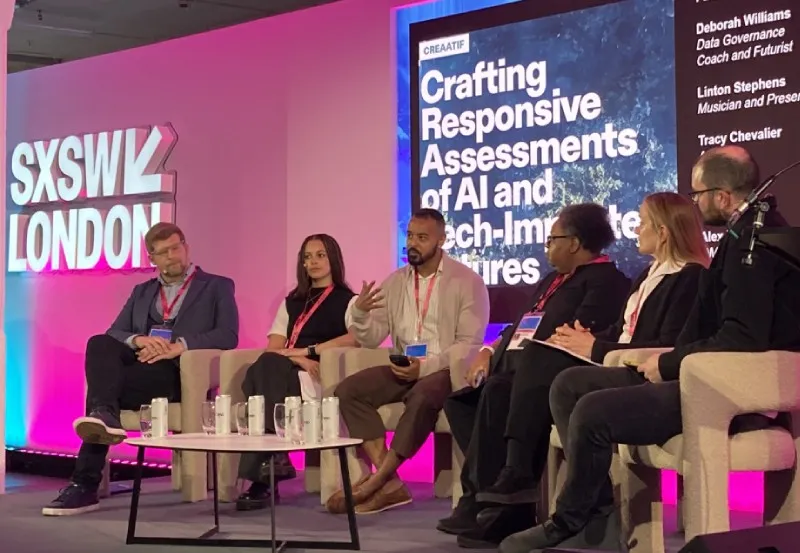
CREAATIF launches recommendations at SXSW London
In another parallel strand within the CREAATIF project, the Institute for Future Work produced a policy brief setting out policy recommendations for regulators to build better governance of GenAI. These recommendations include setting minimum standards for human content/input in AI workflows and the development and testing of new models for fair reward, with statutory backup.
Ensuring AI works for creators
This work demonstrates that Queen Mary researchers are not only at the forefront of understanding the impact GenAI has on individuals, but also of providing solutions to ensure that AI works for those in the creative industries and others, not against them.