
Creating a hands-on activity: Zombie Rubbish! at Green Man Festival 2026
- Faculty: Faculty of Humanities and Social Sciences
- School: School of Society and Environment
- Format: Stall at a music festival
- Key themes: family engagement; hands-on activities; festivals; science engagement; climate change; public engagement
Could you tell us about the RACC (Resilience of Anthropocene Coasts and Communities) project?
There are over 1,700 Coastal legacy waste sites (3,000 HA) at risk of coastal flooding and erosion by the year 2100. The urgency of research into this is imperative; there is limited understanding of the pollution risks of these sites, and there is a disconnect between decision makers on how to assess, manage and respond to this issue in a way that works for both the natural environment and the local communities at risk.
The RACC (Resilience of Anthropocene Coasts and Communities) project aims to help amend this research gap. RACC is an interdisciplinary UKRI and DEFRA-funded research project focused on understanding the risks posed from legacy waste sites and subsequent adaptation and management solutions that decrease the negative impacts of these in a changing climate. The aim is to build understanding around these sites and assist decisions makers to help protect communities, ecosystems, and the blue-green economy as the coastline changes.
The RACC team is made up of staff from Queen Mary University of London, University of Glasgow, University of Bradford, University of Sunderland, King’s College London and Museum of London Archaeology.
Could you tell us a bit about Green Man Festival, your project and what you were aiming to do there?
Green Man Festival is an annual Music, Arts & Science Festival that takes place in Banna Brycheiniog (Brecon Beacons) in Wales. The Festival has a strong ethos of responsible education; and a key part of this is the festival's own dedicated Science, Talks & Climate area section - Einstein’s Garden, where interactive stalls and talks are held. Green Man has a very high footfall, with over 25,000 people attending each day of the three-day festival this year. RACC felt that having a stall at the festival would be a brilliant opportunity to engage with a wide audience of people unfamiliar with our work, but keen to learn. This was also an opportunity for RACC to engage with a range of different demographics from all corners of the UK that had gathered together at the festival.
We had several aims for the activity: Firstly, our aim was to engage with the festival goers and increase awareness of not only our research, but also the topic of legacy waste sites, to as many people as possible. The second aim was to test our public engagement material and receive feedback via online forms on what was done well and what could be improved. The third aim was to give PhD students the opportunity to develop public engagement skills and practice discussing the research in an inclusive, clear, short, and interesting way. The final and fourth aim was to connect with potential stakeholders with whom RACC might be able to develop a relationship with, that could support the research going forward.
What activities did you have at the Zombie Rubbish! stall?
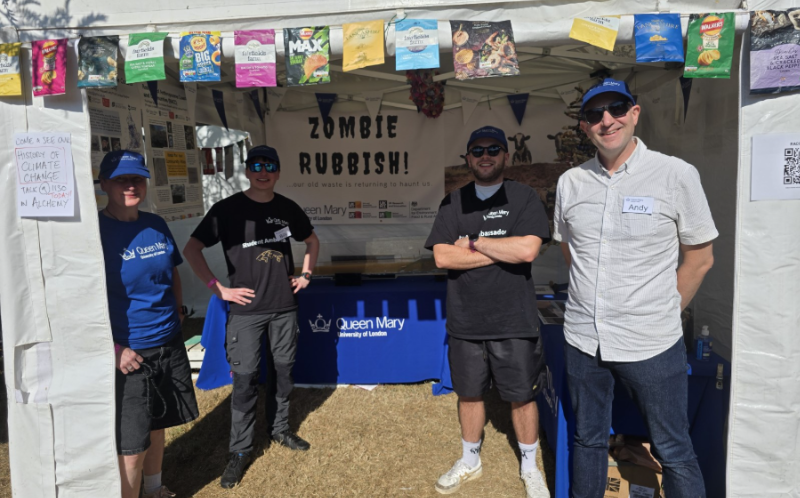
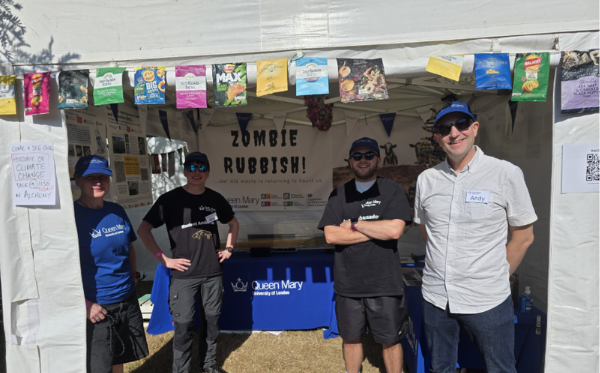
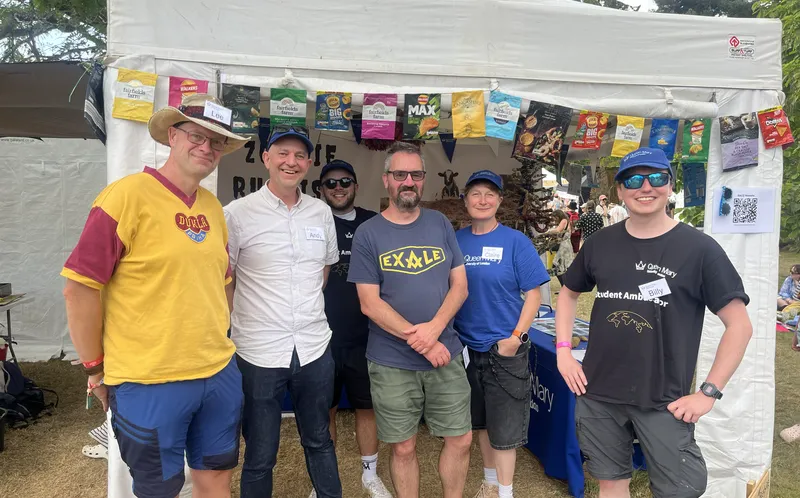
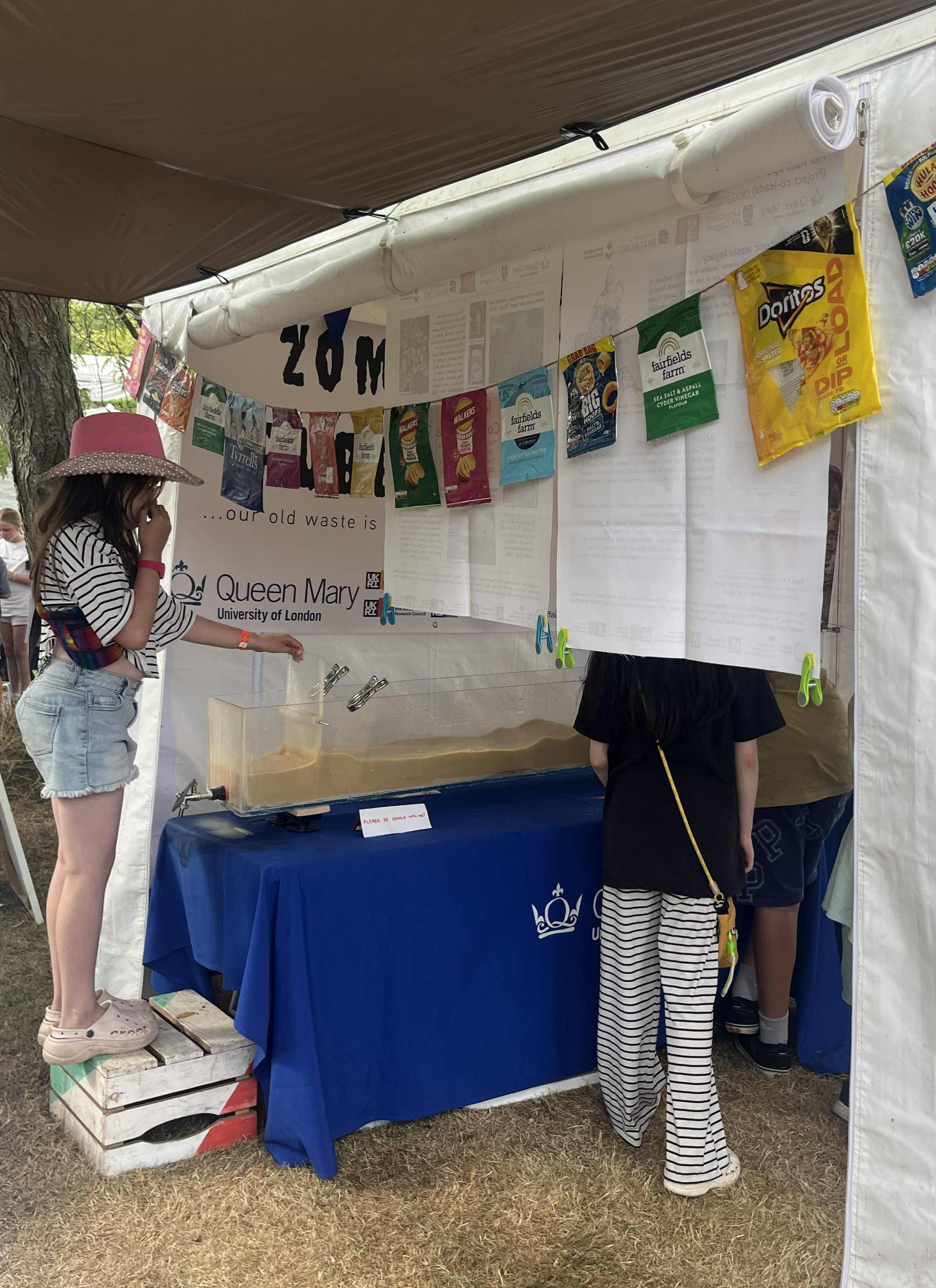
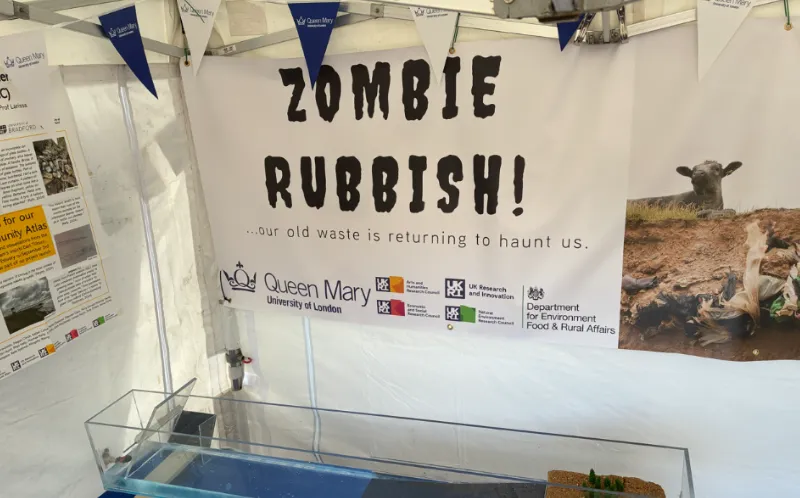
Our stall was made up of several activities to engage different age groups - all drawing on the theme of our old waste returning to haunt us! We had a wave tank, an interactive pinboard map, a ‘Trash, toxic or treasure’ game, a dot questionnaire, and informational posters. We decorated our gazebo with crisp packet bunting, garlands made from recycled textiles and even a repurposed Christmas tree.
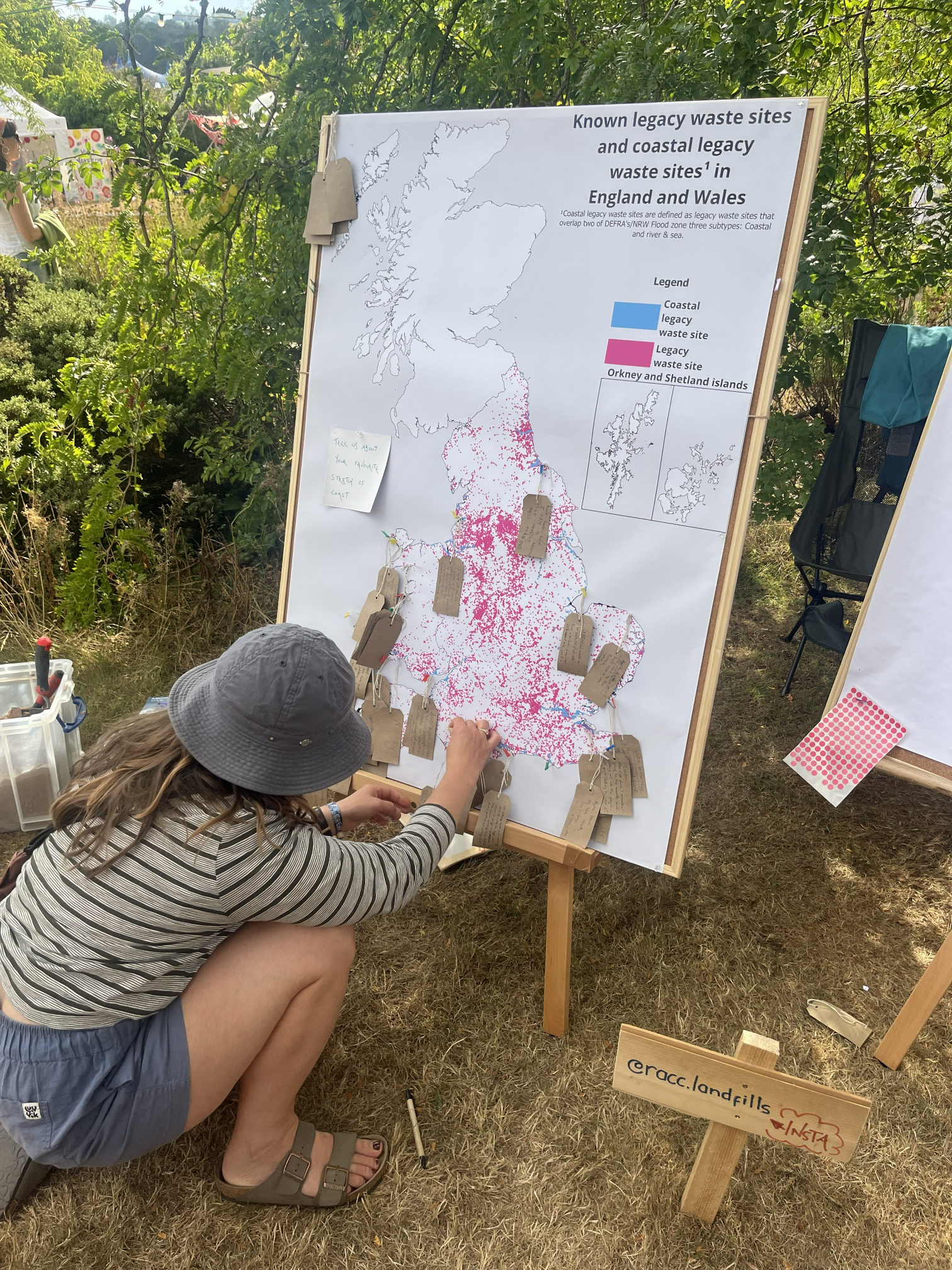
- The pinboard map was aimed at all age groups, here we asked for any coastal experiences and memories that could be linked to a particular coastline. Participants were given a luggage tag to pin this memory and location onto the map.
- Trash, Toxic or Treasure: Three jar containers were brought along and filled with compost. Then examples of legacy coastal waste were divvied out to each jar and a question was posed: Which was Trash, Toxic or Treasure? The idea is that each jar could be described as any of the three highlighting the difference in how the value of 'waste' is perceived depending on who you are.
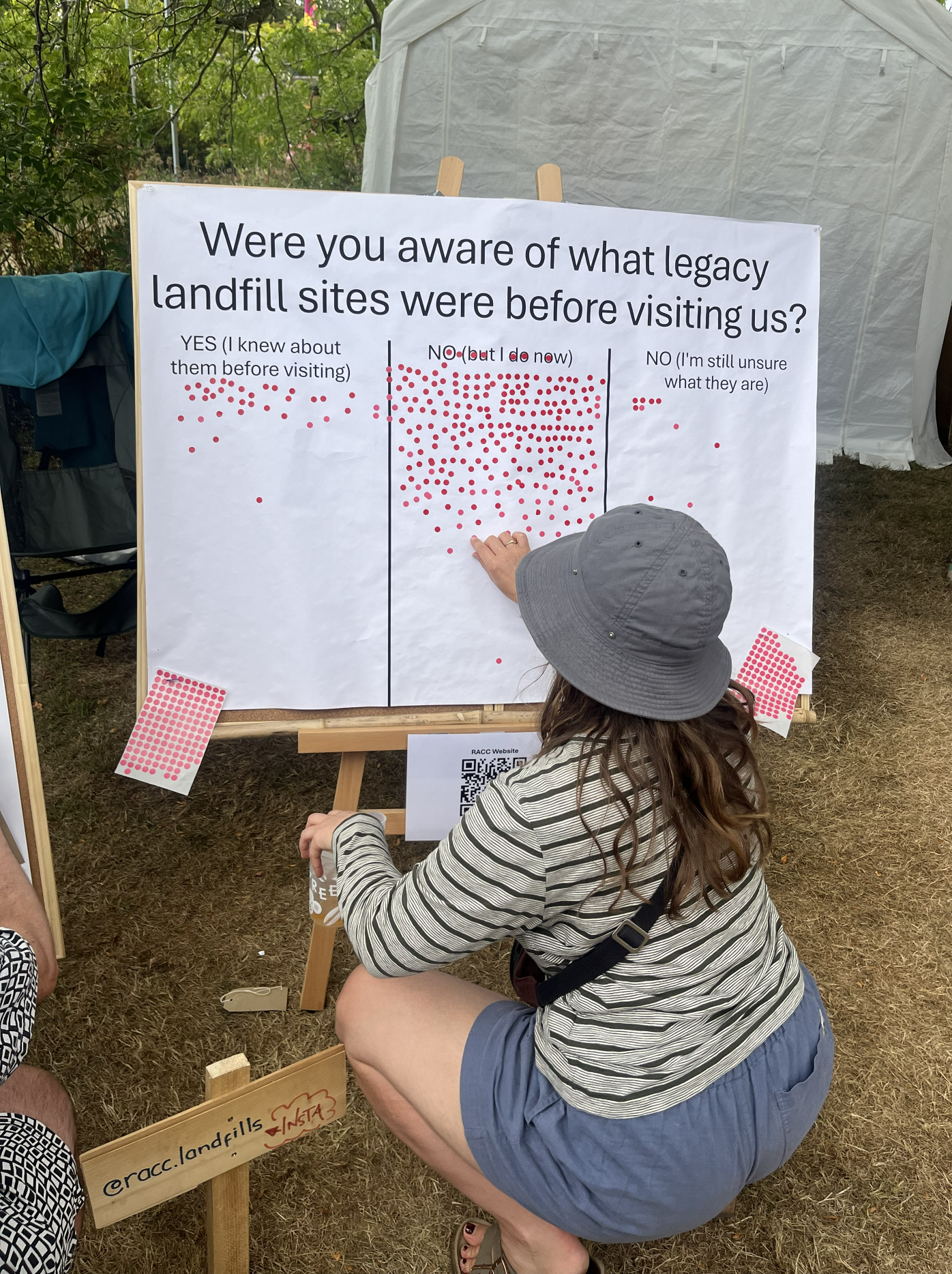
- Dot Questionnaire: Three options were created to enquire about the baseline knowledge of the festival goers on legacy landfill sites before interacting and after interacting with the stall. This was useful to assess awareness of the issue, and evaluate our impact as a stand.
- Dr Andy Russell (project Co-Lead) built a working wave tank as well as multiple "cliffs" with different materials displaying waste. The cliffs were placed into the wave tank to be gradually eroded away by stall members and festival goers. This would visualise the process of coastal erosion, and what happens to the waste from these sites as they are impacted by climate change.
- Fossil dig & Christmas trash tree: Reused from the RACC stall at the Lyme Regis Fossil Festival earlier in the summer, the fossil dig provides opportunity for young children to dig for fossils both modern and prehistoric in a sand box. The Christmas trash tree was a decorative piece made from disused materials and an abandoned Christmas tree to make audiences of all ages think about the waste they throw away and its potential to be reused.
- Waste map explorer: An app was developed to allow participants to view coastal legacy waste sites in England and Wales on an interactive map on an iPad. This enabled festival goers to search for coastal legacy waste sites near an area of interest to them. A QR code was also provided that would enable festival goers to access this map at a later date on a website.
- Posters: Several posters were created to share further information about the project with festival goers. One spotlighted seven sites of interest in England, Scotland and Wales where RACC have been undertaking field work (linked to the pollution research). The other map separated England into its 317 local authorities and displayed the number of legacy waste sites in each (linked to the policy research). People could engage with the posters in their own time without having to talk to the team.
- Face to face conversations with festival-goers aimed to discuss in further detail the work of the RACC project, highlight how this is a topic of relevance, answer any questions about this topic of legacy landfills, and share information about the next steps with RACC.
- Dr Andy Russell also did an interactive 1-hour talk and presentation at the Alchemy stage, on the 200-year history of climate science and policy, with a quiz embedded that linked key events with contemporary music. This also advertised our stall to festival goers that had not spoken to us yet.
- We also displayed a QR code that directed festival goers to an online survey that enabled them to tell us what they thought of the stall. There was also an opportunity there to directly contribute to the RACC research through answering some additional questions about their knowledge of legacy waste sites and their relationships with their local authority.
Please could you tell us more about how you translated your research through the activity?
All activities and all the content were carefully designed in a way that would be relevant and interesting to a festival goer with no prior knowledge on this topic. Interactive activities and posters were crucial in order to initially attract people to the stall, then once the conversation had begun the RACC staff could assess the level of detail to go into and the aspects of the project to talk about further based on the individual's baseline knowledge and areas of interest. Once the festival goer was engaged in conversation, whether that had stemmed from one of the interactive activities or another aspect of the stall, the following aspects would then support their continued engagement:
- Fieldwork information: The use of collected UAV/ phone imagery was collated into a poster to give participants a clear understanding of what these sites look like and what legacy waste items may contain. This was an effective way to highlight the differences in the sites; they come in all shapes and sizes and house a range of different waste. This was further complimented by having Billy Newman share firsthand experience of what it is like to be on the sites.
- Example rubbish: Different items collected from archeological digs of legacy waste sites and waste that had been released by the erosion of legacy waste sites were placed into secured jars for people to view without touching. Confirmed safe waste such as bricks and other materials were left on tables for people to pick up and view.
- Map creation: Curated maps relevant to RACC's research were displayed on posters around the stall. Participants were also encouraged to place pins of places that had value to them on the map that showed the known legacy waste sites across England and Wales, this helped festival goers directly connect with these sites. Online maps of waste locations were made publicly available for people to view afterwards to further build this direct personal connection to this topic, highlighting its relevance and supporting continued interest after they walked away.
How did festival-goers engage with the stall and the activities?
Overall we engaged with over 1,100 people across the three days. Of this, those who entered the stall did engage well and many spoke to the team for a significant amount of time. Further, some festival goers had very good baseline awareness and knowledge on the topic and those interacted in two-way knowledge exchanges; this is vital as it reminds us that engagement activities are not only opportunities for us to share knowledge but they are equally opportunities for us to learn from the public too.
A variety of feedback was collected through a range of interactions with festival goers. We had 55 different luggage tags pinned onto the pinboard map, representing 55 different emotional connections to favourite areas of coast in the UK. At least 45 people attended Andy's talk, that would later come to discuss his talk and learn about the RACC project at the stall. The dot question was the most successful interactive activity; receiving a total of 474 responses. 399 (85%) said that they had learnt about legacy landfills as a result of visiting our stall. This also showed us that only 59 people (12%) had already heard of the topic, an interesting finding in assessing baseline awareness on the topic.
The online form had a total of seven responses, with all saying they enjoyed the stall activities and conversations across their feedback.
From observation, we found the younger children were more engaged with activities such as the wave tank, as it was fun and interactive and allowed them to visualise the force behind how waves break our cliffside landfills. This proved a good technique to pull families into the stall, as once the children were engaged with that the adults were then free to talk about the rest of the stall. Adults were more engaged in activities that had some sort of personal and potentially emotional connection. Such as the luggage tag board or the app that shows the locations of legacy waste sites. The pin board allowed people to reminisce about fun times on the coast and the app allowed them to directly link the location of the legacy landfill sites in relation to them and their lives.
On the whole, the stall engaged all ages successfully, and it was a very rewarding and worthwhile experience that both increased awareness on the project and hopefully honed a sense of care and connection to the natural world amongst those that attended.
Here is a selection of comments from festival-goers:
- "I didn't realise that there were landfills by the coast"
- "Hadn't thought about landfill sites that would be crumbling into the sea"
- "Loved the zombie rubbish name, it really helps make the issue stick in your head"
Do you have any top tips for those that might be planning similar activities in the future?
- Come up with a quick 20 second elevator pitch about what your work is about, and how it is relevant to the audience.
- Practice and be prepared: We tested all activities before the festival to check for any last-minute glitches, and so those present were on the same page as to how everything works, mitigating against unexpected surprises.
- Use a quick interactive activity to initially attract people to the stall, the dot activity works very successfully.
- Ask questions to the festival organisers, they are eager to help you out with any issue.
- Expect anything that is reliant on the internet to not work and create offline backups (if in a remote location).
- Bring many battery packs if you are going off grid like at Green Man!
- Utilise QMUL resources effectively: Printing services, the public engagement team and more can provide tools and equipment.
- Count every interaction: We used a clicker counter to count how many people we talked to across the festival, we also assessed website usage online during and after Green Man.
SDGs supported:
- SDG 6: Clean water and sanitation
- SDG 13: Climate action
- SDG 14: Life below water
- SDG 15: Life on land
Queen Mary University of London is committed to driving action for the Sustainable Development Goals through our research, education, and engagement. Find out more about the SDGs at Queen Mary University of London.