
Impact of ULEZ on children’s lung function growth, 2026
A new study in Lancet Public Health showed that children’s lung growth restored when exposure to traffic-related air pollution is reduced.
Summary
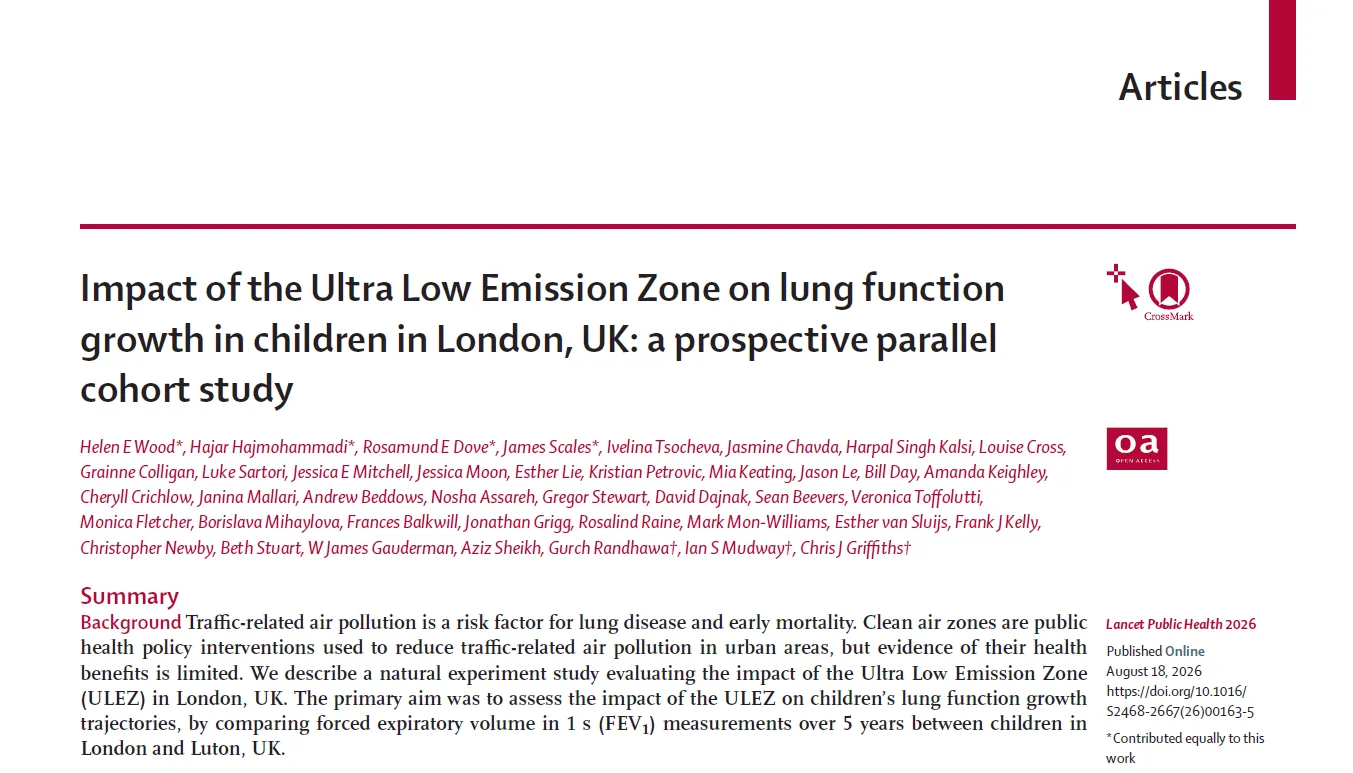
The CHILL Study aimed to find out whether reducing air pollution from traffic, following the introduction of London’s Ultra Low Emission Zone (ULEZ), improved children’s lung growth. The study involved 3,414 children aged 6-9 years: 1,664 in central London (within the ULEZ), and 1,750 in Luton (a comparable urban area without a clean air zone).
Researchers compared children’s lung function every year for five years using spirometry, a gold standard test of lung function. The key measure of lung function used in the study was FEV1, or forced expiratory volume in one second.
Before the ULEZ was introduced, children in London had worse air pollution exposure and lower lung function compared to children growing up in Luton. Researchers modelled exposure to nitrogen dioxide (NO2), a pollutant that is closely related to vehicle exhaust, was significantly higher in London by 19 μg/m³.
Over the following four years, London children’s air pollution exposure fell twice as fast and more than twice as much compared to children in Luton.
In the same period, children’s lung function improved faster in London, with annual growth in FEV1 being around 10 mL per year greater than in London.
London children’s lungs caught up to children in Luton.
Another measure studied was forced vital capacity, or FVC, which reflects lung volume. Before the ULEZ, London children had lower FVC too, by about 55 mL. By the end of the study, they improved significantly, but the gap between London and Luton children did not disappear, as London children still had lower average FVC.
Previous studies have shown that poor lung growth in childhood is linked with poorer respiratory health later in life. These findings suggest that harms in children’s lung growth and health can be restored, which has major implications for improving long-term children’s health.
This is the first evidence that clean air zones may benefit child development and supports its role as an important public health policy.
Key message
Improved air quality following London’s ULEZ is strongly associated with significant improvements in lung growth in children.
Read the publication
Find the publication online: https://www.thelancet.com/journals/lanpub/article/PIIS2468-2667(26)00163-5/fulltext