
“It gave patients and carers a way to be heard”: Co-producing a World Café on living well with COPD
Dr Ratna Sohanpal tells us about how PPI members helped to shape their COMPLEAT study World Cafe event.
/filters:format(webp)/prod01/channel_262/queen-mary-university-of-london/media/qmul/publicengagement/blog/Picture1.jpg)
Chronic obstructive pulmonary disease (COPD) is a progressive lung disease where the lung becomes inflamed and damaged and the airways narrow. This makes it harder for the air to move in and out of the lungs and makes breathing difficult. People living with COPD and other long-term health conditions often tell us the same thing: they want to live well and remain independent for as long as possible. Many are also looking for clearer information about the aids, equipment and assistive technologies that could help make everyday life easier.
The COMPLEAT study (Chronic Obstructive Pulmonary Disease – MulitPle LongTErm Conditions and Assistive Technology) funded by NIHR (National Institute for Health and Care Research) grew from earlier NIHR research exploring how assistive technology can support people with COPD. As part of this work, we wanted to create a space where people with lived experience could shape the direction of future research.
This led to the Living the Life You Want World Café, an event designed to bring together people living with COPD, other health conditions, carers, professionals working in health and social care in an open and relaxed environment to explore an important question:
How can assistive technology help people with COPD and other health conditions live independent and fulfilling lives?
Rather than a traditional meeting or workshop, the World Café approach encourages conversation, collaboration and creativity. Participants move between small group discussions, sharing ideas and experiences in a café-style setting designed to feel welcoming and informal.
But what made this event particularly meaningful was the way it was co-produced from the start.
Public and Patient Involvement (PPI) members played a central role in shaping the event. The initial PPI team of seven members (two people living with COPD and five family and friend caregivers) from previous research all expressed their interest in continuing their involvement into the COMPLEAT study. We recruited another two people living with COPD to join the COMPLEAT PPI team. The team were recruited via the NIHR People in Research platform and the Asthma and Lung UK charity.
The PPI team have been involved in the study throughout, including with development of the team manifesto and attendance in interdisciplinary and interactive training activities. For example, design process training invited PPI members to share lived experience through taking photos and discussing the photos related to problems with technology and solutions needed. This raised awareness and learning about the importance of including public voice in the design of the technology and learning about the design process involving public voice. The PPI members have also been sharing their reflections on research activities findings (e.g. World Cafe findings) to help generate ideas for future research and suggested areas of policy that could be influenced from our work. The PPI team have also been involved in developing dissemination outputs including this blog.
Related to the Word Cafe, from the early stages of planning through to the delivery and reflection afterwards, people with lived experience helped guide how the Café would work and what questions it would explore.
As Deb, a PPI contributor, explained:
- “I feel we were given a lot of opportunities to shape the design of the workshop. I did the online World Café training and felt that it gave me a good insight into the World Café model.”
Planning meetings included breakout discussions where contributors reviewed and refined the questions that would guide the day's conversations. Feedback was also provided on materials such as the invitation flyer to ensure the tone felt accessible and welcoming and an event information sheet to ensure attendees of the event were clear on what to expect from the event.
PPI members Al, Mary and Steve suggested changes to the flyer such as:
- “remove term ‘professional’, instead state ‘Do you work in the health and social care for people with COPD/other health conditions?’”
- “you could use this wording ‘how people can use assistive technology to support them live a more independent and inclusive life’”
- “Make the QR code bigger”
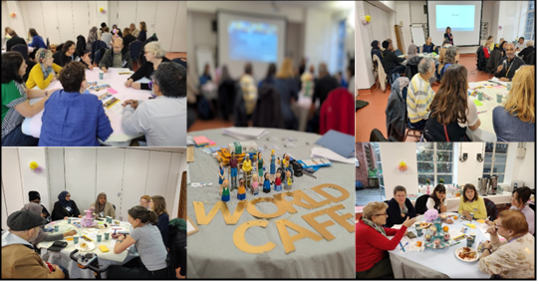
The event was held at the Brady Arts and Community Centre, on the morning of 14 November 2025. On the day itself, the event hall was decorated into a café-style environment to help create a space where people could talk openly about their experiences.
Anne, a public contributor described the atmosphere:
- “What a wonderful opportunity to attend the World Café in London. Here I was able to discuss alongside other attendees our experience of living or supporting someone with COPD in a relaxed café environment at tables set out with cakes and drinks. Sitting together as complete strangers we were free to have open discussions and offer each other mutual support, with facilitators encouraging and guiding the conversations.”
The setup encouraged different ways of sharing ideas. Paper tablecloths and pens allowed people to jot down thoughts, draw, or contribute in writing if they preferred.
Anne added:
- “The paper tablecloths and pens provided an alternative fun way for anyone more comfortable to contribute non-verbally, to draw or write their views. Overall, a very productive and enjoyable day.”
PPI members also helped facilitate the discussions at the tables, ensuring everyone had the chance to contribute.
Deb reflected on the impact of this approach:
- “I attended the World Café on the day to help facilitate one of the tables. The interactive style and the way people were able to write things on the tablecloth meant that we got quite a lot of opinions from all the different people there. It gave patients and carers a way to be heard and has given the researchers rich data to reflect on. It was a pleasure to be part of this.”
The collaboration didn’t stop once the event ended. Contributors were also involved in reviewing the findings and reflecting on what had emerged from the conversations.
PPI member, Mala, shared how meaningful it was to see lived experiences reflected in the outcomes:
- “It was heartening to see how much of the World Café findings reflected real-life experiences and priorities, especially the framing around living well that included dignity, self-management, connection and cultural relevance. I also valued the opportunity to hear different viewpoints during the meeting and to begin thinking about how the next phase of the work can continue to centre lived experience in an authentic and inclusive way.”
Reflecting on the process, Mala also highlighted important areas that may need further attention as the work develops. In particular, she emphasised emotional safety needs to be further explored when using assistive technology.
For some people, particularly those who are neurodivergent or managing trauma or chronic fatigue, emotional safety can influence whether a technology feels empowering or overwhelming. The design, language, tone and way a technology is introduced can all shape this experience.
Mala also reflected on the importance of recognising intersectionality in this work.
Factors such as culture, gender roles, digital literacy, caring responsibilities and stigma can shape how people engage with healthcare services and assistive technology. Within some communities, conversations about illness or mental health may be difficult, and carers may carry complex responsibilities that often remain unseen.
For Mala, being part of the project meant more than simply offering feedback.
- “What felt most meaningful to me was that this was not a single point of consultation, but an ongoing and iterative process in which our input genuinely influenced how the event was shaped and how the findings were interpreted.”
She explained that bringing different lived experiences into the discussion helped ensure the research reflected real priorities rather than assumptions.
- “For me, co-production is about influence, accountability and shared ownership of the work’s direction. Through the training, planning conversations and review of findings, I felt there was genuine space to challenge, refine and strengthen the study in a way that respected lived expertise. That is what made this process feel meaningful rather than symbolic.”
The World Café brought together 19 people, including individuals living with COPD and other health conditions, family caregivers, and health and social care professionals. An advert developed with the PPI team was circulated among patient and carer networks and professional networks known to the research team.
The insights from the World Café are already helping to shape the next stages of the COMPLEAT study and future research into assistive technology for people living with COPD and other long-term conditions.
Most importantly, the conversations reminded us that technology alone is never the whole answer. What matters is how it fits into people’s lives, identities, relationships and daily realities.
And when people with lived experience are involved from the beginning, research is far better placed to support what matters most: living the life you want.
The World Café was led by the COMPLEAT Team from universities in London, Manchester, Exeter, Aberdeen, Sunderland and Hull, the Real Disabled People’s Organisation and the Tower Hamlets Community for Voluntary Services.