Latest News and Events
Associate Principal Investigator (PI) Scheme

The Associate PI Scheme is a six-month, in-work training programme designed to support healthcare professionals who are interested in developing research leadership skills and gaining practical experience in the delivery of clinical research. Participants work alongside their local Principal Investigator (PI), contributing to study delivery while completing a structured learning pathway and checklist of study activities. Successful completion leads to formal certification from the NIHR and participating Royal Colleges.
Why get involved?
The scheme provides an excellent opportunity to:
- Gain hands-on experience in the conduct and delivery of a national research study.
- Develop skills in research leadership, participant recruitment, study management and site coordination.
- Work closely with an experienced local PI and research team.
- Receive formal recognition of your contribution to NIHR Portfolio research through Associate PI certification.
- Enhance your research portfolio and support future academic and clinical career development.
Who can apply?
The scheme is open to doctors, nurses, allied health professionals, pharmacists and other healthcare professionals who wish to make a significant contribution to the study at their local site over a period of at least six months.
How can sites get involved?
Sites participating in the study are encouraged to identify suitable staff members who may benefit from joining the Associate PI Scheme. Interested individuals should discuss participation with their local Principal Investigator and research team.
Further information about eligibility, registration and the Associate PI learning pathway can be found on the NIHR Associate PI Scheme website:
NIHR Associate Principal Investigator Scheme
If your site would like to nominate an Associate PI or would like further information about participating through this study, please contact the study team.
Study recruitment extension
We have submitted a non-substantial amendment (NSA 65) to extend the recruitment end date to 31st December 2030. An email was sent out to all sites with the submission confirmation and amendment pack; if you require this, please contact the registry team.

European ITP Registry Study on Second-Line and Maintenance Therapies
The UK Adult ITP Registry contributed the largest cohort to a major European study of over 5,000 adults with primary ITP. Published in Haematologica, the study examined real-world use of second-line and beyond (“maintenance”) treatments in adults with primary immune thrombocytopenia (pITP). Using harmonised data from six national prospective registries (UK, France, Italy, Norway, Germany, and Switzerland/Serbia), the study included over 5,000 adult patients diagnosed between 2010 and 2022, making it one of the largest analyses of ITP treatment patterns in Europe to date.
The study found that around 40% of patients required at least one maintenance therapy, and approximately 20% required two or more lines. Over the last decade, there has been a clear shift in treatment practice, with increasing use of thrombopoietin receptor agonists (TPO-RAs)—particularly eltrombopag—and a corresponding decline in the use of rituximab, other immunosuppressants, and splenectomy. These trends were observed across most countries, although substantial variation in treatment choices remains between nations, reflecting differences in national guidelines, regulatory restrictions, and clinical practice.
TPO-RAs are now increasingly used earlier in the disease course, likely due to their high response rates, favourable safety profile in most patients, oral administration (for eltrombopag), and the possibility of treatment-free remission after discontinuation. In contrast, splenectomy has been largely repositioned to later lines of therapy.
Importantly, this study demonstrates the feasibility and value of collaboration between European ITP registries, using a common data extraction model and analysis plan without sharing patient-level data. The observed heterogeneity in treatment strategies highlights the importance of continued cross-national registry studies to better understand real-world practice and optimise patient-centred care in ITP.
The paper can be downloaded from: https://haematologica.org/article/view/12138
Paper on AI/ML and ITP
We are pleased to announce the publication of our first paper on Artificial Intelligence (AI) & Machine Learning (ML) and its application in ITP, titled ‘Can Machine Learning Assist in Diagnosis of Primary Immune Thrombocytopenia? A Feasibility Study’. This was a joint collaboration with the School of Electronic Engineering & Computer Science, Queen Mary University of London.
We look forward to building on this work and further exploring the field of AI/ML and its application in healthcare.
The paper can be downloaded from https://www.mdpi.com/2075-4418/14/13/1352.

Data and AI
Substantial Amendment 8 - Change of Study CI
 We have submitted a substantial protocol amendment to notify the change of CI for the UK Adult ITP Registry Study. Dr Frederick Chen (right) has taken over the role of Chief Investigator (CI), form Dr Vickie McDonald. The REC favourable opinion and HRA/HCRW approvals were received on 9th October 2023. The substantial amendment pack with all the documents and approvals can be downloaded from the following link:
Substantial amendment 8 pack for sites [10,348KB]
If you have any questions, please do not hesitate to contact us.
Blood sample collection
The ITP Registry team is now accepting blood samples from all sites again.
If there are any patients who have previously consented to donating bloods for the registry study but you have not taken any bloods due to the hold, please go ahead and obtain the bloods from the relevant patients when they next attend your hospitals/clinics.
Full details relating to the blood sample collection aspect of the protocol can be found in the following link.
Updated database to capture COVID-19 data
The REDCap database for the UK Adult ITP Registry has been updated to include COVID-19 infections in ITP patients, and can be found under the comorbidities section of the REDCap database, as with other infections. This is a simple dataset capturing information about the severity of ITP. We will also capture vaccination.
Whilst updating the database, we have also added Fostamatinib and Avatrombopag as treatment options. A minor amendment has been processed and the data capture forms have been updated accordingly.
Do let us know if you have any questions around this.
Remote consenting - Updated study documents
We have recently updated our protocol and related study documents to enable sites to consent potential patients remotely, i.e. not requiring to see the patient in person in hospital/clinic. The amendment pack has been sent to all sites and can be implemented with immediate effect.
The latest study documents can be found on the following link.
Statement on COVID-19
Due to the COVID-19 outbreak in the UK, there is a possibility that sites may not be able to recruit patients into the registry. Patient safety is paramount and we understand if hospitals decide to halt recruitment for the UKITPR in line with their local policies and use clinical staff aligned to research projects to support NHS resource demands. You do not have to inform us that this is the case; please proceed as instructed by your local research management teams.
In addition to this, we are requesting for sites to not collect or send DNA samples for patients in the ITP registry until further notice. We will keep you posted with further developments as needed.
Thank you for your hard work.
Please do not hesitate to contact us if you have any questions or concerns.
UK Adult ITP Registry – Update January 2020
Moving into 2020, and after a very busy 2019, we are delighted to inform you that 2019 was the highest recruiting year on record for the UK Adult ITP registry with a total of 544 adults recruited. In addition to this, 19 patients have been recruited to the pregnancy registry.
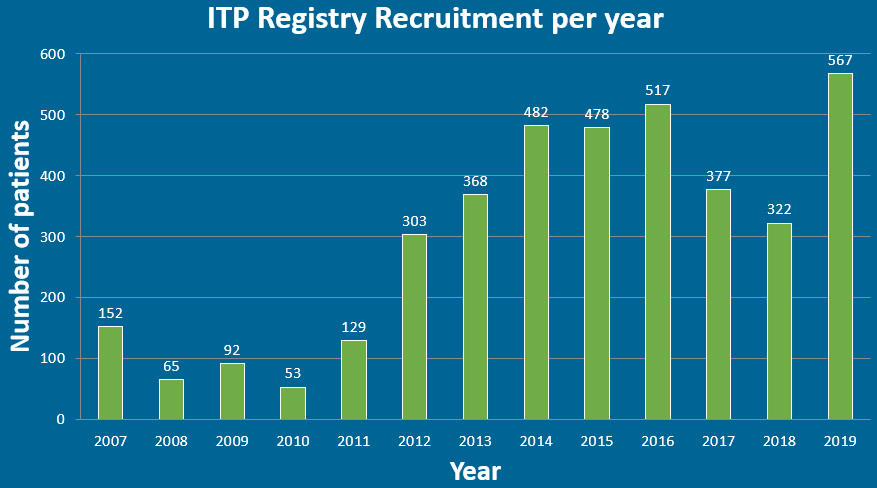
Ahead of the next newsletter, we wanted to share this news and say a big thank you to all the teams involved for the hard work. We look forward to further development of the registry in year ahead.
Wishing you all a very happy and productive 2020.
Recruitment activity on the Central Portfolio Managment System
You may already be aware that participant entry into the NIHR Central Portfolio Management System (CPMS) for trials is changing. As of 1st June 2019, sites are expected to upload their own recruitment figures on to a Local Portfolio Management System (LPMS). This can either be EDGE, ReDA or an alternative system, depending on whether your site is in England, Northern Ireland, Scotland or Wales.
This will have an impact on how recruitment to the registry is recorded. The new process will be as follows:
-
Sites consent the patient locally.
-
Sites upload their recruitment onto their LPMS. This then feeds through onto the CPMS.
-
Sites send their signed consent forms and updated participants logs to the UK ITP Registry inbox.
-
At the beginning of each month, the UK ITP Registry team will review the recruitment figures uploaded onto CPMS from the previous month and correlate with the participants logs received from each site to ensure there are no discrepancies.
-
Any discrepancies identified will be raised with the sites/NIHR as relevant.
-
Once resolved, UK ITP Registry team will confirm recruitment for that month.
If you haven’t sent through the consent forms and participant logs for all patients consented before 31st may 2019, please can you send these through as soon as possible, so that we can ensure that the recruitment figures on CPMS are correct up to the changeover.
If you have any queries relating to transition, please do not hesitate to contact us.