Our Study
Improving Dementia Diagnosis with Hearing Tests
We often take for granted how hard our brains work to interpret sounds in everyday life. For instance, understanding speech amid background noise demands a significant amount of mental effort. Over two decades of research, we have demonstrated that dementia impacts this type of hearing even before other symptoms appear. Therefore, we are developing simple hearing tests to detect subtle changes in the brain.
Diagnosing dementia remains a huge challenge. On average, it takes over three years to receive a diagnosis from the onset of symptoms. A timely and accurate diagnosis empowers individuals to understand their symptoms, plan for the future, and seek appropriate treatments. Early diagnosis will be crucial for accessing future treatments that may slow the progression of dementia. Unfortunately, current diagnostic tests are blunt and expensive, often leading to later and less accurate diagnoses for those who are more deprived or from minoritized ethnic groups.
Innovative hearing tests that can detect early brain changes associated with dementia have the potential to transform this scenario. These tests have the potential to be sensitive, relevant, easy to administer, and effective across diverse populations.
"We desperately need better ways of measuring changes in brain function to support improved diagnosis in memory clinics. Our digital hearing tests measure how well the brain can process sounds. We hope that this will be a relatively quick and easy addition to memory clinic assessments that can be used alongside brain scans and new blood tests for Alzheimer’s disease to allow us to be more precise about who is developing dementia and who has other causes of memory problems. This could improve diagnosis across different cultural and educational backgrounds and support equitable access to future treatments for dementia."
- Prof Charles Marshall, Chief Investigator
Year One: Laying the Foundation
We will begin by piloting and refining a digital auditory battery (i.e., a set of hearing tests) within a research cohort. This initial phase will involve testing the tool on individuals diagnosed with Alzheimer’s disease and healthy controls at University College London (UCL). By analyzing the results, we aim to fine-tune the tool to ensure it accurately reflects cognitive differences between those with Alzheimer’s and healthy individuals.
Year Two: Expanding to Diverse Populations
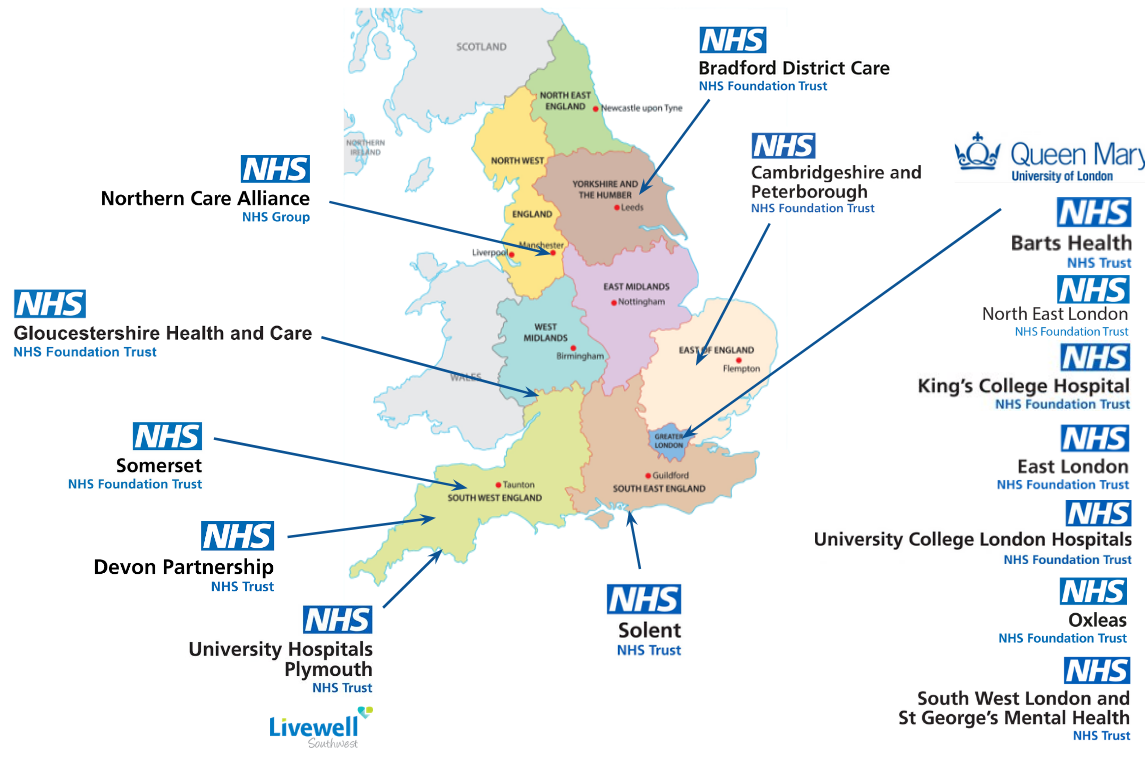
In the second year, we will expand our study to memory clinics serving a diverse inner-city population. Please see the image below for the partner sites involved in DIADEM. We will recruit 500 patients, including those with mild cognitive disorder (MCD), Alzheimer’s disease, and other memory conditions, as well as 100 healthy controls. These participants will undergo digital auditory testing, and we will collect detailed clinical and demographic information. Additionally, we will obtain plasma samples to measure emerging blood-based biomarkers of Alzheimer’s disease. This data will allow us to explore the potential of combining auditory and blood biomarkers for diagnosing and monitoring cognitive changes.
Years Three and Four: Longitudinal Follow-Up
Understanding how cognitive abilities evolve over time is crucial. In the third year, we will follow up with all participants through online assessments. In the fourth year, they will be invited back for in-person evaluations. During these follow-ups, we will conduct longitudinal auditory testing to track changes in cognitive function. For participants with mild cognitive disorder, we will assess the progression to dementia, while for those with Alzheimer’s, we will monitor changes in disease severity.
Year Four: Building for the Future
In the final year, we will concentrate on two key objectives. First, we will evaluate the effectiveness and cost-efficiency of the digital auditory biomarkers, both individually and in combination with blood biomarkers. Second, we will develop a user-friendly web platform, co-designed with input from both users and clinicians. This platform will undergo validation across multiple NHS sites, preparing it for broader implementation. Additionally, we will establish a larger population cohort to support future research and clinical applications, enabling the detection and monitoring of cognitive decline on a larger scale.
Our Research Objectives Are To:
To Develop and Evaluate Digital Hearing Tests for Dementia Prognosis:
- Objective: Develop and assess new digital hearing tests that measure early brain changes associated with dementia.
- Explanation: We will implement these tests in memory clinics that serve a diverse and underserved population. By recruiting 500 patients undergoing dementia evaluation and 100 healthy controls, we will test how well these hearing tests identify dementia at the initial assessment and predict its progression over 2 years. This could lead to earlier treatment for those with dementia and earlier reassurance for those without, while also evaluating the added value of combining these tests with emerging blood biomarkers.
To Design a Web-Based Platform for Risk Prediction:
- Objective: Create an online platform for using digital hearing tests to predict an individual’s risk of developing dementia.
- Explanation: This platform will facilitate the integration of digital hearing tests into both research and clinical settings. It will allow for streamlined risk assessment and monitoring, making it easier to apply these tests in real-world environments.
To Investigate Acceptability, Cost-Effectiveness, and Added Value:
- Objective: Explore the public’s acceptance of the technology and evaluate its cost-effectiveness for NHS use.
- Explanation: We will engage with the public to understand how they perceive the technology’s value and acceptability.
Research in the News
If you are interested in exploring this research area further, we’ve gathered some useful links below. These resources offer background information and additional perspectives on current research being done. Feel free to click on the links to learn more.
First-of-its-Kind Test Can Predict Dementia up to Nine Years Before Diagnosis
Alzheimer’s Blood Test Could Help Early Diagnosis and Direct Treatment.
Alzheimer's Test Less Invasive With New Technique
Dementia: Brain Check-up Tool Aims to Cut Risk at Any Age
Funder, sponsor, and collaborators