
Student contributes to space mission aboard the International Space Station
Ziyaad Ahmed Mohamed, a Physics student at the School of Physical and Chemical Sciences, has contributed to the SCAMPI project (Saltwater Crustaceans, Algae, and Microbial Population Investigation), a research initiative launched aboard NASA’s recent SpaceX CRS-35 mission to the International Space Station (ISS).
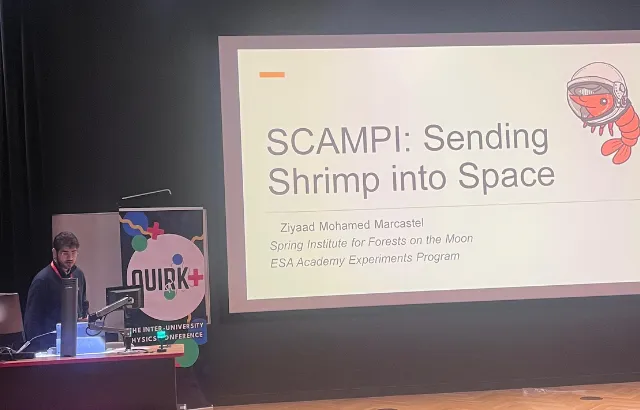
Supported by the European Space Agency (ESA) Academy Experiments Programme, the student-led SCAMPI project brings together 51 students from 11 institutions across Europe and the United States. The experiment will spend 90 days in orbit, studying a sealed aquatic ecosystem containing three Hawaiian shrimp (Halocaridina rubra), macroalgae and millions of microbes.
By investigating how these organisms interact in microgravity, the project aims to improve understanding of how entire ecosystems function in space. Its findings could contribute to the development of future life-support systems that recycle air, water and nutrients to support astronauts on long-duration space missions.
Ziyaad contributed to the systems engineering side of the project, drafting technical documentation and laboratory reports based on the experimental team’s findings and ensuring they met European Cooperation for Space Standardization (ECSS) requirements.
His involvement will continue into the next phase of the mission as a remote operator. Queen Mary’s involvement is also growing, with three more students joining the team: Ben Schmitt (Physics EuroMasters), alongside Andreas Poimenidis and Yusef Harb from the School of Engineering and Materials Science.
It’s exciting to see Queen Mary students applying their academic knowledge to real-world challenges, developing valuable technical and problem-solving skills, and gaining experience that prepares them to thrive in the space sector and beyond.