AI learns complex plasma physics to help make large-scale simulations more efficient
Researchers at Queen Mary University of London develop a machine-learning approach that enables a simpler plasma model to reproduce complex particle-level behaviour, potentially opening a route to faster simulations of collisionless plasmas.
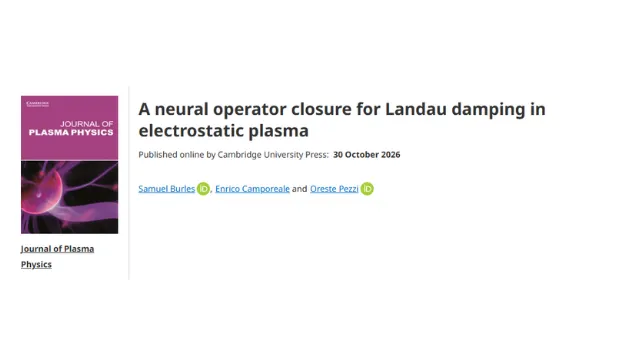
Researchers at Queen Mary University of London have used artificial intelligence to teach a computationally efficient plasma model how to reproduce complex kinetic behaviour that is normally difficult and expensive to capture.
The study, A Neural Operator Closure for Landau Damping in Electrostatic Plasma, introduces a machine-learning “closure” that allows a fluid simulation to account for kinetic effects associated with Landau damping.
The work, led by PhD student Samuel Burles from the School of Physical and Chemical Sciences and in collaboration with researchers from the Institute for Plasma Science and Technology from the National Research Council of Italy, uses a type of machine-learning model called a Fourier Neural Operator (FNO). Rather than attempting to model every particle interaction directly, the neural operator learns how unresolved, small-scale kinetic physics influences the larger-scale quantities represented by a fluid model.
Plasma is a complex, multi-scale state of matter in which processes occurring at microscopic scales can influence behaviour at much larger scales. Capturing these effects accurately using kinetic simulations can be computationally prohibitive because such models must resolve the distribution of particles across both position and velocity.
"Fluid models are much less computationally demanding, but simplifying the underlying physics means that important kinetic effects can be lost. A key challenge is, therefore, the closure problem: when the equations describing a plasma are simplified into a fluid model, additional information is needed to represent the effects of the physics that have been left out. The quality of this closure determines how much of the underlying kinetic physics the fluid model can retain," says PhD student Samuel Burles from Queen Mary University of London.
The researchers used Landau damping as a test case. This is a fundamental collisionless plasma process in which an electrostatic wave loses energy through its interaction with particles.
Traditional closures for Landau damping have largely been developed from analytical theories that describe particular physical regimes. The new approach instead learns the required closure from kinetic simulations using machine learning.
A key feature of the study is how the neural operator was trained.
Rather than training the AI simply to reproduce individual snapshots from a kinetic simulation, the researchers embedded it directly within a differentiable fluid solver. The model was trained by comparing the trajectories produced by the complete fluid simulation with the corresponding kinetic evolution.
This approach is designed to address a practical problem with machine-learning closures: a model that looks accurate when tested on individual data points does not necessarily remain stable when it is allowed to influence a simulation over time.
The researchers found that a single trained neural operator reproduced both linear and nonlinear Landau damping, remained numerically stable in independent fluid simulations, and generalised to initial perturbation amplitudes that were not included in its training data.
The model was also given a form of memory. Instead of looking only at the plasma's current state, it receives a trailing window of recent resolved plasma behaviour. This reflects the fact that unresolved kinetic dynamics can retain information about the system's previous evolution.
The researchers' analysis found that the model's use of this history was structured rather than uniform, with its sensitivity concentrated at time lags related to the oscillation period of the plasma wave.
Importantly, the researchers did not find that the AI needed to reproduce the kinetic heat flux exactly at every point.
Instead, the learned heat flux acted as an effective closure: it reproduced the evolution of the resolved plasma quantities even though the learned quantity itself did not necessarily match the kinetic heat flux point-by-point.
"This suggests that, when embedded in a numerical solver, the useful role of a machine-learned closure may be to reproduce the influence of unresolved physics on the quantities that the larger-scale simulation actually evolves, rather than to recreate every microscopic quantity exactly." adds Dr. Enrico Camporeale from Queen Mary.
The approach could ultimately help researchers carry out larger or more computationally demanding plasma simulations while retaining effects that would otherwise require much more expensive kinetic modelling.
For space plasma research, this is potentially significant because kinetic processes are important across many plasma environments. However, the present study is a fundamental modelling demonstration rather than a new space-weather forecasting system.
The researchers tested generalisation across initial perturbation amplitudes for the particular one-dimensional electrostatic Landau-damping problem studied. Broader generalisation across other physical parameters and plasma regimes remains an area for future work.
The study, therefore, provides a step towards machine-learned plasma closures that could eventually be incorporated into larger-scale fluid simulations, helping bridge the gap between computationally expensive kinetic models and more efficient fluid descriptions.
DOI: https://doi .org/10.1017/S0022377826102517
Related items

 News story:
Queen Mary launches pioneering engineering education partnership in Thailand
28 October 2026
 News story:
Why understanding tyre wear is key to developing more sustainable transport
27 October 2026