
ESA announces ambitious seven-spacecraft mission to unlock the mysteries of the plasma universe, with help from Queen Mary University of London
A major European Space Agency (ESA) mission to investigate some of the most fundamental processes in the Universe has taken a significant step forward, with Queen Mary University of London playing a key role in its development.
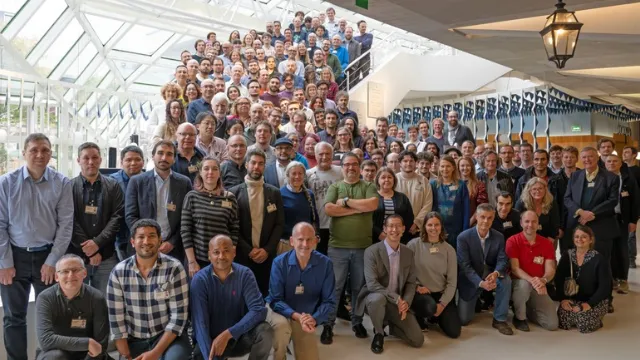
The Plasma Observatory team. Credit: Michaël Bazin / A group photo of about 100 people standing on and at the foot of a large staircase in a well-lit room.
ESA has announced that its member states have selected Plasma Observatory, an ambitious seven-spacecraft mission designed to explore how energy is transferred and transformed in space plasmas, as its next medium-class science mission.
The new mission will tackle some of the biggest unanswered questions in space physics, including how particles are energised in shockwaves, turbulence and magnetic reconnection, and how energy flows through Earth's magnetosphere. These processes lead to phenomena ranging from space weather to some of the most energetic events in the Universe.
Dr Heli Hietala, Royal Society University Research Fellow and Senior Lecturer in Space Plasma Physics at Queen Mary, has been involved in the mission since its original conception and proposal. During the most recent two-year study phase, she worked within the mission's core team, helping to prepare the scientific and technical materials assessed during ESA's review process.
Several researchers from Queen Mary's Space and Astrophysical Plasmas Group also contributed to the mission development through their work during the study phase.
Dr Hietala said:
"This selection is an important milestone for Plasma Observatory and excellent news for Queen Mary. The mission's scientific objectives are closely aligned with the research strengths of our plasma physics group: understanding these processes, their impacts as well as multi-spacecraft techniques
"I have been involved in the mission since its earliest stages, and it has been a privilege to contribute to the development of a mission concept that has the potential to transform our understanding of fundamental plasma processes throughout the Universe."
The selection reinforces Queen Mary's growing reputation in space science and astrophysics, with researchers contributing to international collaborations that address some of the most challenging questions about the nature of the Universe and our place within it.
More information on the mission can be found here: https://www.esa.int/articles/about-us/directorates/science/seven-spacecraft-observatory-to-study-plasma-universe
Subscribe to Queen Mary Connect for the latest research and innovation news.
Related items
 News story:
Scientists uncover how the spine's smallest structures help discs withstand everyday loads
4 November 2026
 News story:
James Busfield recognised with prestigious international tyre industry award
4 November 2026
 News story:
Global wildlife trade involves more than 100,000 species, new study reveals
3 November 2026