
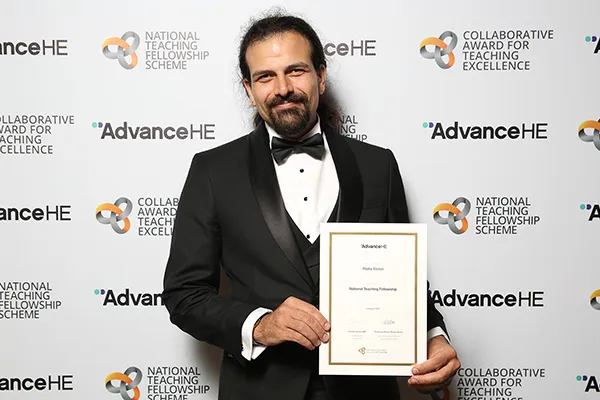
IHSE’s Dr Pedro Elston was recently awarded a National Teaching Fellowship. We caught up with Pedro to reflect on the co-development of the blended learning Graduate Entry Medicine programme (GEP), a cornerstone of his NTF application; how it has improved the student experience; and what Pedro learnt along the way.
Co-developing the blended learning Medicine programme, with students
The idea of introducing asynchronous elements to the medical curriculum was prompted by discussions about supporting medical students whose studies had been disrupted by the conflict in Ukraine. As Pedro worked to make QMUL’s online learning materials available to Ukrainian students, he began to reflect on some of the barriers to learning faced by students closer to home. Cost-of-living pressures, employment commitments, commuting and caring responsibilities can all limit the time and energy available for study. Redesigning some elements of the curriculum as asynchronous learning gave students protected time for independent study and greater flexibility over where and when they learned.
Students were involved throughout the programme’s development. Early focus groups helped the team decide which activities were suitable for asynchronous study and how the week might best be organised. However, Pedro highlighted that some of the greatest value came from involving students in the more practical aspects of developing the programme, citing the example of students helping produce introductory videos. Sitting behind the camera, they gave academics immediate feedback, encouraging them to slow down, include humour or more clearly express their enthusiasm for the topic – things Pedro admitted he would likely never have thought of. These apparently small changes helped students see their teachers as people they could connect with and approach for support.
Pedro also highlighted the value of involving students in the evaluation of the programme. Their interpretation sometimes differed significantly from that of academic staff, highlighting concerns and priorities that educators might otherwise have overlooked. “It since has made me rethink, anytime I'm looking at survey data or transcripts, I'm coming in with such different biases and viewpoints than a student that actually lives that experience”, he explained.
The evaluation indicated that students performed at least as well academically as before, while reporting considerable benefits to their everyday lives. Flexibility gave them greater agency and made it easier to balance demanding medical studies with other responsibilities. Pedro noted, however, that GEP students come to the programme having already developed their study skills and effective strategies for learning at university; greater scaffolding and support would likely be needed for students new to university study.
Reflections and lessons for improving the student experience
Reflecting on the project, Pedro shared that, in future, he would involve students even earlier. “Some of the base concepts of the project had already been fixed, we'd sort of settled on doing two days asynchronously for example”, he explained. “Maybe some of these were unavoidable, but it would have been really nice to have students in the initial brainstorming phases to think about, well, what could this whole thing look like?” Improving the student experience begins with listening carefully, but its success depends on designing structures through which students can genuinely influence what happens next.
Pedro also reflected on the opportunities and challenges offered by the different perspectives and ideas that students bring. “I don't know that necessarily the way in which we've gone about our asynchronous materials is the only way we could have done it”, he said, going on to explain that spending more time investigating and understanding the barriers to learning, with students, might have led to more ideas on how to give students greater choice and flexibility in how they study. However, he also noted that creating a ‘blue-sky’ space while managing power dynamics can be challenging: “There will be times where students will say or want something that is completely impossible, but they won't know from their perspective that that's the case. You do have to be really careful not to just shut things down because I think then it damages that relationship. But there have been many things that I hadn't thought of at all.”
Finally, Pedro shared that he would like to make greater use of student personas in future. Students are not a single group - previous educational experience, digital access, financial circumstances and confidence with new technologies can all affect how they engage. While we might not be able to involve all students in decision-making on a project, constructing profiles and considering the needs of different groups of students can help ensure we design programmes and initiatives that improve the learning experience for everybody.
Hear more about the blended learning Medicine programme from Pedro himself, and from student partners Adrita and Joshua.
To find out more about working in partnership with students, check out Queen Mary Academy’s co-creation resources.