
An interview with Anna Sonander, Mimi Petersen, and Per Wickenberg about their edited book, Building a Sustainable Society Through Child Participation
Our members, Anna Sonander (Lund University, Sweden) and Mimi Petersen (University College Copenhagen (KP), Denmark), and their co-editor, Per Wickenberg (Lund University, Sweden), talk about their edited book, Building a Sustainable Society Through Child Participation: Nordic Research and Practical Application (Springer, 2026).
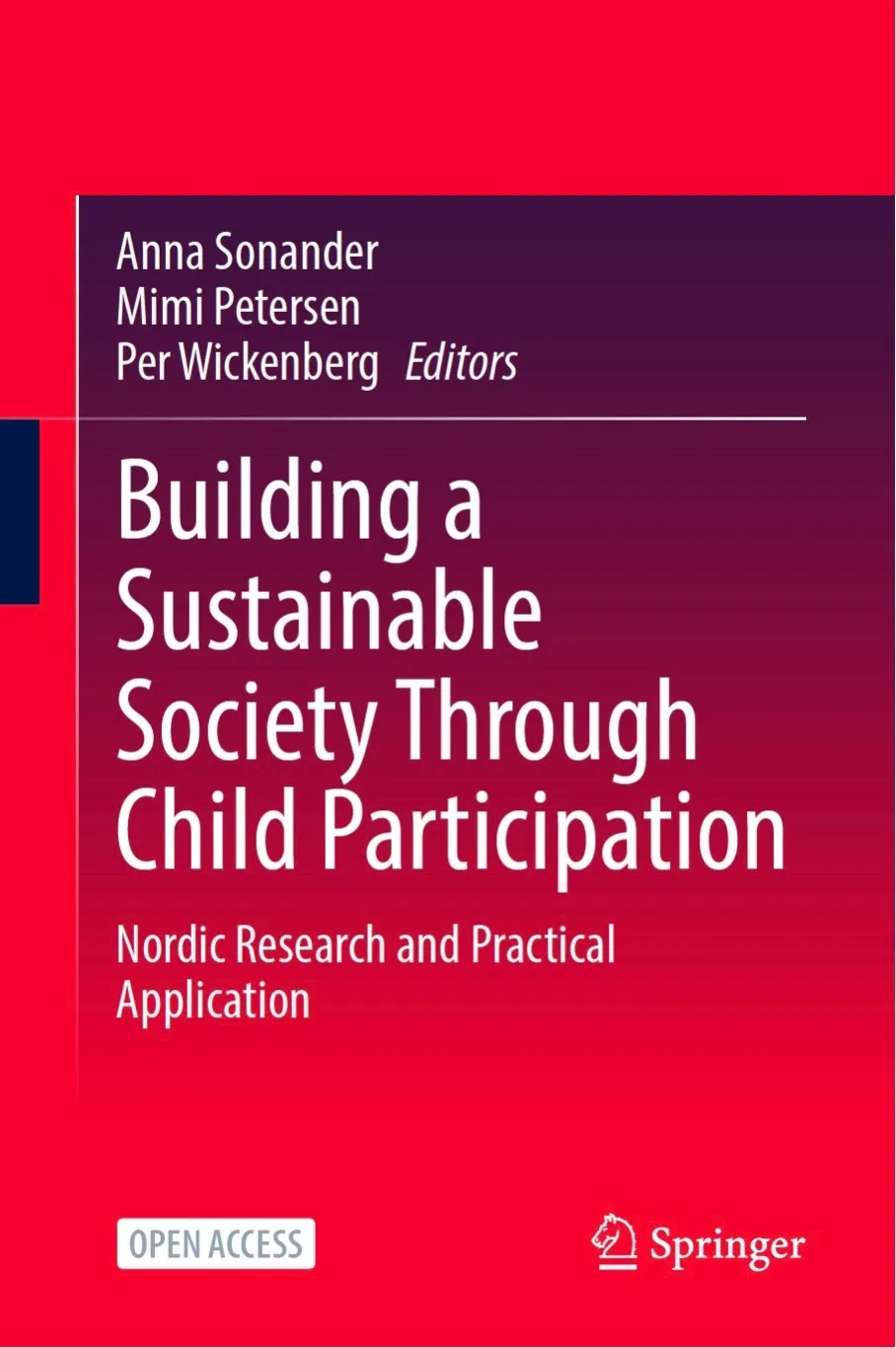
Q: What is this edited collection about?
This edited collection explores a fundamental question: What does it take to ensure that children are not merely heard but genuinely able to influence decisions affecting their lives and the societies in which they live?
Drawing on interdisciplinary research and practical experiences from across the Nordic countries, the book examines children's participation from three interconnected perspectives: those of children themselves, professionals working with children, and the wider society. Its contributions address education, child welfare, family law, research, and institutional decision-making.
By bringing together Nordic research and practice across several institutional settings, the collection offers both critical analysis and concrete insights into the conditions required for meaningful child participation.
A central argument is that recognising children's rights in legislation does not automatically translate into meaningful participation in everyday life. Even in the Nordic welfare states, often regarded as frontrunners in children's rights, gaps remain between formal commitments and children's actual opportunities for influence.
The chapters show how institutional structures, professional practices, power relations, and assumptions about children can enable or restrict participation. They also highlight why children's own experiences and knowledge are indispensable to creating more inclusive and responsive institutions.
Ultimately, the book argues that children's participation is not simply a matter of individual rights. It is a democratic and societal responsibility, essential to building more just, inclusive, and sustainable societies.
Q: What made you initiate this volume?
The idea for this volume emerged from our long-standing collaboration within the Child Rights Institute (CRI) at Lund University and developed further through the international research conference Empowering Children and Youth through Law and Participation, organised by CRI in connection with Society and Digital Pasts, Presents and Futures.
The three-day conference, held from 30 August to 1 September 2023, brought together 41 participants from 13 countries, including researchers and practitioners from the Nordic region and beyond. Presentations and discussions created a space to exchange research, experiences, and critical perspectives on children's rights and participation. They also helped generate the ideas and collaborations that eventually became this collection.
Our work within CRI, spanning several decades, reflects a shared commitment to advancing children's rights through interdisciplinary research, education, and dialogue with practitioners. Building on the conference discussions, we wanted to examine the persistent gap between children's formal participation rights and their actual opportunities to influence decisions affecting their lives. We felt that there was a particular need for a volume that brought together Nordic research and practical experience while also critically examining the Nordic countries’ reputation as leaders in children’s rights.
We also wanted to create a book that could speak beyond academia and encourage professionals, policymakers, and researchers to reflect critically on their responsibilities for making participation meaningful. The volume therefore reflects both our continuing collaboration and our conviction that children's participation is fundamental to democratic, inclusive, and sustainable societies.
An excerpt from the introductory chapter (adapted from Section 1.6, 'The Importance of Child Participation for a Sustainable Future'):
“For society to develop sustainably, children’s participation must be more than a theoretical aspiration—it must be embedded in everyday practices, policies, and governance structures. When children participate meaningfully, they develop civic engagement skills, trust in institutions, and a sense of agency that lasts into adulthood.”
This perspective reflects a central argument of the volume: children’s participation is fundamental to the development of democratic, inclusive, and sustainable societies. It is not merely a question of recognising children’s rights in legal and political frameworks, but of ensuring that these rights are translated into meaningful opportunities to influence decisions affecting their everyday lives.
The United Nations Convention on the Rights of the Child has played a decisive role in establishing children as rights holders and social actors whose perspectives deserve recognition and respect. Nevertheless, a considerable distance often remains between the formal recognition of children’s participation rights and their implementation in practice. This raises important questions about how participation is understood, organised, and negotiated within institutions and professional relationships.
The Nordic countries provide a particularly interesting context for examining these questions. Their welfare systems are characterised by strong commitments to equality, democracy, and children’s rights. Yet even within these contexts, children’s opportunities to participate are shaped by institutional structures, professional practices, social inequalities, and unequal power relations between children and adults.
Meaningful participation requires more than inviting children to express their opinions. It involves recognising children’s experiences, perspectives, and knowledge as valuable contributions to decision-making processes. Equally important is examining whether children’s contributions are taken seriously, how they influence decisions, and what institutional conditions enable or constrain their participation.
From this perspective, children’s participation cannot be reduced to an individual competence or responsibility. Rather, it must be understood as a relational and institutional process in which adults, professionals, and decision-makers have a particular responsibility for creating inclusive and responsive environments. This also requires critical reflection on established assumptions about childhood, authority, protection, and children’s capacities to exercise agency.
The relationship between children’s participation and sustainability extends beyond environmental concerns. Sustainable societies depend on democratic institutions, social justice, inclusion, and the ability of different generations to contribute to shaping their shared future. Recognising children as active participants in these processes is therefore essential, not only for improving their present circumstances but also for strengthening democratic practices and social responsibility across generations.
Ultimately, advancing children’s participation requires a shift from viewing children primarily as recipients of adult decisions towards recognising them as contributors to the development of institutions, communities, and society. Such a shift is central to building a sustainable society in which children’s rights are not only formally acknowledged but meaningfully realised.