
International Women's Café: Challenges for International Women in their job search
International Women's Café: Challenges for International Women in their job search
July 25th 2023.
This article was first posted via LinkedIn.
Hi, and welcome to the first official blog post of the Women’s Café! On the 17th of July, we held our first ever summer session to address issues highlighted by international women's specific challenges in their search for meaningful jobs. The day consisted of three parts: A Q&A session with a Visa Advisor, a panel discussion with international students and graduates, and an in-person jam board.
Visa Advisor Q&A
We kicked off the session with a Q&A with Rachel, a Visa Advisor from Advice and Counselling. One problem that surfaced was the difficulty of students communicating to an employer that they are on a student visa. The women were advised to communicate to a future employer that they can obtain a graduate visa, however, the women said they found employers are often hesitant when employing international graduates due to an absence of information and lacking the relevant HR support to finance graduates. They often tell international students inaccurate information and use this as a reason to not hire them. Several of the women revealed that to overcome this they were willing to pay for their own skilled work visa to convince employers to recruit them.
A further complication that stemmed from the conversation was ‘What is a permanent job?’ This question may seem simple to a home student, however, the session found that international students suffer from fewer opportunities due to the precarious and insecure nature of contracts which cloud the UK job sphere. International students are unable to be employed during their studies through fixed-term contracts (including maternity leave cover), take commission-based jobs, be self-employed, undertake business activities, and face ambiguity when working zero-hour contracts. Permanent contracts are hard to come by.
The Visa and International Student Consultants have supplied some useful resources at the bottom of the page. Rhianna Skeates is hosting 2 drop-in follow up sessions for international women on the 3rd of August, 10am-1pm, and the 29th August 2-4pm. (Further details are below).
International Student Panel
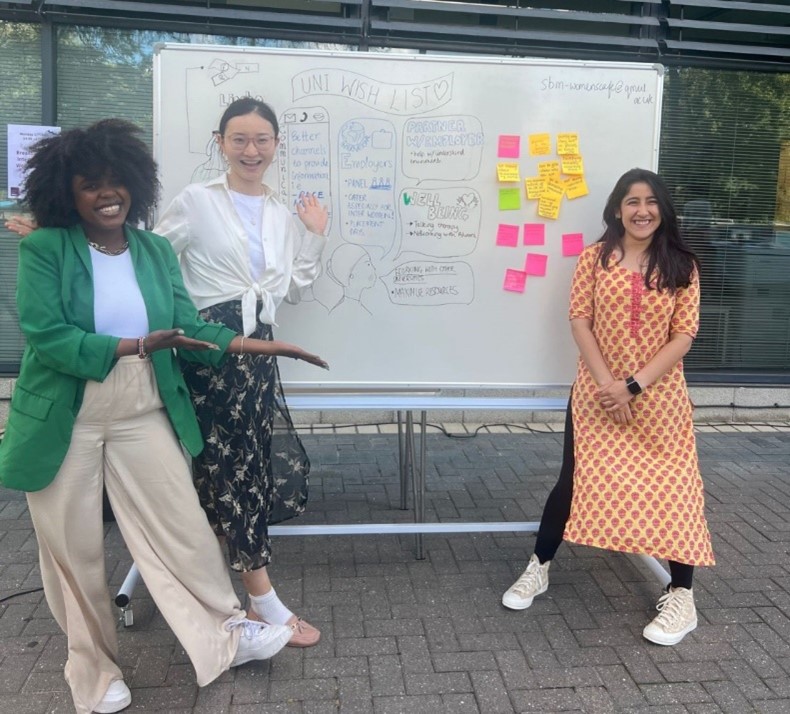
Our panel was kindly chaired by Veronica Kimani a PhD candidate whose research draws from techno feminisms to explore how Kenyan women within a post-colonial context use creativity, technology, and innovation to collectively challenge patriarchy in their work and home space.
The panel consisted of Lijun Hou who is currently completing their Master's and founded the society Major Mixer which helps students in their job search. Lijun is now working as a strategic partnerships Manager in a Branding Company.
Abhilaasha Kaul has worked with organisations across India to support social impact initiatives to create access to health care, literacy, and livelihoods. Abhilaasha is now working for the Borough of Hackney as a User Researcher. She is focusing on improving public service delivery for children and education.
Steps before graduating and the job search.
Lijun and Abhilaasha were asked what steps international women could take before graduating to increase their security in their job search. They advised two ways in which women can improve their chances of acquiring employment.
- Internal Work: Unfortunately, the job market is racist – as many of us already know and have experienced. However, to navigate this, understanding your personal assets and skills is crucial to selling yourself before a recruiter can place you in a box. Abhilaasha and Lijun recommended that international women should write down and analyse their own skills and experience to scrap self-doubts and build confidence in applying. Lijun recommended the programme Gallup to do this. Don’t be modest and minimise your skills - would white men be afraid to talk about themselves?!
- External Work: Both Lijun and Abhilaasha spoke about the steps that international women can take in the world around them. This includes networking, utilising LinkedIn to its full potential, speaking to professors, and writing blogs, all which centre creating impactful connections.
Community and Cultural Differences
Being surrounded by whiteness and a lack of cultural sensitivity can be quite isolating. One note that both panellists expressed was how international women can build their own community and use this community in applying for jobs.
Lijun refers to the Chinese term ‘Guanxi’- meaning connections/strong relationships which acts as the root to navigating your way. Building your own community sounds like a daunting endeavour, but the likelihood is that you already have your own! Exchange your CV with your classmates, other international students, and any groups you belong to. Peer mentoring is a fantastic way to gain honest advice from others in similar sectors and positions and warrants mutual prosperity for all those involved.
Abhilaasha shared her tip which she calls the ‘reverse Bollywood strategy’ – just as a Bollywood trailer reveals the full story, summarise your career in a one-sentence story. Swap this (very short) story with a peer! Having your own story is useful when presenting yourself at networking events and during meetings with prospective employers.
Both panellists spoke about the importance of community – however, attendees voiced that international students often struggle with building community. Lijun herself found this whilst studying, and from this frustration, she created the community Major Mixer, where she grew a network from 10 people to over 300 people. She recommends that international students utilise the WhatsApp groups, and university groups they are in to find others who are also interested in making a community.
Mental Health
The panel was asked how international students can healthily cope with all the responsibilities they face. International students face specific challenges with housing, job hunting, the day-to-day task of being a student, and navigating a new country. The answer? PLAN B IS OKAY! It is a process to be perfect, and sometimes things we would like to be prioritised will need to take a back seat. If you are struggling with your mental health the university provides some support.
In-person Jam board
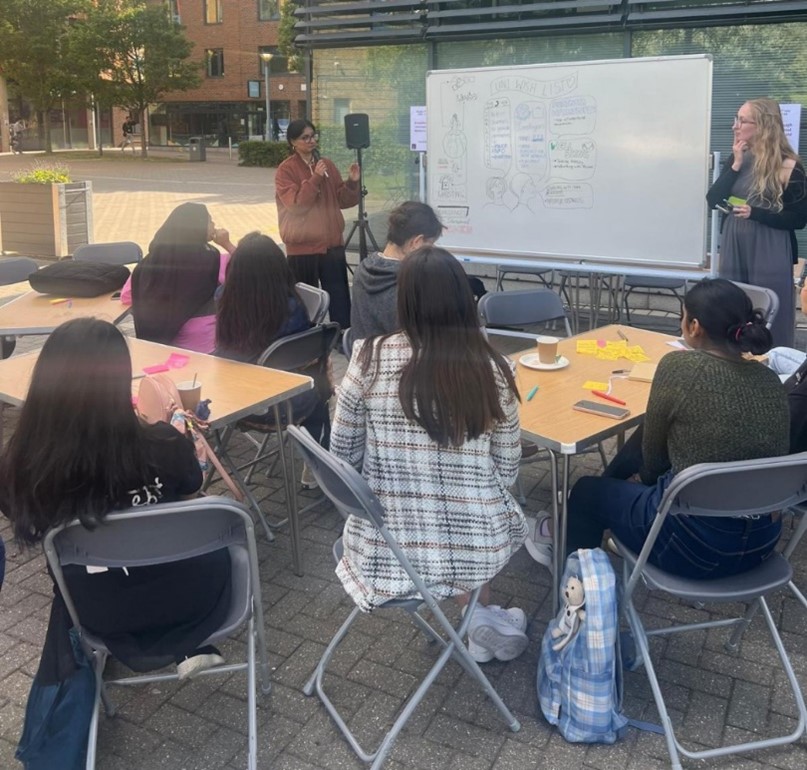
For our in-person Jam board session, we asked two questions ‘What specific challenges have you encountered as an international woman when searching for UK employment opportunities?’, and ‘Is there anything you would like the university to provide for you?’.
We invited the talented artist Maria D'Amico to create an in-person jam board from the women's conversations and answers to these questions throughout the day.
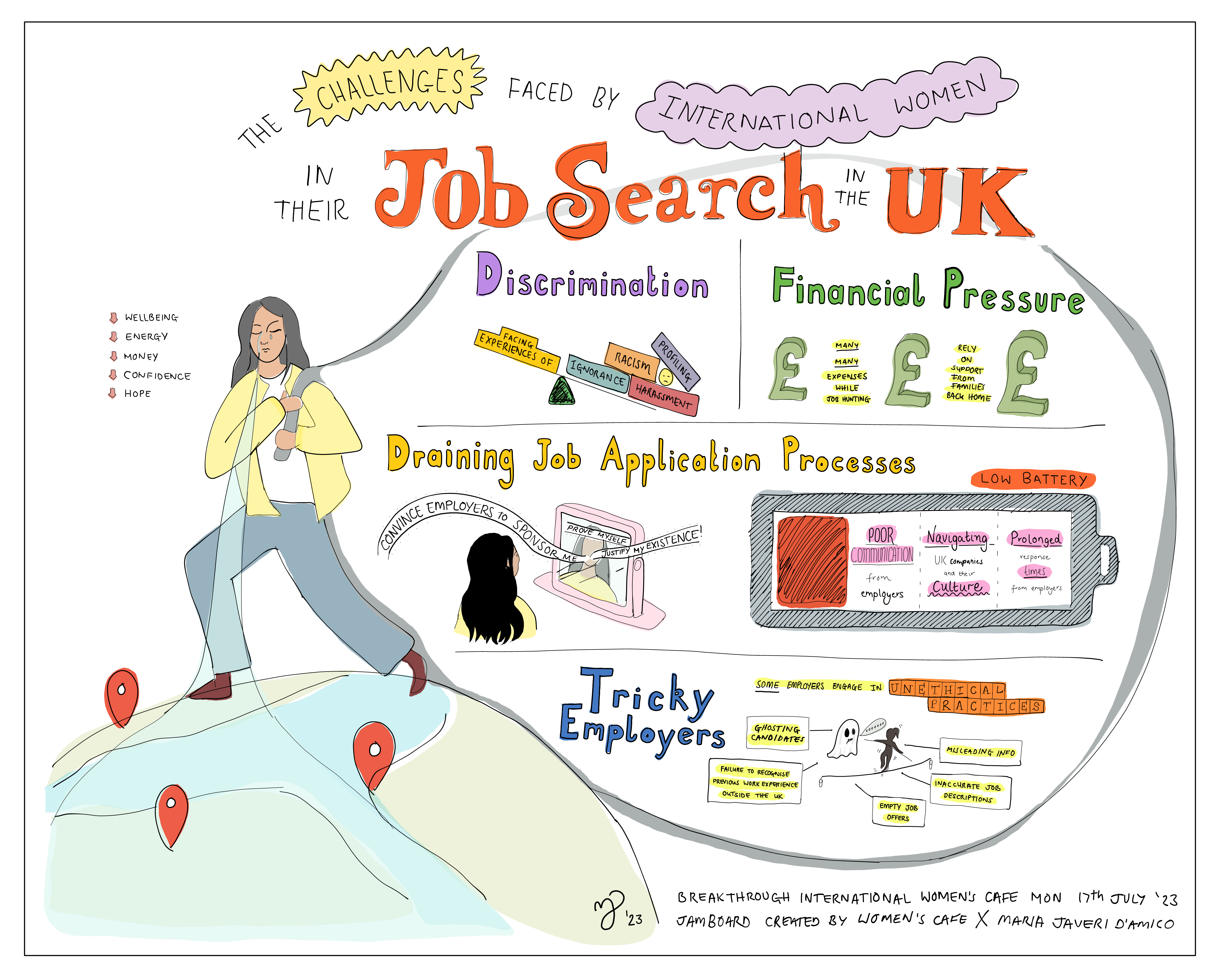
Jam board illustrated by Maria D'Amico
Challenges as an International woman:
A common theme that came up was the need for international women to ‘justify their existence’ within the university and especially to employers. The session found that to convince employers to give them a chance, international women have to justify themselves constantly by explaining why they are in the UK studying, to begin with, and how they have to justify the work experience they obtained outside of the UK – because they have been told that any employment outside of the UK does not count as real work, and is therefore completely disregarded. The women who have been told this have years of university level teaching experience, have worked for incredible NGOs, and had held senior positions. Enduring this casual racism by companies is an exhausting yet inevitable process for international women who have worked hard their entire lives only to be met with a brick wall. International women shared how they have essentially had to work backward from being told an immediate no to sponsorship and having to pick apart every aspect of their lives when interviewed for the small possibility of being told yes. Often, they begin conversations by saying they are happy to pay for their own sponsorship, a responsibility of their employer.
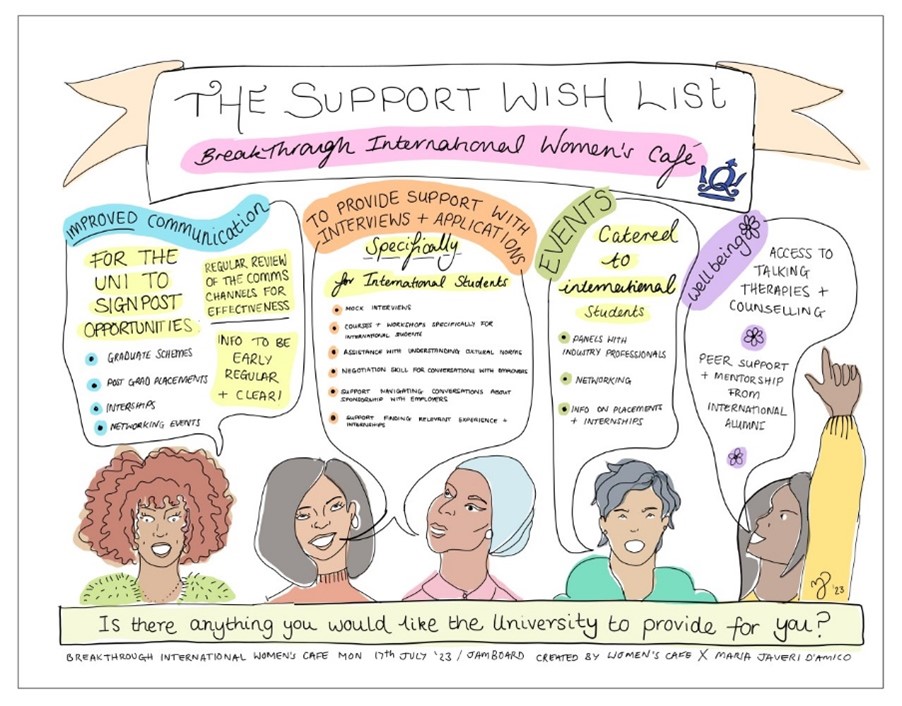
' The Support Wish List' Jam board illustrated by Maria D'Amico
Demands from the university:
Students require better communication from university services. The women described the ‘information overload’ they received during Welcome Week but found that after September, the only way they found information at the correct time was through their own networks. They requested a more spaced timely manner of communication throughout the year, when beginning lectures, and when looking for housing. They said that advertising help through social media would be a helpful tool, as well as a space dedicated to resources as and when they need them throughout the year.
They would also like events that are intentionally geared toward international students. They requested that these events encourage a dialogue between international students themselves, and the university. As many international students work part-time, they found that when these few and far-between events do happen they often miss them – they would like these events to be a lot more regular for this reason.
Conclusions & Support
The Women’s Café attendees wish for the university to do more to bridge the gap between them and international students. Additionally, employers must commit to knowing the visa and sponsoring process. Careers and Enterprise are proactively working on inclusive employer relationships and International Careers Consultant Rhianna Skeates, who was present at the session, is involved in government lobbying surrounding visas on a voluntary basis through AGCAS.
Rhianna Skeates will be holding two follow up drop-in sessions for international women who are seeking advice:
- International Breakthrough Women's Cafe Picnic Event: Follow-up 3rd August 10am-1pm
https://qmul.targetconnect.net/leap/event.html?id=12054&service=Careers%20Service
- International Breakthrough Women's Cafe Picnic Event: Follow-up 29th August 2-4pm
https://qmul.targetconnect.net/leap/event.html?id=12056&service=Careers%20Service
Visa Resources provided by Queen Mary Careers and Enterprise:
https://www.ukcisa.org.uk/Information--Advice/Working/Student-work#moving-into-a-work-route
Graduate route - You made your most recent Student application before 6 April 2022
You must wait for a decision on your Graduate application before you can start:
- a permanent full-time job
- self-employment
- work as an entertainer.
You made your Student application on or after 6 April 2022
You can start a full-time permanent job after making your Graduate route application. But you must wait for a decision before you start self-employment or work as an entertainer.
You must not work as a professional sportsperson with Graduate permission. The date on which you applied for Student or Graduate permission makes no difference.
For information about the Graduate route, see --> Graduate route.
UKCISA - international student advice and guidance - Student work
General Graduate Route information: https://www.qmul.ac.uk/welfare/visas-international-advice/working/graduate-route/
Graduate route (post-study work) - Advice and Counselling Service
Travelling and re-entering the UK and what to carry in your hand luggage: https://www.qmul.ac.uk/welfare/visas-international-advice/travel/re-enter/#travelling-leavingandreentering
Travelling and re-entering the UK - Advice and Counselling Service
Subscribe to QMUL International Advice blog for the latest updates: https://qmulintadvice.wordpress.com/
QMUL International Advice
Information from the QMUL Advice and Counselling Service for international applicants, students and recent graduates.