
Author Interview: Joe Hoover on his new book 'Living just enough for the city'
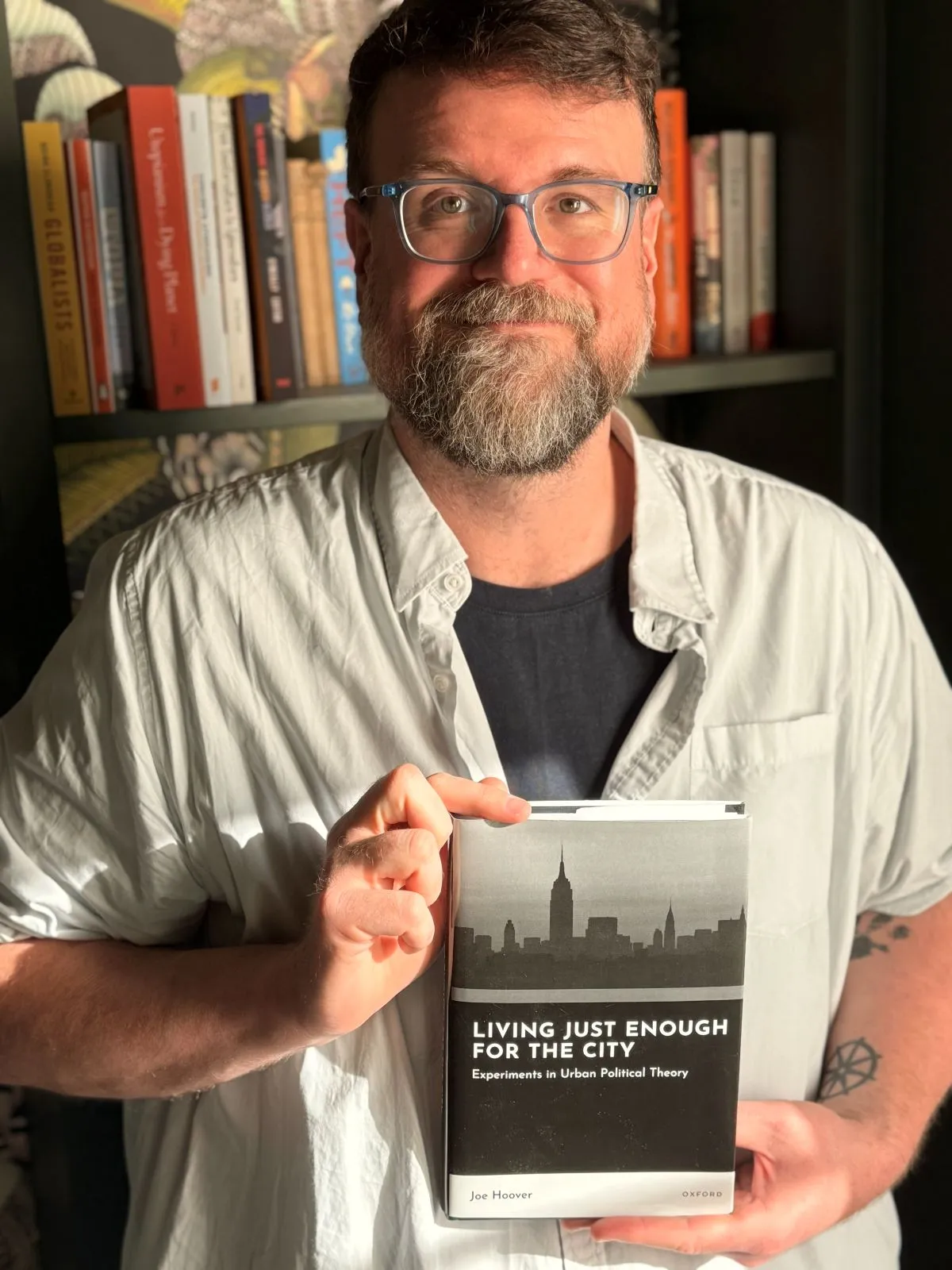
Joe Hoover, Reader in Political Theory at SSE's SPIR, talks about his latest book 'Living just enough for the city: Experiments in Urban Political Theory', where he takes a new approach to political theory through the lens of the 'city'. In this author Q&A Joe talks about architecture, justice, and the art, literature and music of cities - where the book's title originates.
Why publish this book now?
Firstly, at this moment of rising authoritarianism there’s been a real attack on cities as progressive political places, particularly in the US with the Trump administration. We have had physical attacks on some cities and threats against others. Along with that, there’s been a return to the quasi-fascist rhetoric of cities as spaces of violence and moral degradation, part of a radical right-wing rhetoric tracing back to Trump’s image of ‘American carnage’ plauging cities in his 2017 inaugural speech. The city is viewed as a hellscape.
Secondly, humanity experienced a landmark shift in the 2000s, transitioning from majority rural to majority urban. Now that humanity is a majority urban species, we must think not only about the particular problems and opportunities that arise from this shift, but also how it changes what we think about politics and demands new political concepts. Cities have always been important but now that we are in an urban age, we need to rethink some of our basic political concepts like legitimacy, justice, rights, and community.
Can the book be used as a political tool?
The book is really about trying to understand our contemporary urban condition and how we might be able to deal with the problems we face in cities. It’s also about moving towards a participatory approach to urban politics. I’ve tried to simplify this in the book with two motivating questions: (1) where are we? And (2), where should we be going? So, along with, hopefully, helping us understand our urban world better, the book also tries to develop conceptual tools to help us move forward. And my argument is that moving forward is essentially about developing democratic values that affirm urban life and political practices that nurture a politics for our cities that is more responsive and participatory.
How does the concept of justice relate to the city?
In Chapter 4 of the book, I look at gentrification to think about the question of justice. Gentrification is a phenomenon that we hear about all the time and there are lots of critical sentiments and debates about it.
Political theorists have tended to look at gentrification and whether it is just or unjust by first articulating what justice means and then assessing whether gentrification violates their preferred principle. One example is Margaret Kohn, who argued that gentrification is unjust because when people are displaced, they are forced to move and therefore bear the cost of choices they did not make. She argues victims of displacement caused by gentrification suffer an unjust harm. On her account, justice is essentially defined by the principle of equality, which requires every person is treated fairly and shouldn’t face penalties for decisions that aren’t theirs.
My critique of Kohn’s approach, and many other theorists, is that the concept of justice applied precedes an examination of the actual experiences of gentrification. If you look at how gentrification works in a city and how people affected by it frame the harms they experience, they do not view it purely in terms of being forced to move. People point to something more, they talk about powerlessness, saying that they lack the ability to control their lives. In the book, I look at affected people’s experience of gentrification, including their concerns not only about displacement, but also exploitation, dispossession, marginalisation and violence. This gives us a fuller account of the injustice of gentrification which comes from attending to the experience of people living in cities, not just philosophical or academic discussion.
How would you define your theoretical approach in the book?
I take what I call a situated, or situationist, approach to political theory. It’s about starting our enquiries into questions of rights, justice, and authority in the real world. Philosophers and political theorists, I think, need to address things happening in the world and think with people, not just in academic circles. I talk about my approach in Chapters 4 and 5, drawing on empirical work done in Washington D.C. and Chicago.
The approach I take is similar to what is sometimes called a grounded or even ethnographic approach. I ask, how does the city affect us as we try to live our lives? How does our experience, situated in the city, shape how we perceive and evaluate the world?
Traditionally, the philosophical move is to try find a higher point of view, to abstract from the world, so we can look at and understand things at a distance. I argue, however, that we shouldn’t want to remove ourselves from the streets to understand where we are, instead we you must navigate the city by its actual landmarks and with its people. Cities challenge us to accept an overwhelming diversity of sights and sounds and perspectives. They are messy and confusing, and my book encourages us to think about what happens if we start from this fact.
How does the book engage with art, music, and literature that represent the city?
I bring in works of art, music, and literature that talk about the city and urban life, to try to get a sense of different ways of thinking about it. I frame the book through stories of arrival, connecting new arrivals to the city today to the arrivals we say during the industrial urbanisation of the 19th and 20th centuries. One story, W.E.B. DuBois’ ‘The Coming of John’, is about a Black man coming to New York City during Jim Crow. Underpinning this story is the idea that cities are spaces of emancipation and transformation, which is an influential way of thinking about urban arrival stories—and one we still see today, for example in Edward Glaeser’s influential book The Triumph of the City. But I try to complicate these stories. The title of my book comes from the Stevie Wonder song, “Living for the City”, which begins with a similar tale of urban emancipation, but in the second half of the song the protagonist is scammed by a criminal, arrested by a crooked cop, and abused by a corrupt legal system. In the end, the end, the city is his downfall. We can come to the city for positive reasons, but it can corrupt or injure us too. In the final chapter, I look at two works of speculative fiction by N.K. Jemisin, The City We Became and The World We Make, which ask how people in cities can understand themselves as a democratic community – able to cooperate, coordinate, and defend itself – despite the inevitable conflict and pluralism of urban life. My book looks at cultural narratives like these and asks how they help us to think about contemporary cities and the prospect of making them more democratic.
You also talk about architecture. How is that important?
Focusing on cities help us recognise that social and political spaces are also always physical and created spaces. What and how we build affects what the city is like. Utopian architects have often desired to make the chaos and complexity of the city rational and orderly in order to redeem it, which I discuss in Chapter 2. In Chapter 3, however, I argue that we are better served by thinking in terms of finding our ‘bearings’ in the city, rather than ‘orientating’ oneself above it. You find your bearings by looking at the places and people around you, and learning to love the city and its people. By taking this approach, I explore the work of architects and urban planners that similarly embrace the city rather trying to redeem it. From them we get a different idea of how cities are built and what justice looks like. I use these urban thinks to ask different questions: how do we build cities that are adaptable and democratic, that can be used by different people in different ways, and where we can address problems not by destroying and replacing but rather building upon what is already there.