
Ancient viral DNA helps shape the mouse placenta
A new study from the Branco lab shows that a family of transposable elements known as intracisternal A-particles (IAPs) contributes to gene regulation in the mouse placenta, providing insights into how rapidly evolving DNA sequences can help drive placental diversity.
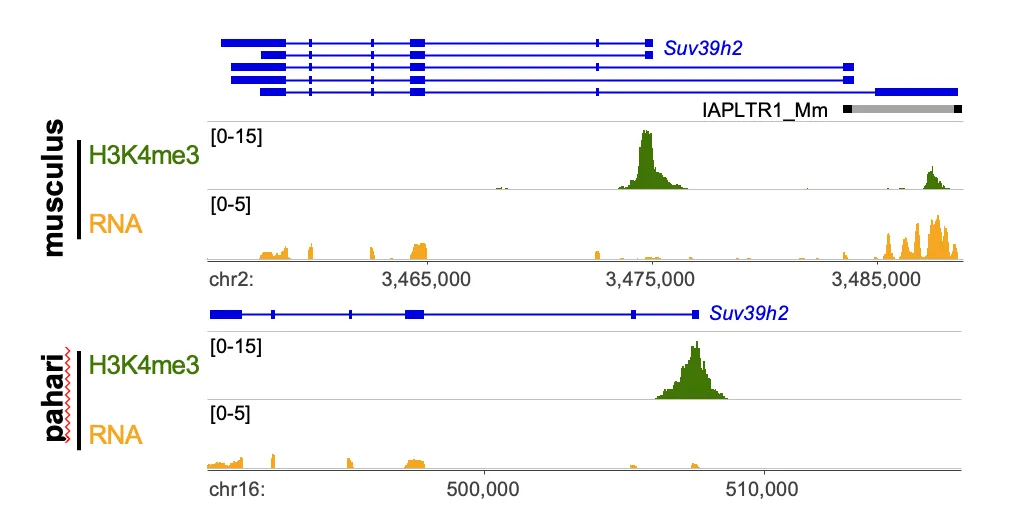
Transposable elements make up a large fraction of mammalian genomes and have long been implicated in placental evolution. However, their role in the mature mouse placenta has remained unclear. In this study led by Dr. Samuele Amante, the team combined epigenomic profiling, transcriptomics and comparative analyses across mouse species to investigate how these elements influence placental gene expression. Contrary to expectations, the team found relatively little evidence that transposable elements act as classical enhancers in differentiated mouse placental cells. Instead, they found that a young and still-active family of retrotransposons, the IAPs, are highly expressed in specific placental cell types and frequently serve as alternative transcriptional start sites, generating placenta-specific gene isoforms. Several affected genes have known roles in placental development, including Suv39h2, Arhgef18 and Acly. Using CRISPR interference to repress IAP activity, the researchers showed that silencing these elements alters the expression of nearby genes, supporting a direct regulatory role.
The study also suggests that IAPs may be an important source of evolutionary innovation. Many active IAP insertions are unique to particular mouse lineages, and genes located near them tend to show species-specific expression patterns. Comparisons between Mus musculus and Mus pahari revealed substantial differences in placental gene regulation associated with these elements, indicating that recent retrotransposition activity may contribute to the rapid evolution of the placenta.
Together, the findings argue that young retrotransposons can reshape placental biology by creating new gene promoters and transcriptional variants, providing a potential mechanism for both evolutionary change and inter-individual variation in placental function.
Link to paper: