
Where We Are Now
Firstly, we would like to express our gratitude to the IHSE staff for their valuable contributions to the prior MBBS curriculum review. Please be assured that we are now reviewing and advancing this foundational work to align with our objectives for the future MBBS programme.
To underpin the review process, the Steering Group was presented with and approved a revised MBBS Vision and Values proposal, developed by the Leadership teams in London and Malta, which forms the overarching principles of the curriculum design.
The Vision: (Programme Aims)
Building on a 900-year tradition of caring and service to those in most need, The QMUL Doctor is:
- A doctor with a strong professional identity, clinically skilled, compassionate, competent, and confident.
- A doctor who can apply a strong foundation in the underlying medical sciences to their patient care.
- A doctor who interprets and applies evidence in the context of a particular patient, situation, and society.
- A doctor who is attuned to the determinants of health, providing holistic care and demonstrating civic responsibility.
- A doctor who is prepared for the future of medical practice, technology and innovation and contributes to advances in health research.
- A doctor who is curious, reflects effectively from experience, and embraces lifelong learning
Further detail has been built into the Vision for the curriculum, including the design of Longitudinal Themes. The Longitudinal Themes help to guide and inform the decisions we make for the curriculum content.
Longitudinal Themes
Currently, we have seven LTs, and the scope and remit of these are still being developed. Inevitably, there is some crossover between each theme, but we believe these LT cross-cut across all 5 years of the MBBS programme.
- Preparation for Clinical Practice
- Professionalism
- Digital Health: Futures and Innovation
- Health Equity
- Reflective Practice
- Patient Partnership
- Interprofessional Learning
As a note, for all the regulatory paperwork we need to complete: MBBS years are known as Modules and what we understand as the MBBS Modules are called Taught Units 😊
Next Steps
The Year Leads will be starting to review and agree on each of the Year’s key themes and therefore the overarching learning outcomes. We have devised a template giving examples of learning outcomes, and there will be some initial mapping to Outcomes for Graduates and the MLA Content map built into this.
There will be some Year Writing meetings set up from September, so we can all come together and discuss the key topics and learning content at the Year level (for now).
Once the Year (Module) learning outcomes are agreed, the taught unit leads can begin to review and refine their learning outcomes. Again, we will try and make this as easy as possible, with writing templates and regular writing group meetings
There is a review of the overall assessment and Feedback strategy to be taking place as well. As you can imagine, there are a lot of moving parts to consider, so if you feel we have overlooked anything at this stage, do let us know!
Governance
A new governance structure for the MBBS Curriculum was approved by the IHSE Board:
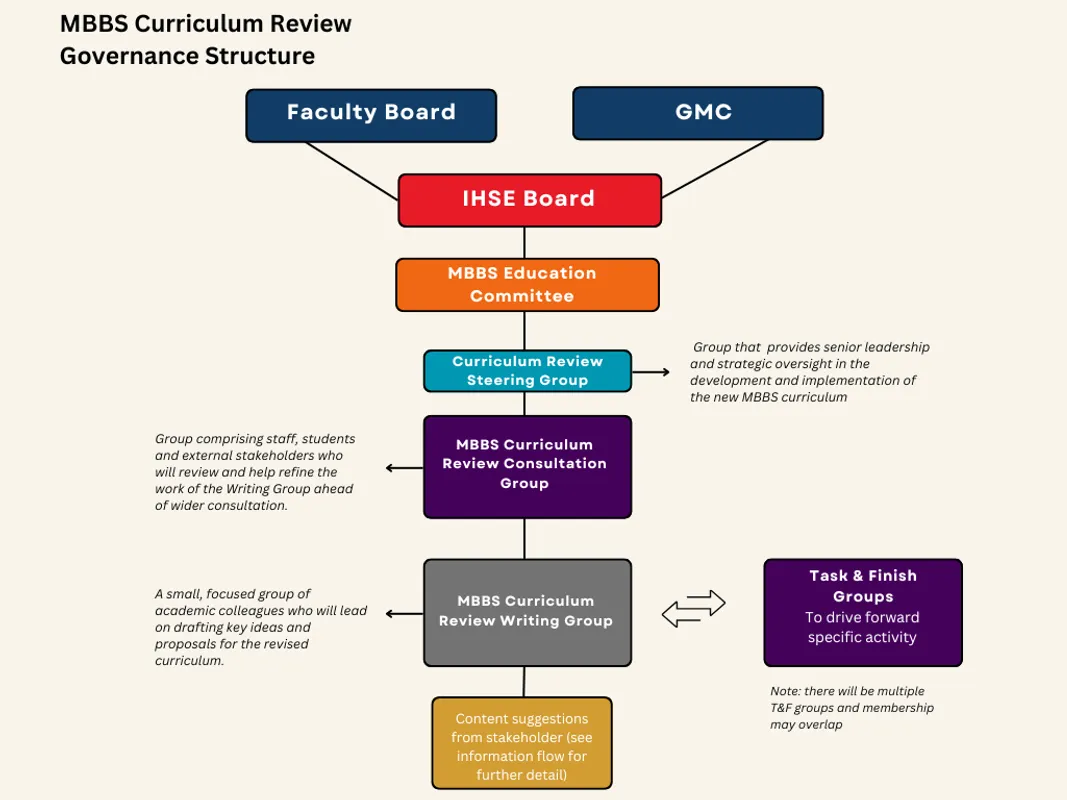
The key changes to the governance structure include replacing the Core Operation Group with the MBBS Curriculum Writing Group. This group will lead in the design and development, drafting ideas and proposals for the content of the new curriculum. Communications will go out on this soon.
If you are interested in joining or just want further information on the Curriculum Writing group, please email mbbs-voices-of-the-curriculum@qmul.ac.uk.
Another change is the inclusion of the MBBS Curriculum Review Consultation Group. This group will be made up of students, staff, and external stakeholders and will review and provide feedback on the work to the Curriculum Writing Group.