
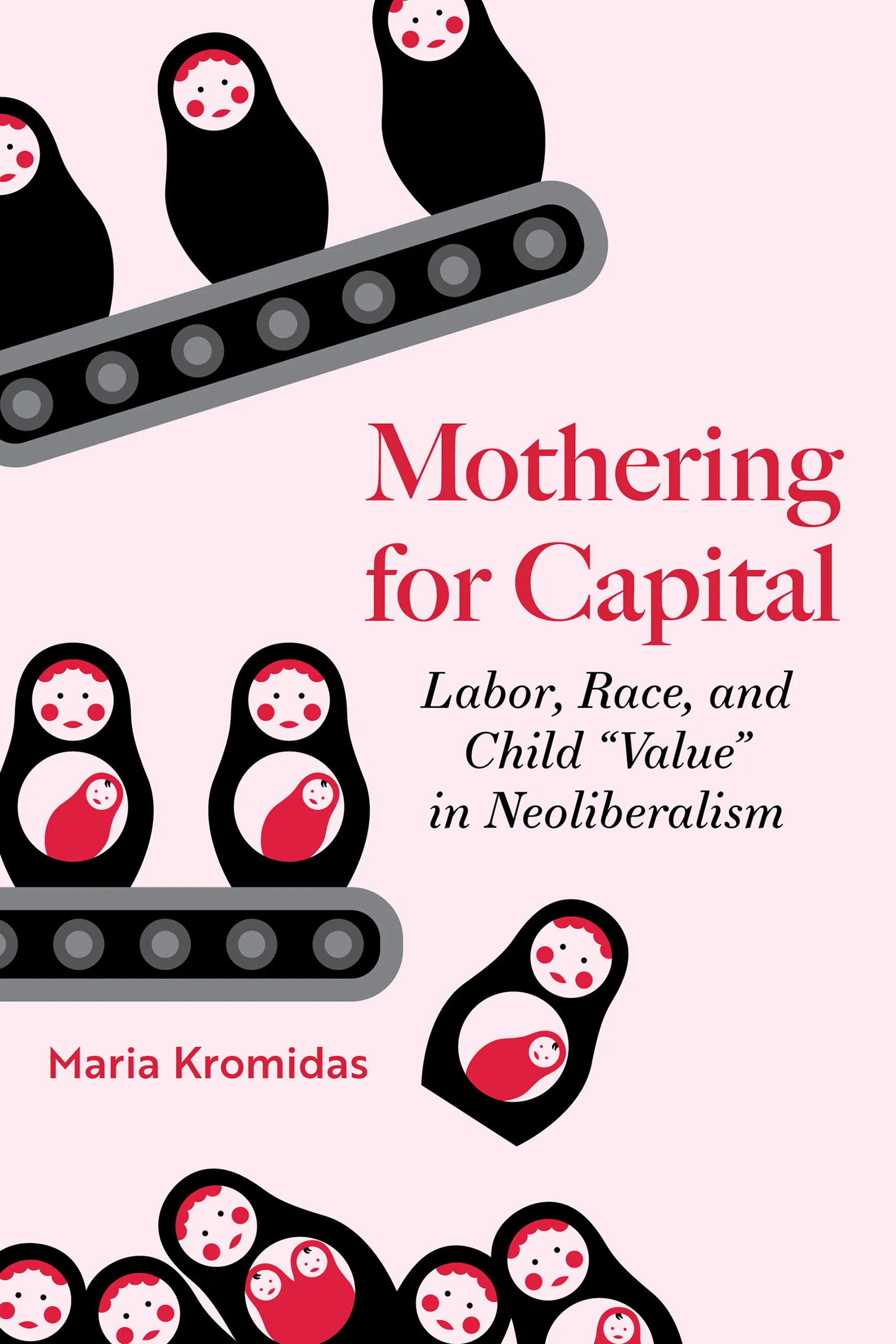
We interview Maria Kromidas about her book, Mothering for Capital: Labor, Race, and Child “Value” in Neoliberalism
Our member, Prof. Maria Kromidas (William Paterson University), talks about her book, Mothering for Capital: Labor, Race, and Child “Value” in Neoliberalism (Vanderbilt University Press, 2026).
Q: What is this book about?
Mothering for Capital offers a new interpretation about the crisis of motherhood in neoliberalism. It documents how the drive of capital stealthily subsumes mothering, tethering women’s work, care, and socialization of children, as well as their wishes, fears, and understandings of themselves as mothers, to the imperatives of value accumulation.
The book is based on my ethnographic encounter with mothers in New York City, demonstrating how being a “good mom” today means being constantly “schooled” (instructed to read to your newborn, install “bedtime math” app on your phone, instill “grit” when your child fails, etc.). In other words, maternal labors are intensified to cultivate a child with a set of specific cognitive, social, emotional, and psychological traits, the ideal future laborer, a manageable yet self-managed subject, the embodiment of "human capital."
It is true that childcare is work and the growing demands of that work, and intensified economic polarization, individualism, and privatization make it difficult if not impossible to do that work. Yet this partial view obscures the nature and magnitude of the problem - an inherently social and political problem whose stakes are much more dire than accounts of motherhood and childcare portray.
The child, I argue, is the site of capital’s most audacious aspirations—to flatten and empty human life of all that is superfluous or dangerous to capital. What is ultimately at stake is the subordination or emancipation of the human subject. Mothering for Capital tracks this hidden terrain of struggle.
Q: What made you write this book?
This project began with my own estrangement from external demands to be a “good mom,” feeling trapped into taking on labors that seemed obligatory, but were alienating me and often put me in an adversarial relation to my child. I was further inspired to take on this project as a rejoinder to the caricature in popular and scholarly accounts of the “intensive mother,” whose hyper-competitive striving to keep up with or get ahead of the Joneses is widely purported to exacerbate neoliberal austerity by denying opportunities to other children, creating a parenting “arms race.” The women around me were nothing like this: they were simply trying to be “good moms” amidst impossible demands.
What sustained my inquiry was my sense that its stakes were not simply interpretive, but political. Domination, oppression, expropriation, and exploitation – all inherent systemic features of the capitalist mode of production – are obscured or excused as long as there is an illusion of equality of opportunity and fairness of competition. By ignoring the particular ways that the massive and historically unprecedented power of capital’s arsenal takes aim at mothers' labors of childrearing, much scholarship is unwittingly complicit in ideologically legitimating neoliberal capitalism.
Lastly, I was dissatisfied with how critical theory concerned with capital’s domination of labor and the human subject consistently ignores mothers and children. The book is my attempt to demonstrate how mothers and children are critical sites of what others call class struggle, and what I call, the struggle of life against capital.
An excerpt from the book:
“Welcome parents and caregivers!” the educational technology company’ greeted me, promising to help me develop my child’s skills that “colleges and employers are looking for as they recruit.” The principal of my child’s middle school (grades 6 – 8) directed parents to this website in a message informing us that the school, like many others throughout the New York City public school system, was using this company’s instrument to measure and develop “eight domains of students social-emotional wellness.” Parents were encouraged to learn more about the skills via a two hour workshop offered by the school and through the company’s website, both of which offered guided activities and resources for developing each skill in children.
“Self-management,” “goal-directed behavior,” and “optimistic thinking” are amongst the skills identified as promising “success.” These should be unsurprising for any analyst of neoliberal subjectivity, or anyone in business, management, or so-called leadership. Indeed, Harvard Business Press recently launched an “emotional intelligence” book series whose titles are, uncoincidentally enough, virtually identical to those parents are asked to develop (“focus,” “energy and motivation,” “positivity and growth”).
The ed tech company’s parent portal explained each skill in child-friendly language, and offered parents age-appropriate activities to “engage in with your family.” To build the skill of self-management with my child who was in middle school at the time, I was advised to encourage her to make a playlist of “energizing or inspiring” songs to “increase energy level and motivation” for her schoolwork, and another for “calming down and relaxing when responsibilities are complete.”
Such “engagement” efforts go beyond informing parents to adopt recommended actions. They target and transform the mother-child relationship, and the subjectivities of both. “Self management,” like many of the other “social and emotional skills” that schools ask parents to develop, is ultimately about regimenting and modulating the subject for neoliberal modes of labor. Indeed, contemporary forms of work across the employment hierarchy rely as much on psychological dispositions as they do on skills - willingness, dedication, commitment, attitude, and personal investment have never been as important (Weeks 2020).
This requires a whole project of subjectification – one’s emotions, sense of self, relationship to time, how one relates to others - that would best begin in childhood. For children are inarguably out of synch with this restrictive and repressive homogeneity, and the longer they might be allowed to inhabit their unruly and boisterous physicality, the more difficult their eventual governing for production would be. And since its institutionalization, schooling has been the site for repressing and modulating children’s physicality and psyche for work. Most observers of schooling are aware that this project has been steadily extending to earlier grades – even kindergarteners should be “career ready.”
Yet few critics appreciate how schools are now involved in intricately modulating subjectivity for value production. Fewer still recognize how mothers are now recruited into this elaborate project. This is necessary because the psychological and emotional homogeneity required for today’s forms of work is a far more complex project than that which can be accomplished in the factorylike conditions of schooling. Who might take up this project with more zeal than the mother, continuously warned that her child will be left behind, unsuccessful, and with no opportunities in the future?
Mothering for Capital reframes recent concerted efforts to “engage” mothers as more intricate and invasive methods of governing the development of children’s subjectivities. After critical theory, any serious critic of neoliberalism has had to contend with subjectivity, the sense that the drive of capital more deeply penetrates the human subject – how humans seem to more willingly acquiesce with its demands for the subject – to behave as, feel, relate to others as value-seeking-value.
Yet the processes by which capital penetrates the subject’s formation are largely opaque, foreclosing an adequate analysis of the extent and specificity of capital’s intensified domination of the subject, its deeper penetration into the human psyche and the simultaneous invisibilizing of this yoke in neoliberalism. These processes remain elusive because their crucial foundations transpire in motherhood and childhood, domains that are largely thought to be outside of “politics” proper by traditional and critical theory alike.
Figuring social reproduction as the site of capital’s most destructive methods of accumulation, I stake my central claim in this book: Capital’s tightening chokehold on the human subject is partly effected through the intricate take-over of the most intimate relation in social life (mother-child), the most important labors of social life (subject-making), and the most sensitive time period in human development and for the formation of subjectivity (childhood).
The transformations within motherhood, childhood, and the family that so many have described but have inadequately traced and theorized, are wrought by capital’s unquenchable drive subsuming maternal labors of shaping children as subjects, a complex set of processes glossed as socialization. Mothering in late neoliberalism has become the key site for capital’s protracted struggle to subordinate the human subject. The current crisis of motherhood is the distorted refraction of this radical restructuring of social reproduction.
While outlining capital’s destructive effects on mothers, children, and us all, this is ultimately an optimistic book because it is attuned to the activities and feelings that are against or outside of capital’s reach. Although they may not precisely identify the source of what they struggle against, mothers perceive capital’s force against their lives and that of their children. And in spite or because of capital’s deepening grip, women’s desires to care for children in ways that diverge from this newfangled role of mothering for capital also intensify, although in ways that do not announce themselves as such. Most cogently, they understand that the stakes are life itself, one worthy of the name.
And it is children that incessantly remind them, with anguished cries and ferocious wills so indomitable that even the force siphoned from the totality of our collective energies cannot stamp out. At its core, the book asks questions that it cannot answer, what then is for children’s own good, and to what ends should love and work of care for children, ourselves, and others, be for?