
Seminar Series
Global Dialogues Series is an annual programme that brings together researchers, activists, artists and students to engage critically and creatively with urgent social questions, especially those that often fall outside mainstream academic spaces.
Global dialogues series on AI, voice, and decolonial knowledge
A virtual research seminar series exploring how generative artificial intelligence reshapes authorship, creative production, and human understanding through a critical and decolonial lens. Bringing together scholars, activists, artists (TBD) and practitioners (TBD) from diverse disciplines across the Global South and Global North, the series interrogates the use and impact of AI in knowledge production, representation, and alternative forms of voice and expression. 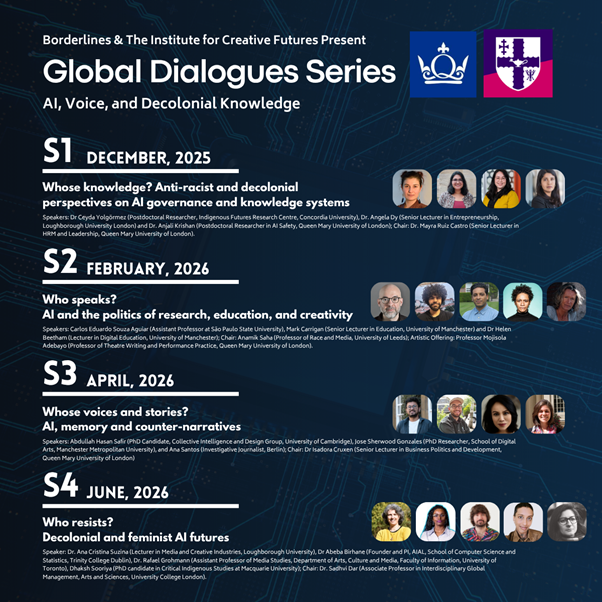
This is a creative seminar series that moves beyond static participation behind screens to invite embodied, situated, and collective forms of engagement.
We aim to build a global community that creates space for difference, resists extractive models of knowledge exchange, and imagines otherwise. We intend to ask difficult questions, share practices, and explore what it means to think, write, imagine, and create with and against AI.
*More speakers, artistic contributors and chairs are being confirmed. For updates on the latest lineup, please keep an eye on our LinkedIn page.
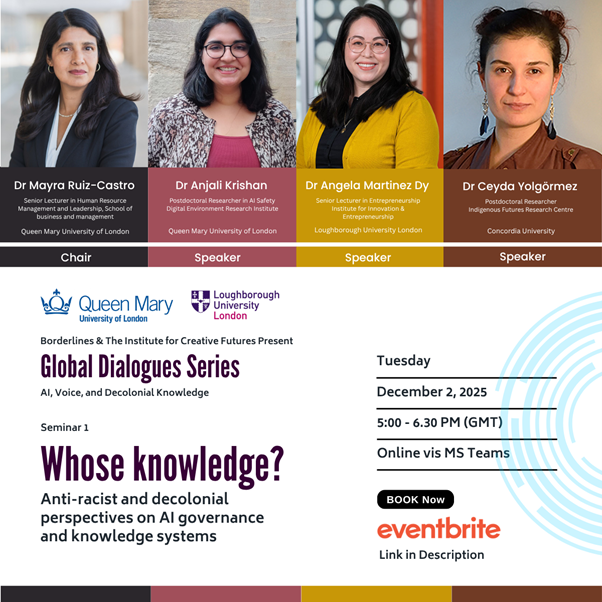
Whose knowledge? Anti-racist and decolonial perspectives on AI governance and knowledge systems
AI is transforming how knowledge is produced and shared, but whose voices and knowledges are centred, and whose are erased or sidelined? This seminar will critically examine the Earthly resources at stake in the AI revolution and the power dynamics behind AI governance. It will also explore anti-racist and decolonial interventions in dominant understandings of the technological evolution of knowledge systems, and how AI is shaping knowledge creation and dissemination in relation to marginalised communities.
Speakers: Dr Ceyda Yolgörmez (Postdoctoral Researcher, Indigenous Futures Research Centre, Concordia University), Dr. Angela Dy (Senior Lecturer in Entrepreneurship, Loughborough University London) and Dr. Anjali Krishan (Postdoctoral Researcher in AI Safety, Queen Mary University of London); Chair: Dr. Mayra Ruiz Castro (Senior Lecturer in HRM and Leadership, Queen Mary University of London).
Who speaks? AI and the politics of research, education, and creativity
How is AI reshaping ideas of knowledge generation, education, and creativity? This seminar will explore the political, pedagogical and creative tensions and possibilities introduced by the rapid uptake of generative AI. Some of the topics it may cover include predatory data harvesting and exclusionary publishing, the dominance of English-language scholarship, and unequal access to AI technologies. Can it enhance curiosity-driven learning and new expressions, but also reinforce silencing, exclusion, bias, and homogenisation?
Speakers: Carlos Eduardo Souza Aguiar (Assistant Professor at São Paulo State University), Mark Carrigan (Senior Lecturer in Education, University of Manchester) and Dr Helen Beetham (Lecturer in Digital Education, University of Manchester); Chair: Anamik Saha (Professor of Race and Media, University of Leeds); Artistic Offering: Professor Mojisola Adebayo (Professor of Theatre Writing and Performance Practice, Queen Mary University of London).
Whose voices and stories? AI, memory and counter-narratives
How is AI influencing which stories are preserved and which are erased? This seminar will consider the impact of AI on archives, oral histories, and storytelling traditions across digital and non-digital worlds. We will explore how AI shapes collective memory and the possibilities for counter-narratives.
Speakers: Abdullah Hasan Safir (PhD Candidate, Collective Intelligence and Design Group, University of Cambridge), Jose Sherwood Gonzales (PhD Researcher, School of Digital Arts, Manchester Metropolitan University), and Ana Santos (Investigative Journalist, Berlin); Chair: Dr Isadora Cruxen (Senior Lecturer in Business Politics and Development, Queen Mary University of London)
Who resists? Decolonial and feminist AI futures
Who is resisting algorithmic colonialism, and how? This seminar will highlight the work of scholars, activists, artists, and communities who are challenging the dominant narratives, structures, and uncritical adoption of AI through experimental uses for non-traditional ends. We will explore decolonial and feminist approaches to imagining alternative, just, and equitable AI futures.
Speaker: Dr. Ana Cristina Suzina (Lecturer in Media and Creative Industries, Loughborough University), Dr Abeba Birhane (Founder and PI, AIAL, School of Computer Science and Statistics, Trinity College Dublin), Dr. Rafael Grohmann (Assistant Professor of Media Studies, Department of Arts, Culture and Media, Faculty of Information, University of Toronto)
Co-organised by:
Borderlines X The Institute for Creative Futures
Borderlines is an interdisciplinary research collective at Queen Mary University of London focused on social justice, decolonial practice, and radical, experimental approaches to knowledge. We bring together scholars, artists, students, activists, and organisers who work across and beyond disciplinary boundaries. Our members are based across the world, including in Australia, Brazil, Chile, Canada, Europe, India, Mexico, and the United States. We support early career researchers and student-led initiatives, and our work is shaped by collaboration, critical enquiry, and a commitment to challenging the norms of academic knowledge production.
The Institute for Creative Futures at Loughborough University London brings together research and postgraduate teaching in Design Innovation, Communication and Media, and the Creative Industries. Based in the Queen Elizabeth Olympic Park and connected to London’s East Bank cultural district, the Institute works with global partners to explore how creativity and technology can shape positive social and cultural change. Our research spans sustainability, innovation, and the role of media and communication in power and social transformation.